NCSOFT's Mobile Casual Division is entering third-party developer game publishing within the year. While it previously focused on acquiring and nurturing studios, moving forward it will take on flagship titles from non-subsidiary developers as well and bring them onto its proprietary platform. Anel Ceman, Senior Vice President and Head of the Mobile Casual Division, revealed that related news could be unveiled within a month or two.
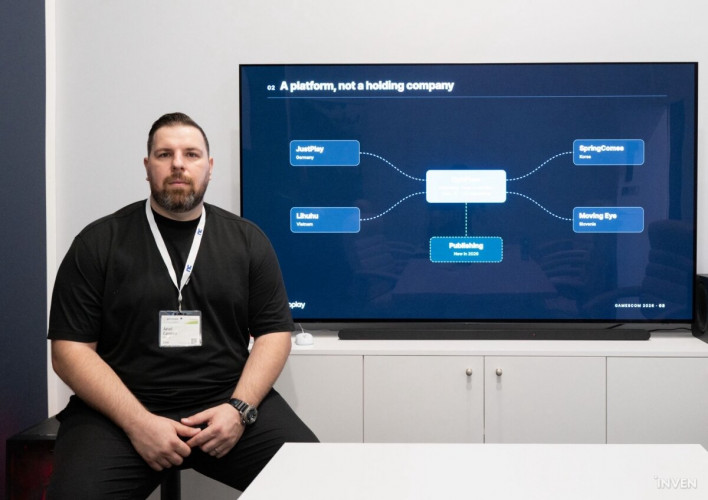
Name: Anel Ceman Affiliation: NC Position: Head of Mobile Casual Division Related Games: In charge of NC's casual mobile games Interview Topic: Business status and plans through 2030 for the Mobile Casual Division
On August 26, at Gamescom 2026 in Cologne, Germany, Ceman met with reporters to explain the current business status and plans through 2030 for the Mobile Casual Division. Having built his career in the European mobile casual industry, he joined NCSOFT in August last year to lead the organization.
Ceman agreed with the assessment that the overall market is in a state of stagnation, but explained that trends diverge when broken down by genre. While downloads are declining, in-app purchases are increasing, and the puzzle genre has grown by more than 20%. He did not disclose the base timeline or source for the growth rate. An increasing number of companies are also shifting toward hybrid casual, which combines ad revenue with in-app purchases.
Ceman defined these two genres as NCSOFT's core focus. Citing the example of Dream Games reshaping the market in 2021 within the match-3 genre, he added that even markets that appear stagnant continue to evolve.
Not a Holding Company, but a Platform: OptiFlow Connecting Four Studios
In less than two years, NCSOFT acquired four mobile casual studios across four countries: Germany's JustPlay, Vietnam's Lihuhu, South Korea's SpringComes, and Slovenia's Moving Eye. The total investment scale exceeds $300 million. Based on this track record, Ceman introduced NCSOFT as the third-largest strategic acquirer in the global gaming industry.
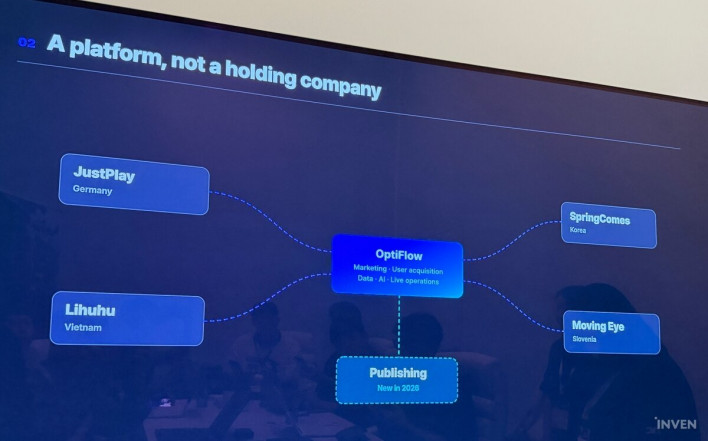
The axis connecting these studios is "OptiFlow," a proprietary platform currently being built. Ceman defined this structure as a platform rather than a holding company, presenting a vision that connects the four studios and the new publishing business to OptiFlow. OptiFlow covers marketing, user acquisition, data and AI, and live operations.
Ceman described the ecosystem in three layers. At the top is the content layer, where games made by the studios and published titles reside. In-house developments, publishing titles, and acquired games all belong here. The second is the data intelligence layer, which handles predictive LTV (lifetime value), return on ad spend (ROAS), experimentation, and churn prediction. The results aggregate into the third layer, OptiFlow, running user acquisition, distribution, and live operations across the entire portfolio as a single engine.
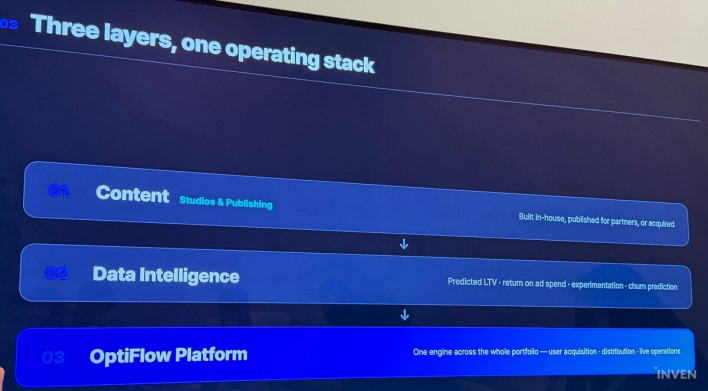
Construction began about a year ago. Ceman explained that it is a structure where system efficiency improves as more games and data are added, highlighting the ability to apply a strategy that worked at one studio across the entire portfolio as a key strength.
The organization was also restructured. The mobile casual organization was elevated from a center to a division, reporting directly to the CEO. He explained that this was not merely a name change, but a structural reorganization that strengthened both authority and responsibility.
"JustPlay's Growth Factors Are LiveOps and iOS"
When asked about JustPlay's monthly active users (MAU) increasing by 70% year-over-year, Ceman cited two factors. The first is lifetime value. Features such as LiveOps, gamification, and challenges drove user engagement. The other is distribution. As Apple App Store policies changed last year, iOS experienced significant growth after previously lagging behind Android. He noted that since iOS is still in the stage of catching up to Android in terms of features, it has even greater room for expansion.
Regarding the sustainability of the rewarded model, he answered that the market itself is growing. While the portion of user acquisition budgets allocated to reward networks was negligible just two years ago, some companies now spend up to 30%. He interpreted the presence of larger players remaining in the market as room for growth. Work is underway to expand JustPlay's model to other studios within the group, with plans to open it up to external studios around next year.
The application of AI is divided into distribution and monetization. In distribution, ad creative production is central. Scaling up requires continuously generating thousands of new video ads and playable ads, and integrating AI boosts production speed. He explained that predicting performance and allocating budgets for thousands of campaigns running simultaneously across the portfolio is another area impossible to handle manually. In monetization, LiveOps is the pillar. Machine learning models are used to determine which offers and features to present to which users and at what time.
Game generation was viewed differently. Ceman stated that while AI can build simple games, it will take time before it can create globally revenue-generating games, which is why they are taking a phased approach. The first phase is playable ad production, while AI is also utilized to generate assets such as UIs, characters, and puzzle blocks.
He also explained that decision-making speed has changed since the introduction of OptiFlow. While establishing a hypothesis a few years ago meant requesting data analysts and waiting one to two weeks for results, team members can now ask questions in Korean or English and instantly obtain analysis results.
"Targeting 30% of 5 Trillion Won Revenue by 2030"
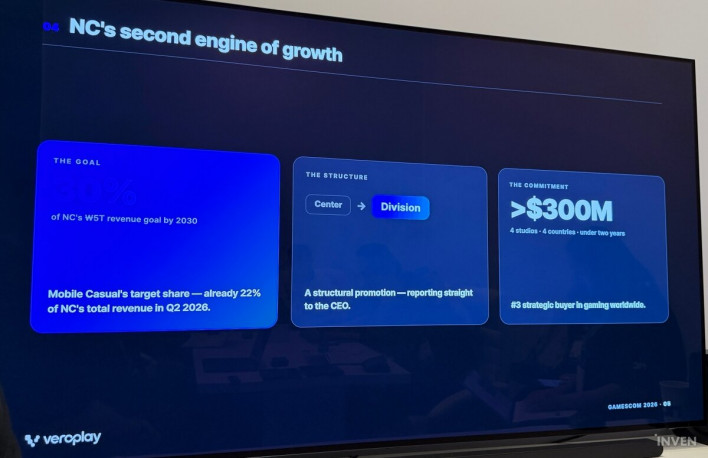
NCSOFT set its 2030 revenue target at 5 trillion won. Ceman set a goal for the Mobile Casual Division to account for approximately 30% of that, or 1.5 trillion won. This is a figure that needs to be raised from its 22% share in the second quarter.
First, NCSOFT plans to selectively acquire studios that build cumulative synergies across the portfolio. It currently has studios in Europe, South Korea, and Vietnam, and is considering candidate markets with concentrated mobile casual development capabilities, such as China, India, and Türkiye.
Next is the publishing strategy. By providing global distribution to developers with no intention of selling their company, the focus will be placed on two titles with a high proportion of in-app purchases. The final pillar is expansion. Titles that have proven successful in one market will be placed on the shared platform and operated globally.
Ceman emphasized, "We came to find diamonds in the rough. Now, we connect them with the world."