Neople is launching 'Neoplayer 2027,' a conversion internship program focused on game design. The DNF Development Division, DNF Mobile Development Division, and Classic Development Department are participating, seeking to recruit 40 candidates in total. The program focuses exclusively on game design roles to find talent who will design fun gameplay and enhance the appeal of each project.
The name carries a dual meaning. Combining Neople and 'Player' signifies becoming a new player who makes an impact on Neople's stage starting from Lv. 1, while reading it as Neople and 'Layer' symbolizes building up layers of experience step by step as a game designer.
The internship starts not with practice assignments, but by joining actual development teams. For six months, interns work alongside active developers on live or in-development game teams, collaborating with mentors on tasks like monster patterns or specific dungeon segments. While prior design experience is not required, submitting a portfolio is mandatory. Rather than listing numerous projects, candidates are advised that showing 'why it was designed this way' is what truly matters.
What do game designers at Neople do, and what qualities are needed to grow as one? To answer this, members of the DNF Mobile Development Division—who oversee dungeon content for Dungeon & Fighter Mobile—and the Talent Acquisition Team shared insights into game design roles, recruitment preparation, and intern life via NEXON TAG. Below is the full text of the interview published on NEXON TAG.
What Does a Game Designer Do?
When people think of a game designer, they vaguely imagine someone who just comes up with ideas. What do you actually do?
Kim Chul-soon: I lead Content Team 2, which creates dungeon content for Dungeon & Fighter Mobile. This game is a 2D side-scrolling action RPG that brings the world and action of Dungeon & Fighter—the PC online game loved since 2005—to the mobile environment.
Our team designs and produces all dungeon content, ranging from standard dungeons to raids. The role of a game designer is to design the dungeon concepts, structures, monster patterns, progression flow, and rules, as well as create the script data* used in the game. Coming up with an idea is just the starting point; turning that idea into something functional within the game is what a designer does.
Our team's goal is to preserve the game's core identity—'Action Pleasure'—while creating a game that delivers lasting enjoyment.
*Script data: Data written so that the game engine can actually process design details, such as monster behaviors and dungeon rules.
Where do you start when designing a new dungeon?
Kim Chul-soon: The starting point of design is thinking about what kind of experience we want adventurers to have in the dungeon. Even when adding a single mechanic like a monster attack pattern, it shouldn't just be "because it seems fun." We must be able to explain what experience that pattern will deliver to players.
Since I work on Dungeon & Fighter Mobile, there are also many factors to consider for the mobile device environment. Attacks that are easy to dodge using a keyboard might be difficult to dodge with touch controls, so we extend the telegraph time allowing players to anticipate and dodge attacks, or adjust the actual hitboxes.
Considering that many people play the game while commuting or taking short breaks, we also design the play time per dungeon run and the daily content progression flow to match the lifestyle patterns of mobile users.
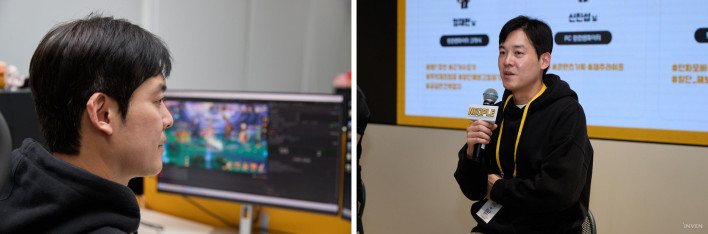
What were the most challenging and most rewarding moments during your time as a designer?
Kim Chul-soon: The hardest time was when I transitioned from the PC Dungeon & Fighter project to Dungeon & Fighter Mobile. Many things that worked naturally on PC didn't apply to mobile. I had to reexamine the know-how I had built up and adapt it to a new environment.
For example, if you port a monster pattern directly from the original game to mobile, elements required to overcome the pattern can be hard to spot on a small screen. Even for the same gimmick (a special mechanic designed to add variety to gameplay or playstyles), executing it with touch controls may require more time and effort. We had to refine existing patterns taking into account differences in control schemes and screen sizes between PC and mobile.
The most rewarding moment is when guide videos for patterns created by our team get uploaded. Seeing adventurers figure out how to tackle patterns and share strategies with one another makes me feel that the fun we intended was successfully delivered.
What kind of designer does Neople look to work with?
Lee Su-bin: A game is the result of collaboration across multiple disciplines. That's why Neople considers collaboration and communication to be fundamental competencies for any role. In particular, a designer shouldn't just generate ideas; they must clearly communicate their intent to colleagues and navigate differing opinions to find better solutions. On top of that, passion for games, responsibility, execution power, and problem-solving skills are also key.
Kim Chul-soon: I think the ability to translate ideas into actionable, concrete specifications is crucial. For instance, rather than just explaining "the boss gets stronger when enraged," you need to specify "when HP drops below 50%, attack speed increases and the pattern sequence changes." That way, colleagues in art, client, and server engineering can work toward the same vision. Conversely, if there's something you don't understand about a task, having an attitude of asking questions without hesitation is also vital.
Good design starts by taking a step beyond simply enjoying the game and connecting the fun and friction experienced during play into concrete directions for improvement. It requires a perspective that doesn't stop at personal impressions as a single player, but considers the viewpoints of diverse players and the overall flow of the game. Finding justification to improve identified issues and shaping them into practical implementations within the game is a major responsibility of a designer.
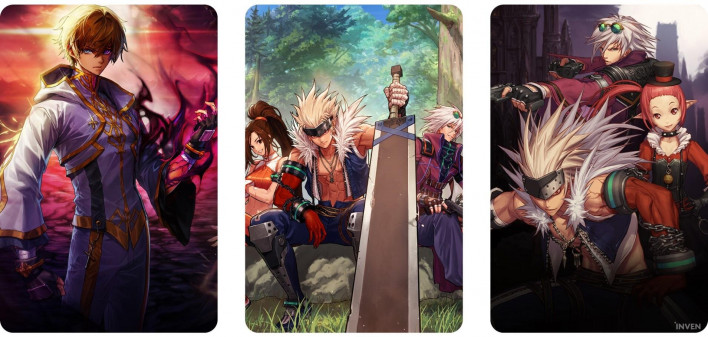
Taking a Step Closer to the Dream of Becoming a Game Designer
When preparing to become a designer, what did you work on hardest?
Kim Chul-soon: I was originally an avid Dungeon & Fighter player. While adventuring through Arad, imagining "what if there were a dungeon like this?" eventually inspired me to apply.
When preparing for job applications, I focused on playing a wide variety of games. In particular, I gained experience with games in genres similar to the project I applied for, analyzing the underlying intent behind each game's content and systems. I built my portfolio based on these analyses.
Looking back, experiencing games deeply as a player was my greatest asset. Understanding the fun and pain points felt during play serves as an essential benchmark when conceptualizing and evaluating new content as a designer.
What advice would you give to applicants wondering what to include in their portfolios?
Lee Su-bin: For this Neoplayer recruitment round, portfolio submission is mandatory. What we especially want to see in the portfolio is 'why it was designed this way.' Showing what problem was identified, what alternatives were considered to solve it, and why the final approach was chosen helps us understand the applicant's design thought process.
If it was a team project, please clearly state your specific role and how you collaborated with team members. Rather than listing numerous tasks, showcasing 2–3 core works in depth is much more effective. Since applicants apply to specific projects in this recruitment process, it is also good to highlight how your experience and skills align with the target project.
Kim Chul-soon: A portfolio that clearly conveys the rationale behind game design decisions is ideal. Rather than packing in many deliverables, logically explaining the reasons behind designing just one or two pieces stands out far more.
I also recommend playing the game you are applying for and conducting reverse game design analysis on it. Pick a specific piece of content or system, analyze its intended purpose, and articulate your own conclusions backed by reasoning.
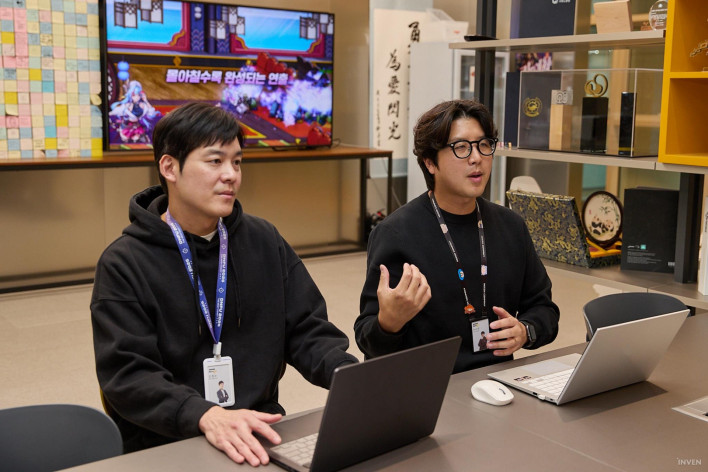
Is it okay to apply even without much hands-on project experience in making actual games?
Lee Su-bin: Neoplayer is not a program looking for fully finished game designers. It is completely fine if you don't know everything right now. What we want to see is growth potential to build things together rather than current perfection. If you genuinely love games and have a passion for creating fun experiences yourself, please don't hesitate just because you feel lacking in experience or preparation.
It doesn't need to be a grand project. Even small projects or student club activities carry meaningful stories as long as you thought deeply and carried them through to completion. If you show what you pondered and how you solved problems during that process, we can clearly see your potential.
Kim Chul-soon: Prior design experience is by no means mandatory. Starting now, I recommend practicing viewing games through a slightly different lens. Whenever you experience fun or frustrating moments while gaming, make brief notes on why. Thinking through why it was fun and how it could be improved, and putting those thoughts in writing, is a great way to practice game design.
As these notes accumulate, they help shape your own design perspective. What matters most is thinking through your reasoning thoroughly and being able to explain your rationale.
We heard that on November 18, Neople held a 'Meetup Day' event at the Seoul office to connect with university game club students. Talking to students directly at the event, what questions were asked most frequently?
Lee Su-bin: There were many questions about Neople's hiring process and portfolio guidelines, but many were also curious about what kind of candidate Neople ultimately seeks. True to our slogan, 'WE MAKE WONDERS!', Neople values people who constantly take on challenges to create new forms of fun—individuals who proactively seek out new challenges, identify and solve problems, and grow alongside great colleagues.
Ultimately, rather than someone who excels alone, Neople seeks candidates who can achieve better results together and who continuously think about delivering more enjoyable games to players. Meeting with students directly to share their passion for the game industry and their personal questions was a meaningful experience for me as well.
Kim Chul-soon: We received many questions about what game designers actually do on a daily basis and what kind of challenges they face.
In particular, we discussed how design intentions are communicated and pitched to other disciplines like development and art, as well as the thought process behind delivering fun to players. It was a great opportunity to give aspiring game designers a concrete look into actual job responsibilities and real-world considerations.
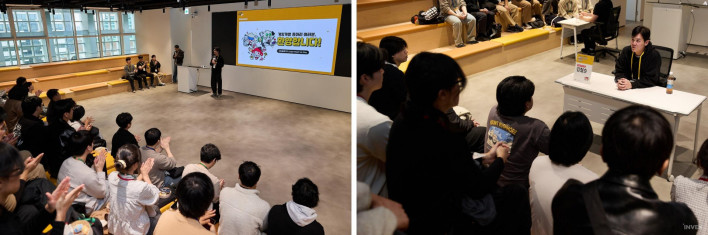
Neople Life Experience Through 'Neoplayer 2027'
Does the work environment or atmosphere differ depending on the location, Jeju or Seoul?
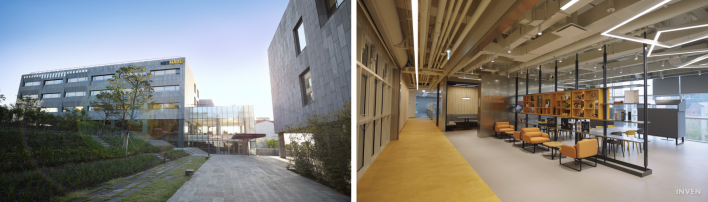
Lee Su-bin: Workplaces differ by project. The DNF Development Division is based in Jeju, while the DNF Mobile Development Division and Classic Development Department are located in Seoul.
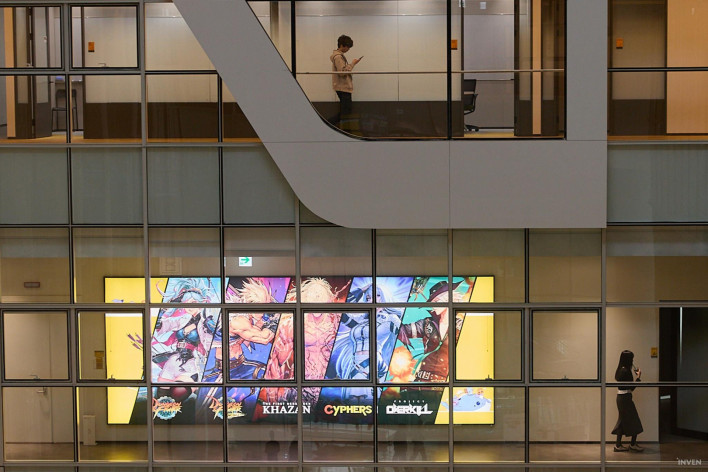
Jeju offers the appeal of working close to nature. You can focus on work in a relaxed environment and recharge after hours or on weekends near the ocean and forest. Seoul provides convenient transportation and living infrastructure, making it great for networking and accessing information across the gaming and IT industries.
Even though work locations differ, Neople's way of working remains identical. Both offices operate using the same methodology, communicate through the same tools, and maintain seamless collaboration regardless of region.
Kim Chul-soon: I work at the Seoul office, where convenient transit makes commuting easy and office space is very comfortable. The cafeteria serves both lunch and dinner with great menu choices, which sometimes makes mealtime something to look forward to. Receiving quarterly welfare points that can be spent on self-improvement or leisure is another major plus.
Above all, I love the open culture where anyone, regardless of seniority, can comfortably ask and answer questions. It's so flat that even our CEO is addressed as 'Myeong-jin-nim' rather than by title, allowing us to solve bottlenecks collaboratively and stay focused on our work.
When thinking of internships, practice tasks often come to mind first. Is Neoplayer like that as well?
Lee Su-bin: The biggest feature of Neoplayer is that interns join actual development teams from day one. Rather than working on practice assignments or standalone exercise projects, interns take on real work alongside active team members on live services or games currently in development.
Of course, we don't expect anyone to handle everything alone right away. We provide training and mentoring programs to help interns adjust quickly to the company and their roles, growing as game designers. You can think of it as a six-month journey of learning on the job while growing through hands-on experience.
Kim Chul-soon: Speaking from our team's perspective, during the first month or two, interns examine actual design documents and script data for dungeon content to learn how content is structured. Since we have team guidelines and mentors assisting by your side, you will comfortably get up to speed even with large volumes of data.
Afterward, alongside a mentor, you take charge of specific monster patterns or dungeon segments to author design specs and build the associated data. Through iterative feedback and reviews with your mentor, you can refine your design to the point where content you designed actually gets implemented in the live game during the internship.
How do you support onboarding and professional growth after joining?
Lee Su-bin: Immediately upon joining, new hires undergo onboarding to understand the company and its working methods. Once assigned to a team, senior staff partner with them through a mentor-mentee system. We ensure new hires receive the support they need—not just for work tasks, but also for adapting to a new environment—so no one faces challenges alone.
Once or twice a year, a 'New Hire Camp' is held where employees can connect with peers from different departments and roles. They can exchange ideas while attending job skill lectures and training programs, and we also sponsor education so employees can study areas they wish to learn. Neople offers such a wide variety of interest clubs that it's hard to find one that doesn't exist, giving plenty of opportunities to meet new colleagues based on shared passions.
Kim Chul-soon: Role-specific training courses are available, allowing game designers to select programs tailored to their job responsibilities and professional growth. We also host lectures like Nexon Forum, where guest speakers from various fields are invited, providing ample opportunities to broaden perspectives with diverse insights from inside and outside the gaming industry.
What is evaluated during the internship period?
Lee Su-bin: We place greater importance on consistently observing how tasks are carried out over the six months. We comprehensively assess how interns solve assigned problems, collaborate with teammates, and grow compared to where they started. Throughout the internship, ongoing feedback will be exchanged so interns can track their own growth.
For interns, we evaluate not only current skills but also future growth potential. The internship period is a time for evaluation, but it is equally a time to grow into a colleague we can build games with.
Finally, do you have any closing words for applicants taking on Neoplayer 2027?
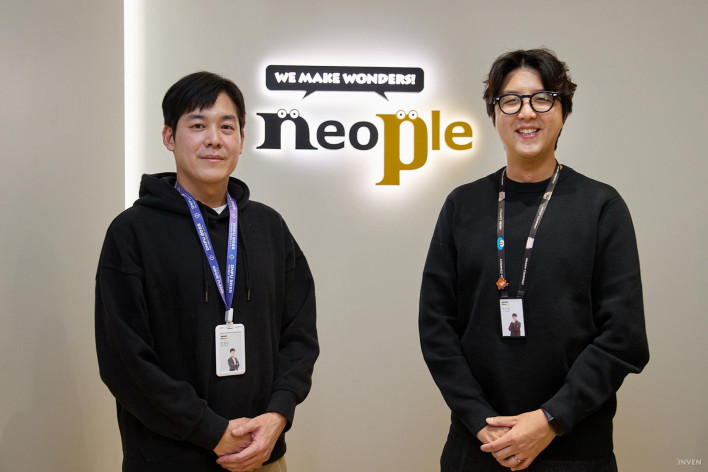
Kim Chul-soon: At first, vast amounts of data and unfamiliar terminology might feel overwhelming—I felt that way too. But feel free to ask anytime if there's something you don't know. I hope you apply with a genuine love for DNF and a passion for pondering, "How can we make this even more fun?"
The thrill of seeing strategy guide videos uploaded for a pattern you created is something you have to experience firsthand to truly understand. I really look forward to sharing the moment when adventurers encounter the very first boss monster you design.
Lee Su-bin: From the application process to the interviews, we will attentively listen to each applicant's personal story of why they chose Neople. Spending six months deliberating, tackling challenges, and learning alongside peers in a live game development environment will be an invaluable experience for anyone taking their first career steps. I hope Neoplayer 2027 becomes a memorable milestone of growth for all of you.