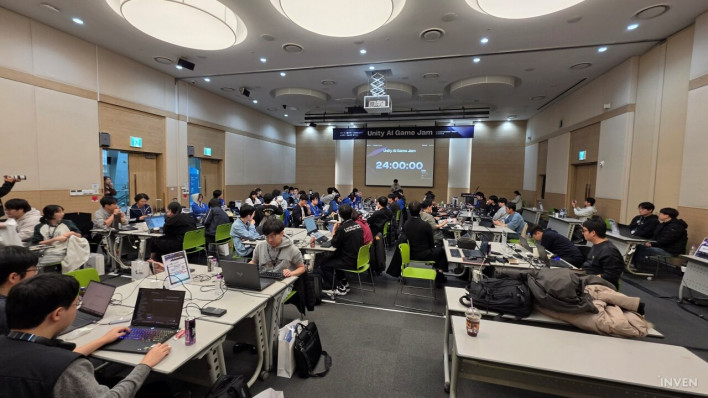
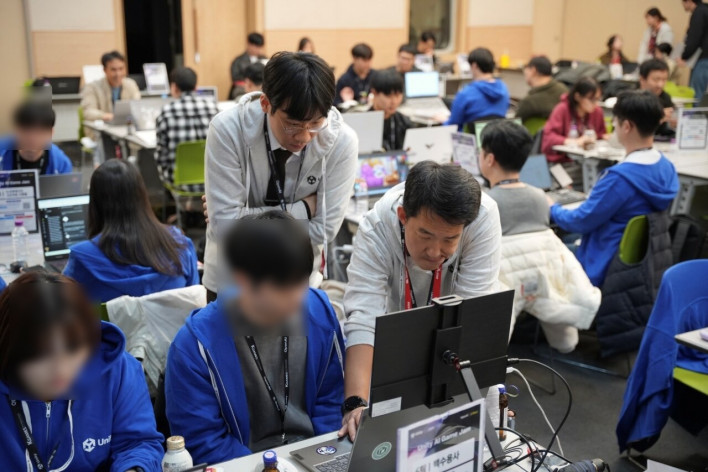
On November 18, ahead of G-STAR 2026, Unity held an AI Game Jam. Timed with Korea's largest game show, G-STAR 2026, the non-stop 24-hour Unity AI Game Jam also featured OpenAI as a sponsor and mentor, helping aspiring and current game developers efficiently adopt AI to build complete games in a short timeframe.
Having advanced dramatically in recent years, AI has become an indispensable presence. How will it transform the game development process, and how far into game development can AI reach in the future? Following the AI Game Jam, we spoke with Bum-joo Kim, Unity APAC Advocacy Leader, and Taeyoung Kim, Account Director at OpenAI, to hear their insights.

What was the main reason for hosting an 'AI Game Jam' at G-STAR instead of a conventional tech seminar?
Bum-joo Kim, Advocacy Leader: When it comes to using AI for content creation—and game development in particular—there are countless attempts and mixed opinions. Our research shows that over 90% of game studios are already using AI, but surveys like the GDC report also show that more than half hold negative views toward AI. Media outlets report on games that achieved huge success through AI, while others highlight games being criticized for using it, so a wide variety of perspectives coexist.
In this environment, we pondered how best to communicate with game creators. We concluded that directly observing and engaging with them on-site through a game jam—a practical opportunity to apply AI in game creation—was key. We wanted to see how creators use the Unity engine alongside AI, what new processes or ideas they develop with these new technologies, and what support we need to provide. Since there are many things you can't learn just from looking at data, we felt a game jam was the most suitable format and brought up the idea internally. Global headquarters responded very enthusiastically, calling it a great initiative and offering extensive support. As we searched for a partner to join us, OpenAI willingly agreed to support the event, bringing it to life.
Taeyoung Kim, Account Director: From OpenAI's perspective, our headquarters considers the gaming industry, client studios, and overall gaming ecosystem to be extremely important. Unity graciously invited us, giving us a great opportunity to join. We felt this event would allow us to see firsthand how AI is used in practical game creation and gain a concrete sense of the current state of the game scene. In particular, as requested, having mentors work through problems alongside participants on-site held great value for us. We were delighted to participate, believing it would be a great opportunity to help more people tackle game development easily and expand the foundation of the indie and solo developer ecosystems.
It has been a while since Unity hosted a full-scale game jam at G-STAR. What was the makeup of the participants, and what was the atmosphere like on-site?
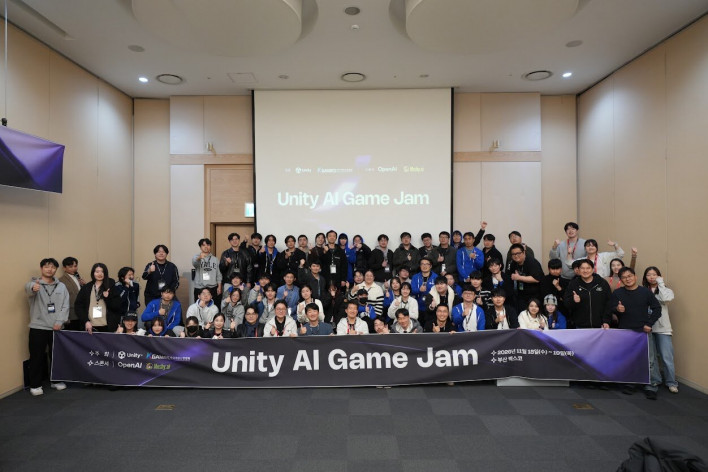
Bum-joo Kim, Advocacy Leader: People from very diverse backgrounds participated. Around 500 people applied, and we selected 54 to participate. About 44% were students, while the rest included studio CEOs, prospective entrepreneurs, and job seekers.
In terms of enthusiasm, game jams always attract passionate participants, but this time, because they were actively developing with AI agents and Unity CLI, the vibe was a bit different. Traditional game jams primarily involve independent work followed by integration: programmers write code, artists draw, and musicians compose, and only then do they say, "I finished my part, let's merge and see if it works." In contrast, this time programmers helped with art, and artists built and experimented with process automation themselves. Alongside the familiar passion, the drive to try new approaches stood out in particular.
You mentioned role boundaries broke down during the jam. How did that concretely affect the development process and the final projects?
Bum-joo Kim, Advocacy Leader: In the past, even with 48-hour or 3-day game jams, finishing a game was rarely easy. Out of 10 teams starting, many wouldn't complete their projects. Because everyone was consumed with just getting something working, there was never enough time to test how the game would look to players, how it played, or whether the tutorial was clear.
This time, however, teams didn't divide tasks into "this is art, this is programming." Instead, they actively crossed discipline lines to collaborate, which meant feature implementation wrapped up quickly. Once implementation was done, they moved on to post-completion polishing—adjusting balance, adding more fun mechanics, and refining the UI for better usability.
Looking at the finished games yesterday, I didn't think, "These are novel even if unpolished because they were made at a game jam." Instead, I felt many games were both novel and remarkably high in overall quality. Typically at game jams, presentation elements are weak because teams are rushed just trying to implement core mechanics. This time, over half the games included intro cutscenes, staging, or story videos so first-time players could quickly grasp the setting and lore to immerse themselves. That was a standout difference compared to past jams.
From an OpenAI perspective, what were your impressions watching the overnight AI Game Jam firsthand?
Taeyoung Kim, Account Director: Since our Korea office was established relatively recently, this was our first time supporting an overnight game jam. We have frequently run half-day hackathons for corporations or universities, but we had little experience with overnight events where participants must produce a finished product within a strict timeframe.
However, the level of AI utilization among participants on-site was extremely high. As we evaluated the finished products created by combining AI with the Unity game engine, we were surprised and deeply impressed by the extraordinary quality. We were struck by how significantly entry barriers for the gaming ecosystem and solo developers have dropped, enabling people to accomplish more with fewer resources. It made us feel that we should definitely plan more events like this in the future.
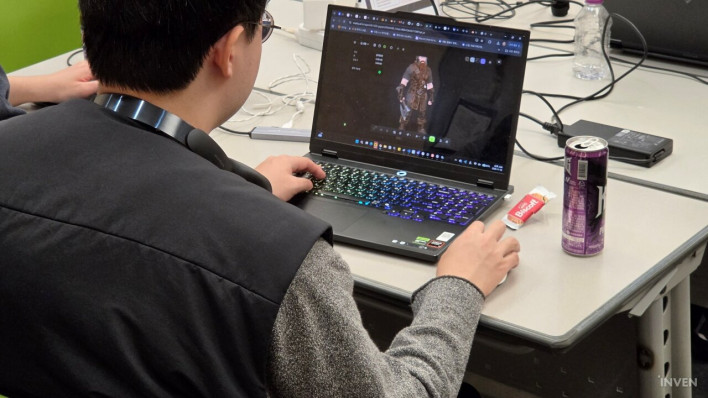
Korean developers have shown a very fast rate of AI adoption, such as ranking 3rd globally in Unity CLI usage. What do you attribute this to, and did it influence the decision to host this game jam?
Bum-joo Kim, Advocacy Leader: Our global HQ is well aware that Korean game developers are keen innovators. Just as Korea pioneered graphical MUDs back in the day with titles like 'The Kingdom of the Winds', Korean creators actively contemplate how to leverage every new platform or technology to expand game quality and world-building. In my role at Unity, I meet many developers in Korea and abroad, and Korean creators clearly exhibit a strong drive to embrace and utilize new technologies rather than resist them. That built up anticipation for what kind of results an AI Game Jam in Korea would yield.
As mentioned earlier, our primary motivation for hosting the AI Game Jam was to observe how developers use AI on-site so we could formulate our support plans. Secondly, it is true that we had high expectations because Korean game developers have consistently mastered and applied new technologies faster than anyone else to build better games.
From OpenAI's perspective, observing this jam and everyday cases, do Korean developers have unique strengths in using AI compared to other countries?
Taeyoung Kim, Account Director: Their greatest strength is that Korean game developers are early adopters. In our experience, that aspect is overwhelming. We hear that developers in some other countries can be quite conservative or even hostile toward AI. In contrast, the Korean developers we observed learn technologies and advance their skills at an exceptionally fast pace. While rapidly experimenting with new tech, they place great importance on evaluating how much it actually benefits their project.
The models we provide are split into various product offerings rather than a single frontier model. We were deeply impressed to see participants actively utilizing not only Codex—which was used extensively in this coding jam—but also the Responses API for reasoning and responses, and the Decision API for making fast in-game decisions and actions. This demonstrates that Korean developers' AI affinity and technical implementation speeds are truly world-class.
Bum-joo Kim, Advocacy Leader: I also found their active adoption of tools like the Decision API very encouraging. Up until now, the trend was to use AI to make existing game formats faster and more economically. At this game jam, however, it was impressive that many teams pitched ideas aimed at tapping into AI's diverse features to discover new forms of fun that weren't possible before.
What was your primary focus while providing hands-on AI mentoring at the event?
Taeyoung Kim, Account Director: Four technical engineers from our headquarters came in person to conduct mentoring. Our main reason for providing that level of support was that while Korean developers are extremely adept at learning and using AI tech, there are unexpected roadblocks. In particular, once developers get comfortable, they can tend to stick to familiar workflows. Given how fast AI technology evolves—a new model was released just two days ago, and model-based API products keep expanding—developers can sometimes fall behind on new options if they stay in their comfort zone.
That drove our strong desire to provide hands-on assistance on-site. Our main focus was helping participants absorb real-world use cases and situational best practices through mentoring, applying them to actual in-game systems so they gained hands-on experience they could use independently after the event.
Could you elaborate on what you meant by "sticking to familiar workflows," and how you guided participants on newly released models and features on-site?
Taeyoung Kim, Account Director: Because tech advances so rapidly, a gap can open between knowing a new feature exists and seamlessly weaving it into an actual development process. We try to communicate these updates to major enterprise clients regularly and quickly. It is also important to tailor usage methods to the developer's goals and working environment. When new models like 6.2 models are released, new API products accompany them and Codex skills expand, so our priority is delivering these updates in a way that helps developers adopt them easily and effectively.
What were the most memorable examples or features among the completed games at this game jam?
Bum-joo Kim, Advocacy Leader: Many aspects were impressive. First, because the burden of core implementation was lifted overall, many entries pushed asset quality in graphics, sound, and animation to a significantly higher level. Additionally, we saw something unprecedented at past game jams: when participants sought mentoring after completing their games, instead of asking technical or functional troubleshooting questions, they asked extensively about player-facing elements like art, game design, and balance. We plan to showcase several titles at our booth, and many were highly polished games with excellent visual quality, timing, game feel, and balance—hard to believe they were built in such a short window.
Another striking point was that even though teams used AI and leveraged AI assistance for concept art or 3D modeling, the results didn't look homogeneous at all. Depending on the prompts used and the target genre, styles ranged from cel-shaded to realistic, with distinct color palettes and motion nuances. Students often ask us, "If everyone uses AI, won't games look identical? How can we differentiate?" Looking at the entries from this game jam confirmed that even when using the same engine, AI agents, and APIs, unique design concepts and approaches lead to completely different outcomes.

Where past game jams focused on technical and practical execution, developers are now shifting to a 'director' perspective overseeing the whole game. Do you think this shift creates the difference in overall polish?
Bum-joo Kim, Advocacy Leader: Yes. As the burden of implementation lightens, creators can think more deeply about the player experience—whether a game should deliver high-difficulty achievement or feel cozy and relaxing. While AI handles implementation, the creator must continuously playtest to judge whether the balance is right and whether it fits the intended genre. Even at game jams, conversations have shifted from "We implemented it, congratulations!" to "Now that it's implemented, let's balance it and polish the edge cases and UI readability," taking high-level decisions. We saw many creators engaging in higher-level creative reflection rather than finding the work reduced or simplified by AI.
Taeyoung Kim, Account Director: To build on that point, no matter how advanced AI becomes, creating a game and determining what makes it fun remains the creator's role. That is why the developer's role will become even more vital in the future. Designing the game and shaping the fun belong to the creator, while AI acts as a helper that rapidly turns those vision elements into concrete output. When combined with a developer's production experience and domain expertise, AI tremendously aids in validating and shipping features that were previously difficult to attempt due to time and headcount constraints. To use an orchestra analogy: where developers previously gave their best effort performing just their specific instrument, they can now act as conductors to deliver broader, richer content.
In your regular collaborations with game studios and corporate clients, what are their biggest questions or concerns regarding AI adoption?
Taeyoung Kim, Account Director: Broadly speaking, there isn't a huge difference compared to solo developers. Because competition is fierce and technologies emerge rapidly, major game studios also adopt technology at a very fast pace. However, there is always a gap in familiarity with newly released tech. We try to provide numerous use cases showing how new capabilities benefit studios across the gaming vertical, in-game features, productivity, and AX (AI Transformation).
We break down our assistance into three key areas. The first is from an AX perspective: transforming the development environment itself using coding tools like Codex. The second is productivity. Many studios and IP holders maintain games built on legacy codebases; we help them with code migration and refactoring, as well as using image models to rapidly iterate on art concepts and drafts. Finally, the area discussed most actively is in-game integration.
Because we have strengths in reasoning models and multimodal features (audio and vision), we are expanding in-game use cases. Multiple studios are exploring Audio APIs to enable smooth NPC interactions or build voice AI companions and assistants. We are also supporting work with the Decision API to enable NPCs to make rapid decisions and act, allowing them to interact with players like real human beings.

Beyond this game jam collaboration, what are your expectations for future partnerships or synergies between the Unity ecosystem and OpenAI models?
Bum-joo Kim, Advocacy Leader: Our shared goal is finding ways to empower Korean game creators so they can stay ahead of the curve, and both companies align completely on that point. Concrete collaboration plans are something we need to discuss further, but we believe opportunities will open up whenever the timing is right.
Taeyoung Kim, Account Director: While future arrangements remain to be discussed between both companies, this event ended with positive results, and OpenAI gained significant insights. The output quality demonstrated a huge step up compared to outcomes from previous hackathons we hosted. We have run similar events building individual games with Codex, but partnering with a major game engine provider created immense synergy and exceptional quality. If future opportunities arise to build synergy between both companies, we see great potential for collaboration.
As discussed, technology is advancing rapidly. From the perspective of Unity preparing next-gen engines and OpenAI leading AI, how do you see game development technology evolving going forward?
Bum-joo Kim, Advocacy Leader: When a new medium emerges and changes how we perceive existing media, an analogy I often use is the transition from manuscripts to the publishing industry following the invention of the printing press. As printing dramatically lowered publication costs and enabled more people to publish their writing, the industry expanded beyond limited genres like legal codes or religious texts to give rise to concepts like poetry, sonnets, and periodicals. This enabled an exchange of diverse emotions and experiences, leading to explosive growth in publishing culture.
Similarly, gaming evolved from electromechanical pinball machines to arcade culture, and then integrated with PC, mobile, and internet technologies to evolve into forms unimaginable in the past. Moving forward, as new technologies are added, there will be opportunities to develop ideas, genres, and interactions previously unthinkable. Ultimately, if creators harness technology with human creativity, I believe this shift will not be a crisis, but a progression toward crafting an entirely new realm of gaming experiences.
Taeyoung Kim, Account Director: Focusing on gaming, the core capabilities that will remain essential are specifically defining the desired experience, supplying the necessary context to AI, and evaluating whether the output aligns with intent. AI will serve as an enabler to boost productivity and enrich in-game experiences in multiple ways, such as providing more natural voice synthesis or near-photorealistic visual quality.
Conversely, as AI advances, a developer's design skills, critical judgment, and prompt engineering capabilities—providing the context needed to reach a desired result—will become relatively more vital. I suspect those developer skills will become even more decisive than advancements in AI itself.
Bum-joo Kim, Advocacy Leader: To add a concrete example, we are entering an era where people who previously didn't make games are starting to build them. People around me from film or dance backgrounds are now able to create games. I expect cross-disciplinary cultural and genre fusions to break out of conventional frameworks and drive new experiments that advance gaming as a medium.
Lastly, do you have any final words for aspiring developers, students, and industry professionals looking to create games using Unity and OpenAI?
Bum-joo Kim, Advocacy Leader: I would like to highlight two main points. First, please do not dismiss traditional development methods—study them. You need to understand basic C# syntax and concepts, color psychology and terminology in graphics, and animation concepts alongside technical steps.
On-site, we often hear people ask, "Others make great games with a single AI click, so why can't I?" When you look at their prompts, essential details are missing. If you simply ask, "Make a running game," AI doesn't know if it's on a road, if characters are animals or humans, if it's a speed race, or if you collect coins.
The Unity engine already houses 3D Render Pipelines, Particle Systems, and VFX Systems. If you understand traditional development concepts, you can give far faster and more effective instructions, such as "Use the Unity VFX System to create a fireworks explosion game." The superior quality produced at this game jam stemmed precisely from uniting traditional game dev expertise with cutting-edge generative AI tech.
Second, it is time for creators to ponder their strategic goals more broadly. Many people say, "I want to make a puzzle game" or "I want to make a strategy game," but often haven't reflected on whether they ultimately want to run a studio, remain a solo developer, or build an original IP world to keep creating long-term. As implementation grows easier and faster, standing out among lookalike AI games will strictly require crafting your own genre language, art style, world-building vision, and community.
Taeyoung Kim, Account Director: I feel the same in broad terms. Rather than feeling you must master everything to build a massive project from scratch, I encourage you to try bringing a small idea you've always wanted to make to life alongside AI.
For aspiring developers, AI serves as an 'enabler' that lowers entry barriers to shipping a first project, so I encourage you to build whatever you imagine. For established developers, AI has become a tool to unleash expertise across a broader scope, expanding into previously untouched areas to deliver higher-quality output. Recent news stories highlight non-developers achieving hundreds of millions of won in revenue as solo developers through vibe coding; I hope you leverage our underlying products and technologies to take on the challenge.