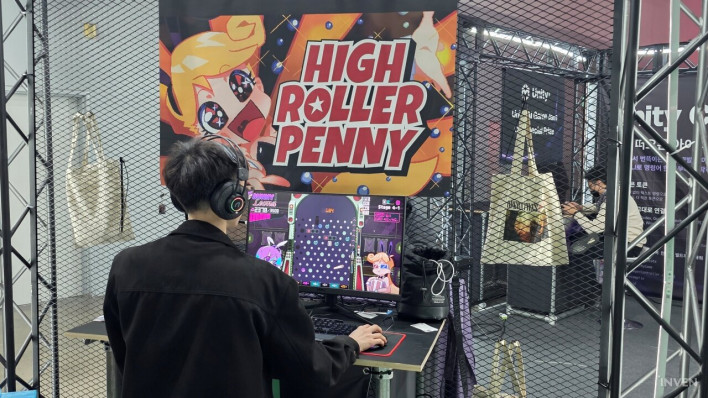
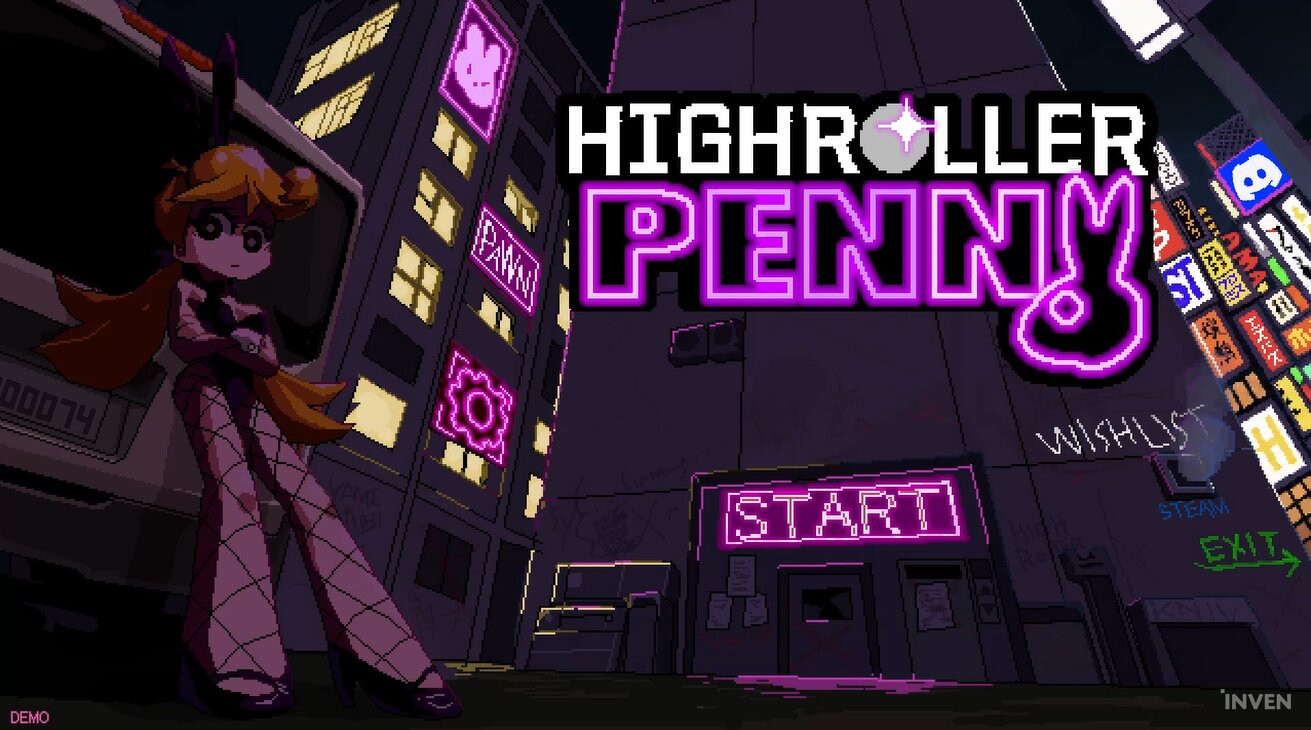
Kniv Studio, which caught the attention of indie game fans this past May with the traditional SRPG 'STARDUST: Wish of Witch', participated in G-STAR 2026 at the Unity World booth with its new title, 'High Roller Penny'. 'High Roller Penny' is a new roguelike set in an underground pachinko parlor, where players engage in life-or-death wagers alongside bunny girls. Since launching its demo on September 29, the game has garnered significant interest among indie gamers by delivering the thrill of aiming for high scores. It pairs intuitive rules—shooting balls to score points—with diverse pegs and balls, alongside a high-risk, high-return structure that even allows players to sell off their own starting balls to build up synergy.
Having subsequently passed through Steam Next Fest with over 50,000 players enjoying the game, 'High Roller Penny' came to G-STAR 2026 to gather direct feedback on-site beyond what play data alone could reveal. Even while staying busy managing new game development, publishing, and preparing another long-term project, CEO Jonghyun Hong was actively moving around the show floor to hear from players firsthand. Amid the bustle, we had the opportunity to speak with him directly about 'High Roller Penny'—which is scheduled for release on January 12—as well as the studio's next steps.
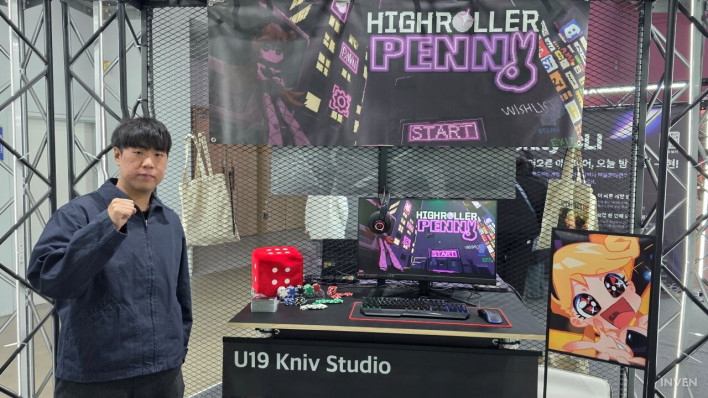
To start, please introduce yourself and your studio.
"Hello, I'm Jonghyun Hong, CEO of Kniv Studio. At Kniv Studio, we make narrative-driven games. Even in short-session genres like incremental or roguelike games, we strive to showcase games that highlight our unique worldbuilding and art concept.
The value we hold most important is intrinsic gameplay fun, which we internally refer to as 'sharp fun.' We are an indie game studio where all seven team members pour their efforts into pursuing this.
Currently, we handle art, development, and design in-house to continue our self-development efforts. As our previous work, 'STARDUST: Wish of Witch' released last May, achieved meaningful success, we are also leveraging that foundation to operate a publishing business for small indie dev teams.
How do you feel about exhibiting your new game, 'High Roller Penny,' at G-STAR 2026? Also, was there a specific background behind meeting attendees at the 'Unity World' booth?
"We launched the demo for 'High Roller Penny' on September 29, and nearly 50,000 players around the world have played it. One player even spent over 60 hours playing it.
However, up until now we had only seen demo run data without watching players actually play in person, so we were curious where they got stuck and at what points they found the fun. We wanted to set up a physical booth, and fortunately, with support from Unity, we were allocated a space in the Indie Showcase booth and were able to participate.
Our main goal in participating is to gather real player feedback while also doing some modest promotion. Seeing people enjoy our game right here in person feels truly fresh and special.
You've had a busy year with your previous title, 'STARDUST: Wish of Witch,' winning the Game of the Month award and securing a console publishing deal. What has the studio been up to recently?
"'STARDUST' is a precious title that we want to keep as a flagship IP for our studio. It's our very first game, after all. And the story of 'STARDUST: Wish of Witch' is not over yet. We plan to prepare a sequel as well.
That said, for now, we are focusing development on titles with shorter development cycles that can be quickly validated and deliver fun to players. Separately, we also have one internal long-term project under development. Right now, our primary focus is on bringing games to players more quickly through 'High Roller Penny,' 'Traymon World,' and new publishing contracts, but we can say that the next chapter of 'STARDUST' is also planned.
Unlike your previous title, which was a traditional SRPG, this time you took on an entirely different genre: a pachinko-style roguelike. What motivated this shift in development direction, and how was the development process using the Unity engine?
"Our company philosophy is not to stay confined or tied down to a specific genre or a single universe. If something can deliver genuine fun, we are willing to drastically change the genre or concept.
Developing a traditional SRPG was enjoyable, but this time we wanted to create something faster and test it in the market. While discussing genres that align with market trends and player needs, someone suggested blending pachinko with roguelike mechanics, and that idea became the foundation for 'High Roller Penny.'
As for our development process using Unity, Kniv Studio focuses on pixel art, so we use a tool called 'Aseprite.' Unity has a dedicated importer for it, which allowed us to reflect revisions very quickly and significantly shorten development time.
How would you describe 'High Roller Penny' in your own words? What would you highlight as its core appeal that sets it apart from existing roguelike games?
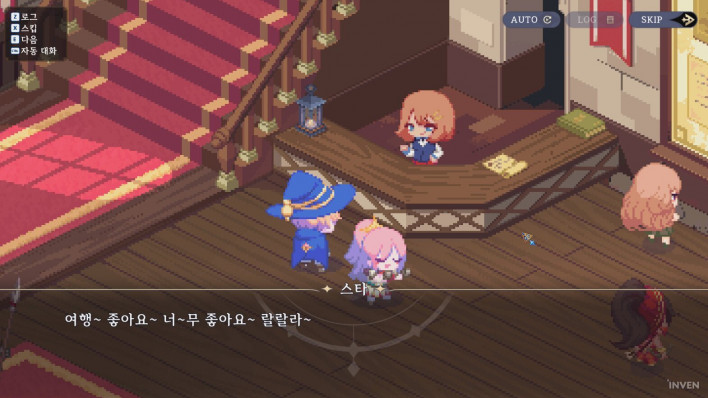
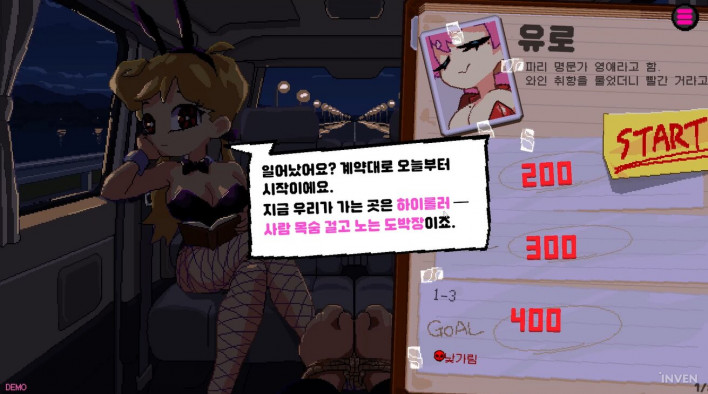
"I would say it's the 'bunny girls.' The worldbuilding concept is quite unique: the protagonist is a debtor to an organization called 'Yami-Pachi.' Here, the bunny girls aren't just cheerleaders—they are the creditors. They kidnap the player, bring them to an underground pachinko parlor, and place wagers. The opposing bunny girl bets on the player losing, while our allied bunny girl, 'Penny,' bets on the player winning. So if the player wins, they pay off their debt little by little through the show, but if they lose, they face ruthless death. It tells a dark yet engaging story.
Existing roguelike games that achieved major genre success, like 'Balatro,' have fantastic mechanics and core gameplay fun, but narrative doesn't play a huge role, right? While our game shares the structure of shooting balls and deck-building to reach a target score, we integrated an immersive universe into the roguelike where bunny girls move dynamically, attack, and speak lines. On top of that, we added the visual satisfaction of balls bouncing via pachinko physics, aiming for a game with simple controls that is great to watch. To summarize, the two major differentiators are 'the thematic fun created by the bunny girls and the Yami-Pachi syndicate' and 'visual thrill.'
The 'dopamine' design—where simple controls of launching balls combine with synergies between pegs, tickets, and balls to explode your score—is impressive. What did you focus on most when tuning this tactile feel and balance?
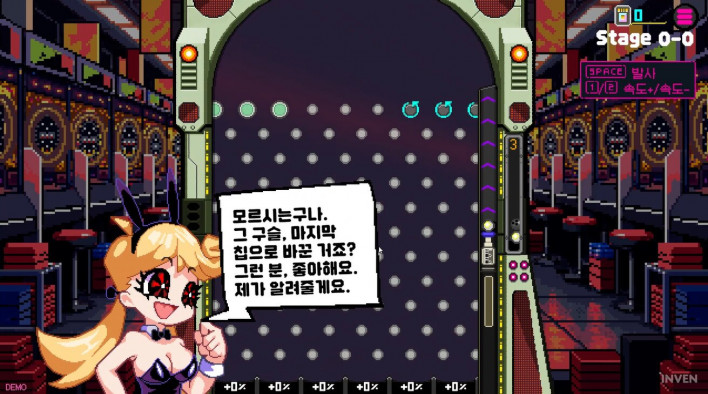
"Because our game relies on bouncing physics, even launching with the exact same power won't yield identical exact values every time, so outcomes vary slightly. While luck can't be eliminated entirely, we wanted players to feel a sense of strategic control—feeling like "I designed this board and generated these points." If it relies too heavily on pure luck, it's hard to trigger that dopamine hit. Since players get satisfaction from stepping in and watching points rise as balls hit pegs, giving players choices on where to place pegs and in what order to launch balls is the core element.
As for balance, scores don't climb very high early on due to the lack of synergies and engine pieces, but a turning point comes when purchasing pegs and balls from the shop completes your engine. We are continuously checking whether the difficulty feels appropriate at that point. If the target score is too low once a build is completed, it cuts the fun in half. By examining demo data to identify the average timing and score when engines click into place, we adjust deck-building difficulty through peg nerfs and buffs, fine-tuning clear balance based on the relationship between stage target scores and the total points generated by pegs.
The flexible system of selling owned pegs, tickets, and even balls for cash stands out. What was your design intent behind introducing these high-risk, high-return rules?
"First, it comes down to thematic reasons. Since the game is themed around pachinko, we borrowed the concept of pachinko exchange booths (prize buyback) to allow players to freely buy and sell pegs and balls.
Second, we wanted to grant players the freedom to switch builds flexibly. By keeping liquidation options easily accessible, players can comfortably pivot from one build to another and experiment with various combinations, adding the fun of choice on top of the strategic placement of pegs.
The intense characterization—such as the underground gambling house 'Yami-Pachi' and the unhinged bunny girl 'Penny'—and the dynamic reaction animations based on scores are eye-catching. What is the secret to embedding rich narrative and character depth into a game with simple rules?
"Our studio itself values story very heavily. No matter how light a game is, we make an effort to embed a narrative and worldbuilding. As with our previous title, characterization is crucial to us; details like characters' eyes going wild or having unique eye colors and features are part of that effort. To share a small spoiler, Penny has 'roulette eyes,' while Leona, who appears second, has 'swirl eyes.' Anna, from the yet-to-be-revealed third stage, has 'sparkle eyes,' so we poured a lot of individuality into their eye design.
Because we wanted to weave narrative into a roguelike, we spent considerable time pondering character design. As for reaction animations, our studio excels in animation, so just as we presented scenarios through full-frame animation in 'STARDUST,' we worked hard to implement vibrant, frame-rich animations here as well.
During Steam Next Fest and through the demo this past October, you received enthusiastic reception with 'Very Positive' reviews. What was the most memorable player feedback, and what improvements did you make based on it?
"Initially, we included 'negative multiplier zones' where losing a ball cut your score in half. However, many players expressed that this felt frustrating. We tried reducing the negative zones from three at the bottom to just one, but analyzing the data confirmed that having a run painstakingly built up to Stage 4-3 get abruptly ruined by accidentally dropping into a negative zone once felt overwhelmingly negative. Therefore, we removed it entirely from the standard game and plan to reintroduce it in a higher-difficulty mode added later.
Another point was character dialogue. Some lines didn't align with our initial vision for the characters, so we updated dialogue about four times during the demo period. Players who had grown fond of the previous lines left feedback asking, "Why did you change the dialogue? That's a shame." While we judged that the updated lines better served the character identities, it made us realize how many players attached fondness to our world and characters in such a short time. Since then, we've approached every line of dialogue with much greater care.
In a recent trailer, you announced a release date of January 12, 2027. What is the current state of development progress, and what content will be added for the launch version?
"Currently, the number of pegs and balls has nearly doubled compared to the demo. At full launch, you will be able to experience far more pegs, balls, and diverse builds, discovering new synergies not seen in the demo. Additionally, while only two bunny girls appear right now, six more will be added for a total of eight opponent bunny girls in the full version.
Beyond that, we are adding a 'Collection' feature to unlock new pegs and balls as you play, along with a system to check out the bunny girls' lore, secrets, and backstories. A high-difficulty mode named 'House Edge'—derived from the casino term representing house advantage—will also be included.
You previously stated a goal of building a pipeline to release new titles consistently every 3–4 months. Following the release of 'High Roller Penny,' what are Kniv Studio's next steps and goals?
"First, after releasing 'High Roller Penny' on Steam in January, we plan to prioritize platform diversification, such as a mobile version. Once that work is wrapped up, we will immediately jump into our next title. Since 'High Roller Penny' was developed and released in about 8 months, we plan to prepare another short-term title at a similar cadence.
We are also preparing 'Traymon World' this year, and next year we will publish 'Attention Addicted NEET.' To maintain a 3–4 month release cycle, we plan to secure another publishing contract to release in the second half of next year. As an unannounced reveal, we are also developing a new multiplayer open-world crafting survival game as a long-term project, targeting a demo reveal at the end of next year.
If bandwidth permits, we intend to include the 'STARDUST' sequel in this long-term lineup. In short, our goal is to operate three pipelines simultaneously—one long-term development cycle of 2 years, one short-term development cycle of 8–9 months, and one external publishing pipeline—releasing around 4–5 games next year.
Any final words for players waiting for the official release of High Roller Penny?
"Many players in Korea and overseas are currently playing the game. We've been pushing updates almost every two weeks based on your feedback, and we will continue making improvements after full launch to show you our best work. Please give us your interest and love, and don't forget to wishlist us on Steam!