Launched in South Korea in 2004, 'Flyff Online' was beloved by players around the world for its fairy-tale fantasy universe and a flight system that allowed players to soar through the sky on brooms and hoverboards. An eleven-year-old boy playing this game on the French server with his friends grew up over the years to become a full-fledged computer engineer. He then took on the challenge of recreating the nostalgic game he had spent the most time playing, bringing it directly into the web browser. This is the story of Loïc Saos, Executive Producer leading 'Flyff Universe' at Gala Lab.
Around 2017, while studying at INSA Lyon in France, the web-based prototype he started as a hobby evolved into an official project after meeting Gala Lab, the developer of the original game. In November 2019, he founded the development studio 'Sniegu Technologies' in France to work alongside the original development team, and through its global launch in 2022 and its South Korean service in 2025, the game established itself as a cross-platform MMORPG spanning PC and mobile browsers.
Now based in the Korean office and overseeing the entire game, Executive Producer Loïc Saos was met at the venue of the global esports tournament 'Flyff World Championship (FWC)'. Expressing how deeply moved he is every time he sees players exploring and enjoying the world he built, he pledged to continuously create game content for players to enjoy.
"I hope the players and spectators enjoying FWC together can put down their smartphones for a moment and fully soak in this festival moment, which comes around only once a year."
For someone who achieved his dream and is still chasing new ones, here is a Q&A covering his vision for Flyff Universe, the secrets behind browser optimization achieved with just 200MB of memory, security concerns in the AI era, and his heartfelt gratitude for the time players have invested.
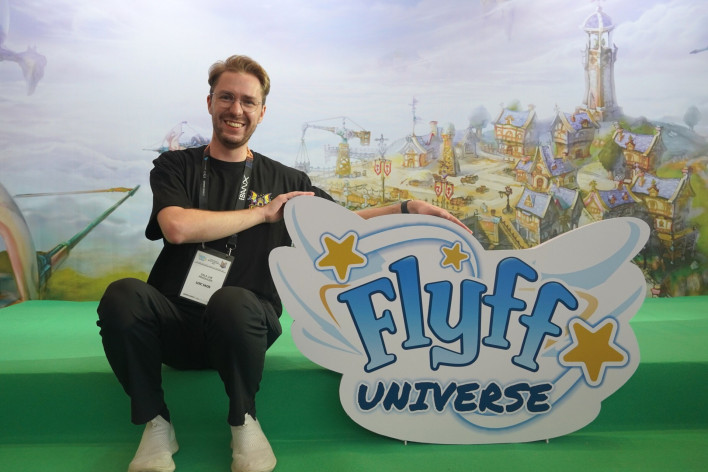
You have a unique background, having joined as a developer for a game you enjoyed in your childhood. We're curious about the journey from starting a personal project in college to becoming the Executive Producer of 'Flyff Universe' today.
" I first started playing 'Flyff' with friends in France when I was eleven years old, and I had a blast playing it. It was my first MMORPG and the game I spent the most time on. Later, while studying computer engineering at university, I was looking for a personal side project. Hearing that web technology was advancing rapidly at the time, I thought, 'Can't we build a 3D game that runs directly inside a browser without any separate installation now?' That must have been around 2017.
While pondering what to test it on, 'Flyff', my favorite PC game, came to mind. I judged that its cartoonish graphics were timeless and that its structure was well suited for a web environment. At first, it was just a proof of concept (PoC) to see if it would actually work, but as I built it, the results were quite interesting, so I kept developing it. After refining the prototype for about a year, I held an online showcase in 2019 to gather feedback from players and reach out to Gala Lab, the original developer. A few weeks later, Gala Lab contacted me, and after meeting at Gamescom, we began working together in earnest.
Some viewed it early on as running a private server. Given that it was an unofficial version using the original game's assets, it was in a bit of a gray area. What form did the build you revealed back then take?
" When I revealed the prototype online, it was not a complete MMORPG. Most core MMORPG systems were missing, and it was merely a tech demo level where you could log in and connect, so it can hardly be called a private server. However, since it was true that we used 'Flyff' assets without permission, we clearly stated on the front of the website, 'This is only a prototype for showcase purposes, and we hope to get in touch with Gala Lab.' Fortunately, the company looked favorably upon our passion for the game and our ideas, which led to official co-development.
Running a massive MMORPG inside a web browser is technically challenging. How was it implemented internally?
" Online games are largely divided into the client part running on the user's device and the server part. The server architecture is almost identical to traditional MMORPGs, with only minor differences in network protocols.
The truly tricky part was the client. Because it had to run within the browser's isolated security area, the 'sandbox' environment, there were significant limitations in accessing hardware resources on PC or mobile devices. To solve this, we built our own custom engine and iteratively performed meticulous optimizations using C++, a low-level language that allows direct memory control. Tuning took a long time because even minor mistakes could easily lead to bugs, but thanks to that, we were able to maximize device performance. Currently, the entire game runs inside the browser sandbox using only about 200MB of memory.
While there is no installation process, loading assets when logging in for the first time or entering a town takes quite a bit of time. Wouldn't the connection environment be even more difficult in countries with slower internet speeds than South Korea?
" The data taking up most of the initial loading time consists of texture images that render colors and surfaces on the screen. Considering the different network environments in each country, we prepared three texture quality modes in the game: Low, Medium, and High. Players in regions with slower internet speeds can finish loading much faster and enjoy the game by lowering their texture settings, even if it means trading off a little graphic quality.
Recently in the gaming industry, hacking attempts to extract clients, train AI models on them, and decompiling via reverse engineering have become a major headache. How is Flyff Universe responding to these security threats as an HTML5-based web game?
" Honestly, over the past few months, developers across all platforms—including PlayStation and Nintendo—have shared this concern. Technically speaking, there isn't much difference in security between a program running inside a browser and one installed directly on a PC. If anything, many people are currently attempting to use AI to port existing games to web browsers, whereas we already hold a finished browser version years ahead, giving us a technical competitive advantage.
Have you actually experienced hacking attempts or operational threats that misuse AI?
" As long as it is an online game, hacking attempts always exist. However, rather than changing the fundamental nature of hacking, AI has simply increased the efficiency of hackers' attempts. So far, there haven't been any fatal issues on the server itself, but what we are truly vigilant about is a situation where players delegate coding to AI to easily generate external tools like 'bots (auto-hunting software)' to play on their behalf. Because 'Flyff Universe' preserves the feel of old PC MMORPGs where players control everything directly—without adding an auto-battle button even on mobile—we are heavily monitoring to ensure these AI bots do not harm the game ecosystem.
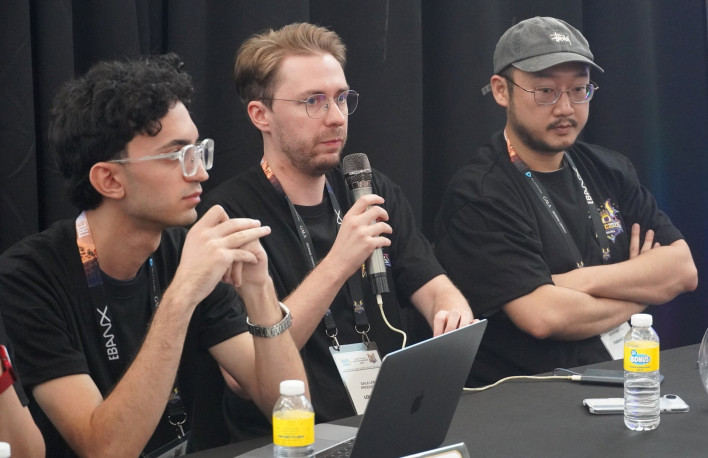
Given its web-based nature, you must experience limitations or regrets as a developer. Have you ever thought about creating a dedicated standalone client separately?
" It is true that there are overall performance limitations compared to native applications. Even when we want to add fancy effects or rich particle systems to make it look like a modern MMORPG, we bump up against the inherent limitations of the web version. We also cannot infinitely raise the 3D model quality due to the network speed issues across countries I mentioned earlier. On the security side, commercial anti-cheat programs cannot be directly embedded into the browser, so we must constantly find alternative defensive logic to maintain security. Nevertheless, being able to connect safely and conveniently from any device without a separate installation remains a powerful weapon unique to web technology.
You became the Executive Producer of a game you admired as a child and are now leading development at the Korean headquarters. How did it feel when you first stepped into this role?
" It was truly wonderful, but it didn't happen overnight. I founded my company (Sniegu Technologies) in France and worked alongside the original development team for two years, after which I chose to move to Korea, deciding it would be much easier to work face-to-face in the Korean office. Even after joining the team in Korea, my role grew step by step from lead developer to development director, and eventually to Executive Producer in charge of the entire game.
Even so, I still find it hard to believe at times. When I wake up in the morning, it suddenly hits me: 'I actually did it.' Looking back to my eleven-year-old self playing this game with friends in France, I never dreamed I would end up becoming the Executive Producer of this game in Korea.
How do you feel when you see countless players stepping into and enjoying the world you built?
" It is extremely thrilling. I feel a huge rush of excitement every year when FWC takes place in particular. At the same time, however, a fair amount of stress comes with it, because I feel a heavy sense of responsibility. All the players trust me and look forward to smooth operations and future updates. Excitement and responsibility always coexist.
While operating the game, are there players who stand out in your memory, for better or worse?
" Since an MMORPG is a community system where people gather, disputes or bad behavior inevitably happen, and we frequently have to mediate them. On the flip side, though, I am happiest when I see players forming parties or guilds, connecting with one another, and creating their own stories. I often hear news that people who first met inside the game later met in real life and became true friends, and that kind of online community is the greatest charm of MMORPGs.
If you had to pick the most rewarding moment and, conversely, the most nerve-wracking moment as Executive Producer, what would they be?
" The most rewarding moment was when I first visited the FWC offline stage in person. Seeing the crowds filling the venue and the players competing fiercely in the esports tournament right before my eyes made it all feel real for the first time. When you only see numbers online, you don't really feel the tangible reality of having thousands of players.
Conversely, the most terrible and stressful moments are downtime when servers stop due to technical issues. I really hate situations where players cannot log into the game. So whenever a problem occurs, we pour all our energy into restoring service so players can reconnect as quickly as possible.
Do you plan to continue developing 'Flyff Universe' moving forward, or do you also aspire to challenge yourself with a new next-gen title?
" Both. However, even if I start a new project, it will not be a new title related to 'Flyff'. In the case of 'Flyff', it is right to continuously polish and evolve the existing 'Flyff Universe'. Players have already invested so much time here developing their own characters. Currently, my top priority is focusing on improving 'Flyff Universe', and if I attempt another project in the future, it will be a browser-based MMORPG utilizing a different IP.
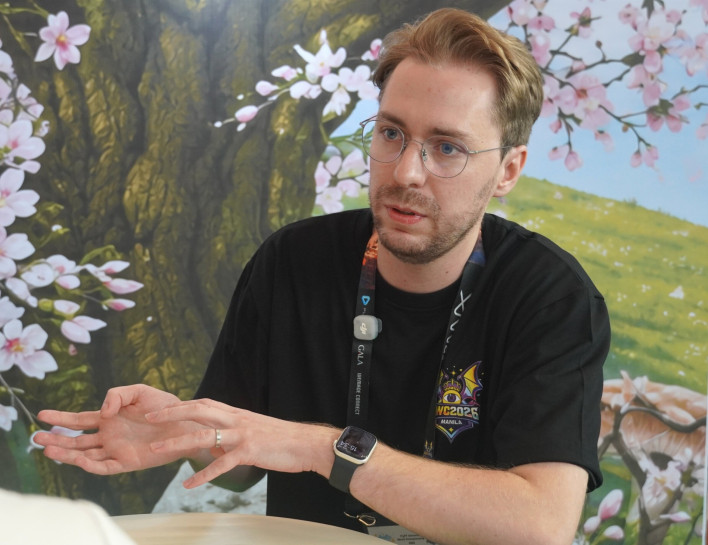
Do you believe web browser-based games will continue to advance and stay competitive in the market?
" Definitely. Moving forward, the gaming market will increasingly shift toward cloud gaming, including browser games. As web performance and capabilities improve rapidly, players will soon find it hard to even tell whether the game they are playing runs inside a browser or is installed directly on their device. Looking at projects like Starlink alone, internet speeds everywhere in the world are becoming fast enough to support cloud gaming, so connection speeds will no longer serve as a limitation.
Finally, do you have any promise or message you'd like to share with the players who cherish 'Flyff Universe' and the fans who visited the FWC venue?
" I would like to promise our players that we will consistently deliver new content and updates without stopping over a long period. I believe that is what players desire most. And for the players and spectators enjoying FWC together, I hope you can put down your smartphones for a moment and fully soak in this festival moment, which comes around only once a year.
7,000 On-Site Attendees, 50,000 Cumulative Streaming Viewers
The Power of the Tournament Driven by Dedicated Servers and Progression Seasons
Secrets Behind the Three-Peat and 'McVP's Retirement Thoughts
Wemade Connect CEO Lee Ho-dae & Gala Lab CEO Kim Hyun-soo
The Development Story Told by Executive Producer Loïc Saos
From Celebratory Stage Thoughts to Plans for Their First Korea Visit
The Festival Scene in Manila Filled by Fans
The Venue Heats Up with Performances and Cheers
From the Grand Finals to the Award Ceremony, Moments of Victory