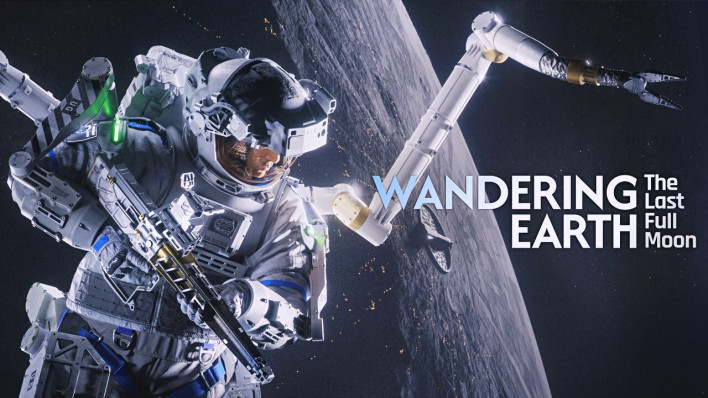
The new title from Studio Surgical Scalpels, developers of sci-fi shooter Boundary, is an adaptation of Liu Cixin's sci-fi novella The Wandering Earth. Its official title is The Wandering Earth: The Last Full Moon.
The Wandering Earth: The Last Full Moon is a linear narrative-driven, single-player third-person shooter. Featuring hard sci-fi and warfare as its primary themes, Studio Surgical Scalpels is handling the setting and development, while IP holder Starry Dome joins as publisher.
Notably, the game is being developed under a direct license of Liu Cixin's original novella rather than the Wandering Earth film series. Liu Cixin himself is participating as a supervisor, personally reviewing key content and providing advice throughout development.
The game is set during the Braking Era, the opening period of the original novella. To survive an impending solar catastrophe, humanity builds 12,000 planetary engines across the globe and embarks on the Wandering Earth Project—a 2,500-year plan to relocate Earth itself out of the solar system.

The first stage of this monumental endeavor is the Braking Era, during which Earth's rotation is brought to a halt. However, one major obstacle remains before Earth can embark on its journey: the Moon. Humanity must push the Moon out of Earth's gravitational reach, and The Wandering Earth: The Last Full Moon expands this process—briefly covered in the novella—into a full-fledged story.
The story takes place in Year 46 of the Braking Era, as the plan to push the Moon out of Earth's orbit enters its final stage. Players take on the role of an engineer working on the project who gets caught in the center of events after a mysterious attack near the Moon. Through this journey, the 300-year-old conflict between the "Earth Faction" and the "Spaceship Faction" over humanity's path to survival comes fully into light.
"The Last Full Moon" in the game's title carries multiple meanings. First, the Moon serves as the central stage for the game, and a "full moon" marks a critical operational window in the project to propel the Moon away. At the same time, the developers explained that in Chinese culture, the full moon symbolizes reunion and completeness.
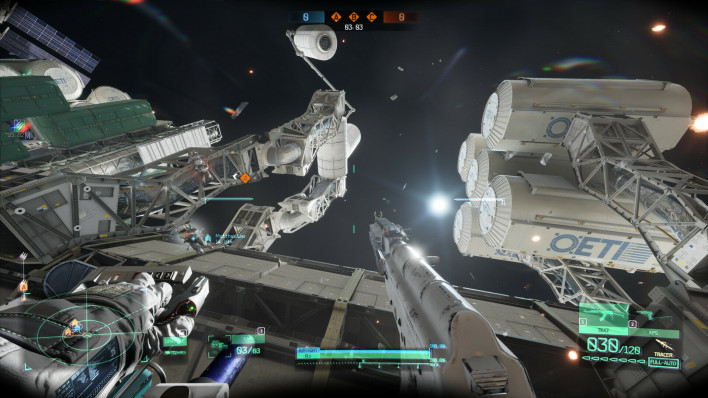
The gameplay has also been designed to fit this worldview. While shooting forms the foundation, the developers intend not to restrict themselves to traditional third-person shooter mechanics. The game actively incorporates futuristic firearms, various gear, space vehicles, and robots, while integrating space environments—including low gravity and zero gravity—directly into gameplay.

One example is the "multi-crosshair system" currently in development. In standard shooters, the center of the screen, the crosshair, and the direction the character faces are usually tied together as one, but The Wandering Earth: The Last Full Moon decouples them to achieve more natural movement.

An exoskeleton robotic arm is another piece of key equipment. Rather than acting as a simple tool for solving puzzles, it expands the core shooting mechanics by allowing players to handle heavy weapons and objects that humans normally could not lift. Outside of combat, there will also be non-combat segments that require interacting with the environment or using gear.
The developers emphasized that these systems are not merely gimmicks to look different from other games. While maintaining the core identity of hard sci-fi, the goal is not to create frustrating controls, but rather to ensure players feel immediate, intuitive fun from the moment they take the controls.
The Q&A session that followed covered topics including the current state of development, the game's relationship to their previous title Boundary, the scope of expanding the original story, and the process of collaborating with Liu Cixin.
You mentioned discussing the project starting in 2024 and beginning development this year. What is the current status?
= Because The Wandering Earth is such a major IP, there were many issues to resolve before starting our collaboration. As such, it would be inaccurate to say game development began immediately in 2024.
Back in 2024, Starry Dome reached out to ask if we were interested in developing a Wandering Earth game. We then shared proposals, plans, and various ideas back and forth. While we established concepts and conducted some testing, that period was more about building mutual trust between both parties.
= We reached a consensus on the fundamental direction toward the end of last year, and formally launched the project after signing commercial and legal contracts around March of this year.
So it is true that we are still in early development, and this is not a game ready for immediate release. However, we are building upon the experience and tech accumulated from our previous projects, and internal builds capable of testing core gameplay are currently being produced.
From the footage shown, the game appears somewhat similar to Dead Space minus the horror elements. Should we understand this as a game that combines action and puzzles?
= In a broad sense, there are similarities. They share common ground as third-person shooters set in space that deliver a story through a linear narrative.
However, Dead Space was not a direct reference point or benchmark for us. Any resemblance is simply due to genre conventions.
Studio Surgical Scalpels' previous title, Boundary, was also a space-based shooter. Is there any connection between the two works?
= The settings and IPs are completely separate. However, the knowledge and experience with space environments that we gained while developing Boundary can be directly applied here.
In fact, we believe we were given the opportunity to take on the Wandering Earth project precisely because we made Boundary. Without Boundary, we likely wouldn't have gotten this opportunity.
Space is a theme we want to keep exploring. What Studio Surgical Scalpels values most is fulfilling players' "shooting fantasies." Whether it involves space or military hardware, if a subject matter can satisfy that experience, we want to keep pursuing it.
In the original novella, pushing the Moon away from Earth is covered relatively briefly. Is the game an expansion of the original work, or a completely new story?
= You can think of it as taking a specific event within the novella's universe and expanding it—specifically, the event of pushing away the Moon.
We aim to keep everything established in the original novella intact as much as possible. However, turning it into a game requires creating many new elements from scratch, including specific organizations, characters, and events.
= As I recall, the original novella is a short piece of about 23,000 Chinese characters. Because it condenses a massive world into a brief overview, translating it into a game naturally requires a lot of original content. Think of it as expanding an event that was mentioned only briefly in the original text into the central narrative of the game.
The designs of the massive structures and various equipment are quite distinctive. What kind of art direction are you pursuing?
= We want to establish our own distinct visual style, but the core direction is firmly rooted in "hard sci-fi."
The key is not just making things that look sci-fi. We approach designs from as scientific and rational a perspective as possible to create things that feel plausible in reality.
For instance, there are iconic elements of The Wandering Earth like the planetary engines and lunar engines. Alongside these, we place great importance on the weight and cold, industrial feel characteristic of human industrial design.
When players look at them, they should get the impression that "if human technology progressed to that point, they really could build something like this." We didn't want them to look like unfounded, fantasy-like futuristic technology.
Are there any plans for multiplayer elements?
= Currently, there are no plans to include multiplayer in the game itself. Whether we might add multiplayer elements later through DLC or other means is something we could discuss with the IP holder, but nothing is decided at this stage.
For now, we feel the single-player format is best suited to deliver the experience we want players to have.
The equipment fitted with a robotic arm was striking. It seems like you're putting weight on varied gameplay at the expense of shooting mechanics. What was the intention behind this?
= The presence of the robotic arm is not meant to weaken the shooting mechanics. Shooting remains the core, foundational aspect of gameplay. However, we don't believe a single-player game composed solely of firing weapons from start to finish makes for good design. Between combat encounters, there will be various types of experiences, such as non-combat missions and environmental interactions.
Rather than being gear separate from shooting, the mechanical arm is meant to extend the shooting experience. By augmenting human physical capabilities, it allows players to handle gear and weapons that could not ordinarily be lifted.
What matters most to us is whether players find it fun. From the moment they first press a controller button or mouse click, we want them to feel, "This is the exact kind of control feel I was looking for."
= The Wandering Earth is a world spanning a 2,500-year plan. How technology will evolve hundreds of years into the future opens up countless possibilities. We want to leverage that imagination to continuously create unexpected and fun experiences—even slightly playful ones at times. However, shooting will always remain the primary core experience.

Earlier, you mentioned the multi-crosshair system. Could you explain exactly how this system works?
= On screen, you will see two reticles, while a third element is less of a crosshair and more the center of the screen or camera perspective.
Most traditional first-person or third-person shooters lock the crosshair tightly to the center of the screen. By separating them, we wanted to make the character feel more dynamic and alive on screen.
The space setting is also crucial. In low-gravity or zero-gravity environments, we have to consider how to express inertia and mass. We are tying those physical sensations directly into the controls.
That doesn't mean we want to make a game that feels clumsy or difficult to control. We want to lower the barrier to entry. Expressing "hard sci-fi" doesn't mean requiring "hardcore controls"—those are two completely different things.
= For example, as we speak right now, the direction we are looking and the direction the microphone in our hand points aren't always identical. It's easier to understand if you picture holding a gun instead of a microphone. Where you look and where the muzzle points don't necessarily have to be locked together.
= Since the system is still under development, it's hard to explain every detail right now. But I think it's a mechanic that becomes much easier to grasp once you play it firsthand.
When discussing the development of the Wandering Earth game with original author Liu Cixin, were there any memorable comments or anecdotes?
= What impressed us most was how remarkably open Liu Cixin was regarding adaptations of his work. Compared to other authors, he was very open even to significant changes being made to his work.
To summarize his mindset, it was simply: "If the resulting adaptation is a good piece of work, I am satisfied."
= Personally, I felt he is someone who deeply respects specialists in each field. He clearly draws the line between his own area of expertise and that of others.
So while he is extremely careful when selecting a professional team, once he decides to work with them, he places immense trust in their expertise. He wants us to exercise our expertise to the fullest within his IP and ultimately create a great game.