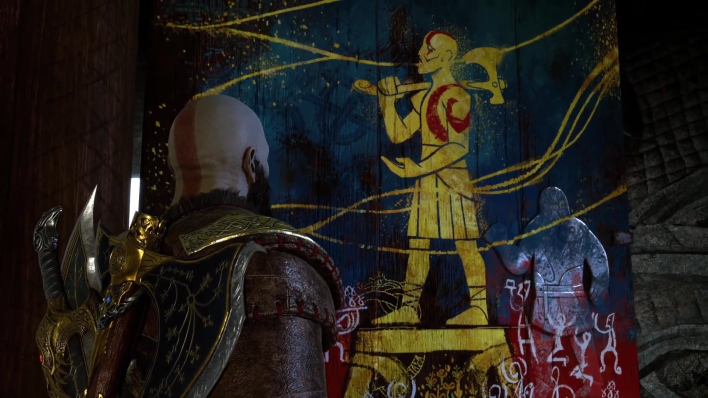
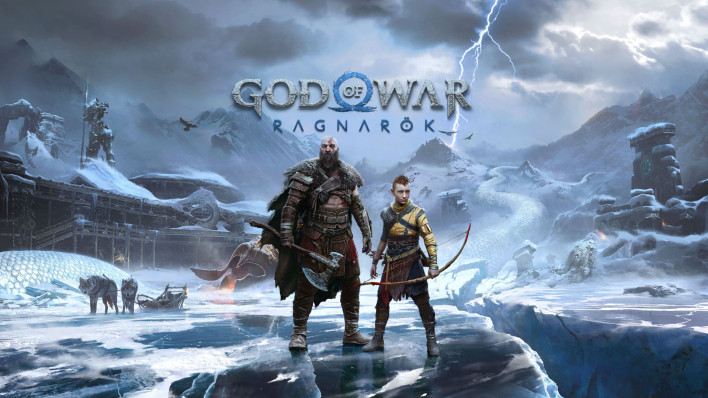
The 'God of War' series is a prime example. The original Greek trilogy, where the series began, didn't really require background knowledge, nor was there much need to look for it. True to the games of that era, it was quite straightforward: Kratos, blinded by revenge, simply had to slaughter every mythological monster and god that stood in his way.
However, the sequel series that began in 2018, set in the Norse world, is a different story.
Kratos, who once moved forward by smashing everything in his path regardless of the situation, now has a family, responsibilities, and people to protect. In Greece, he lived only for the day because his family and subordinates were all dead, but he could not afford that luxury after arriving in Midgard.
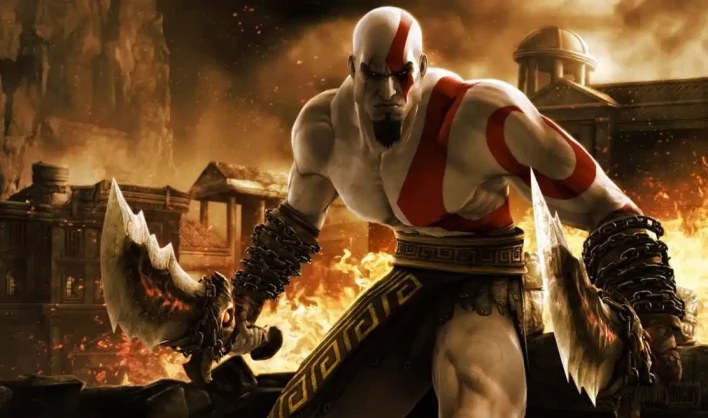
With this slightly complex setup, the developers breathed life into the two-part saga spanning 'God of War' and 'God of War Ragnarök' by masterfully adapting the original myths. It was done so well that even those with a prior interest in Norse mythology would find themselves nodding in approval.
However, there is a limit to the fun you can have if you don't know the source material. That is why I have compiled this guide. For those who played without any knowledge of Norse mythology, here is the original lore and a look at how Cory Barlog and the development team twisted and reinterpreted it.
In the Norse saga of 'God of War', the protagonist 'Kratos' is a foreign god. Even if you've only played the game casually, you likely know this. Kratos is a general from Sparta—a place far to the south of the Scandinavian Peninsula where Norse mythology is set—who slaughtered the gods that used him under the guise of revenge. While some, like Athena, pitied him, and others offered temporary help, they all eventually met their end.
Because of this global rampage, the Greek world in the game, where gods governing every aspect of life were wiped out, rapidly spiraled toward destruction. Kratos tried to end it all by taking his own life, but he failed and somehow drifted to Midgard. This means that, unlike the many characters in the game, the figure of 'Kratos' does not (naturally) appear in the original mythology. The developers placed this 'Kratos' in the position of 'Fárbauti,' a figure with a somewhat ambiguous standing and few surviving accounts in the original lore.
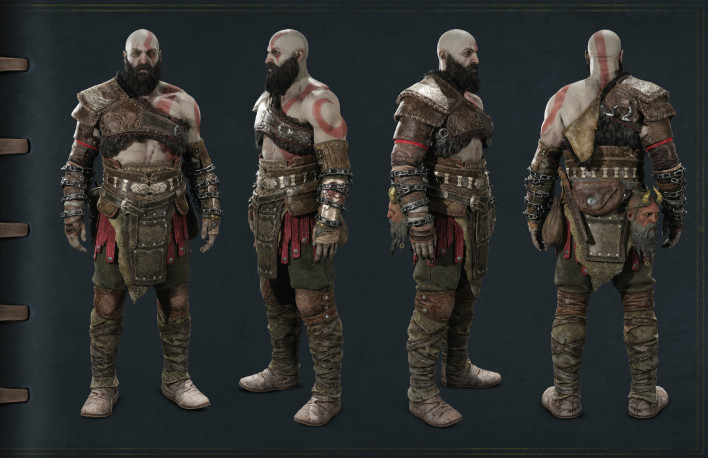
In various Eddas, Fárbauti is depicted as Loki's father and Laufey's husband. The meaning of his name is quite striking; in Old Norse, 'Fárbauti' translates to something like 'dangerous striker,' 'angry striker,' or 'sudden striker.' The noun 'fár' carries connotations of hostility, danger, misfortune, or falsehood, while 'bauti' means 'to strike.' Fárbauti is essentially a personal name formed by combining these two words. It is a name that, by any measure, feels very 'Kratos-esque.'
Once this perfect spot was assigned to Kratos, it naturally followed that his wife met in the local land would be 'Laufey,' and his son would be 'Loki,' the bringer of the end of Norse mythology.
Atreus, the game's second protagonist—or 'Loki'—is also a highly complex character. Loki displays a profound duality even in the original lore. While he is depicted as a dualistic being in the sporadically transmitted 'Poetic Edda,' his more malevolent side is emphasized in the 'Prose Edda,' which was influenced by Christian thought.
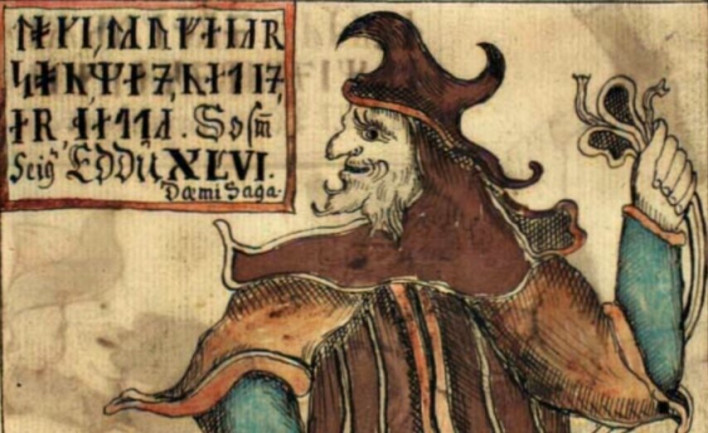
The attributes of Loki recorded in the original lore are as follows.
- He is skilled in most languages and knowledge.
- He belongs to both the gods and the giants.
- He can freely transform into animals.
- He is at the center of the prophecy of Ragnarök.
- He is involved in the birth of the wolf of destruction, Fenrir, and the world-encircling serpent, Jörmungandr.
- Ultimately, he becomes the catalyst that collapses the order of the gods.
And these attributes of Loki are all concentrated in Atreus, the game's Loki and son of Kratos. He reads runes for his illiterate father, is a demigod and half-giant as the offspring of the god 'Kratos' and the Jötunn (giant) 'Laufey,' transforms into a bear when his emotions flare up to pummel his father, and shifts into a wolf in front of Angrboða. And, as will be discussed later, he possesses the other two attributes as well.
Laufey, the protagonist of the sequel and Loki's mother, is—like Fárbauti—a figure not treated with much significance in the original myths. A notable peculiarity is that in Norse society, where names were almost exclusively passed down through the paternal line, Loki is more frequently referred to as 'Laufeyjarson' (son of Laufey) rather than 'Fárbautison' (son of Fárbauti), following his mother's lineage instead.
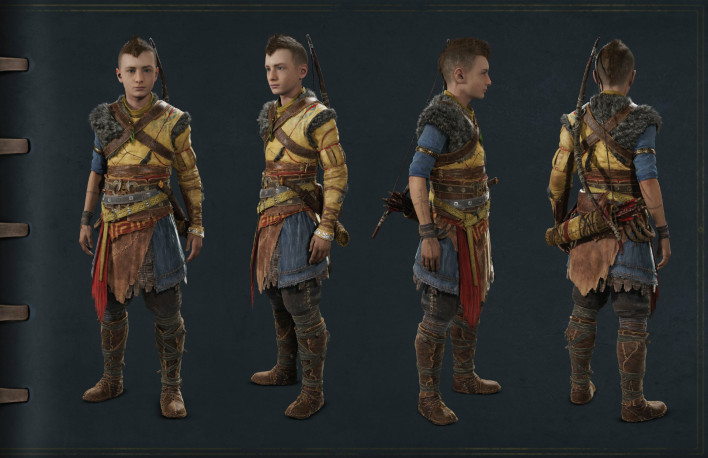
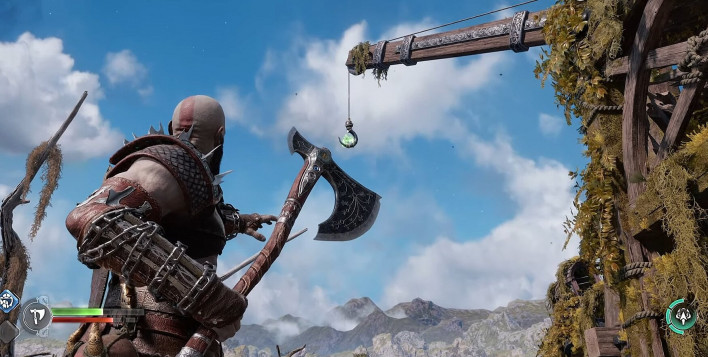
Because of this gap—the lack of a specific narrative and the fact that she is considered more important to Loki than his father—Laufey plays a massive role. She is the reason Kratos and his son embark on their journey through her prophecies, but more importantly, she is the figure who had the greatest impact on the emotional transformation of the protagonist 'Kratos.' The 'Leviathan Axe' that Kratos uses throughout his time in the North was originally hers.
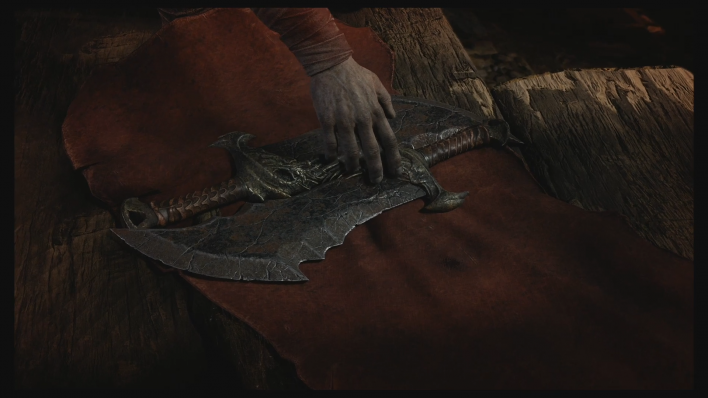
In 'God of War (2018),' Kratos uses only the Leviathan Axe for a long time, drawing an emotional line from his past and refusing to unsheathe the 'Blades of Chaos,' the weapon and mark of his former life. The weapon serves as a metaphor for Kratos separating himself from his past and trying to live in the present—a 'present life' that came from 'Laufey.'
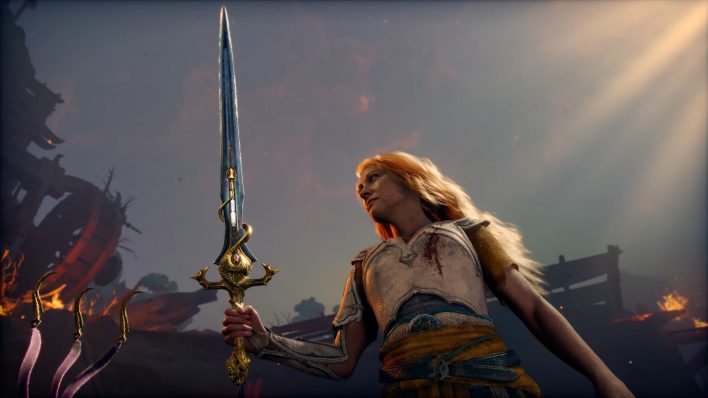
However, there comes a point when Kratos must unsheathe the 'Blades of Chaos': when his son 'Atreus' falls ill with a fever, and he needs a way to dispel the chill of Helheim. Personally, I consider this the most symbolic and iconic scene in God of War (2018). In the process of retrieving the 'Blades of Chaos,' Kratos faces the past he had been ignoring and overcomes it.
Through this process, Kratos shifts the reason for his 'new life' from his wife, 'Laufey,' to his son, 'Atreus.' Atreus evolves from being 'the child left behind from a perfect new life with his wife' to 'the only remaining trace of his wife and the reason to continue his new life.' Because the original Laufey had no significant lore, she could be assigned a pivotal role that deeply influences Kratos' story.
If the 'Kratos family' carved out a place for themselves by cleverly filling the gaps in the original lore, the major gods of Norse mythology underwent significant reinterpretation. The interesting part is the method of this 'reinterpretation.' The developers did not grant the Norse gods new attributes. The characteristic of Norse mythology is that the 'Eddas' themselves are transmitted quite sporadically, making the personalities of the gods incredibly complex. The developers simply adjusted the 'angle of view' to depict the gods in the game.
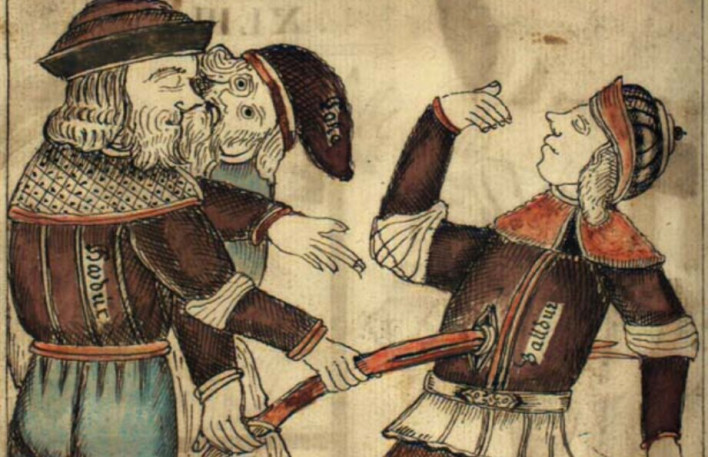
As for Baldur, the final boss of God of War (2018) who delivered such a shock upon his first appearance, the Baldur of the original myths is the most beloved god in Asgard. His mother, Frigg, doted on him so much that upon his birth, she extracted an oath from all things in the world not to harm him. The only exception was mistletoe, which she deemed too weak and insignificant to bother with. This decision would later become the reason Loki goaded Höðr (Baldur's brother) into killing Baldur with a mistletoe branch, which in turn triggers the beginning of Ragnarök.
In the game, Baldur also appears as an immortal. However, he is mentally unstable. No matter how much he is beaten or pummeled, Baldur does not die, but at the same time, he cannot feel anything. With no pain or death, there is no danger; with life being too easy, there is no fun. In a situation where all emotions are fading, only rage remains, directed at his mother, 'Freya,' who made him this way.
This narrative of Baldur reinterprets the 'immortal' setting not as a mythological tale, but as a modern psychological drama. While the narrative process itself is quite different, the broad framework remains intact: Baldur is immortal, his mother tried to protect him but failed, and Baldur meets his death at the hands of Loki. Consequently, Fimbulwinter arrives, and Ragnarök begins.
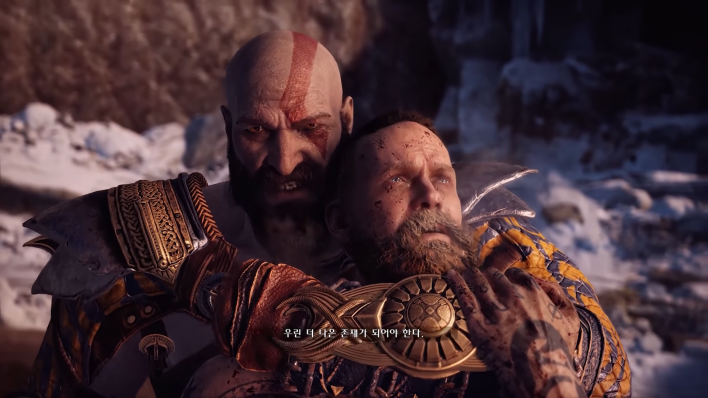
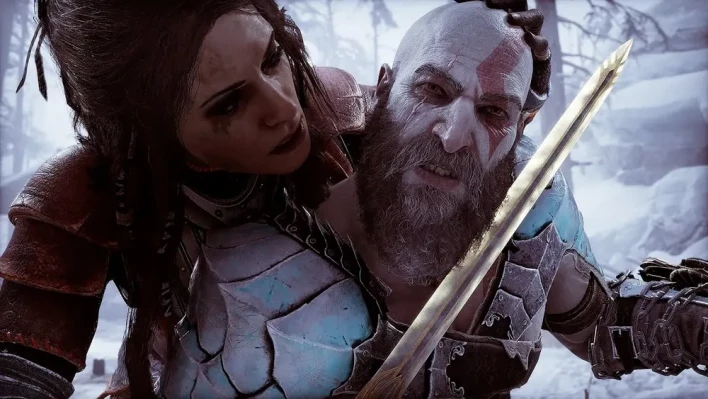
'Freya,' Baldur's mother, is a special case. In the original lore, Baldur's mother is 'Frigg,' and while she is a separate goddess from Freya (though some interpret them as the same), the game uses the setting that the two are the same person. Therefore, the game's Freya possesses both the attributes of 'Frigg'—Odin's ex-wife and Baldur's mother—and the attributes of 'Freya'—a Vanir goddess, Queen of the Valkyries, and a master of 'Seiðr,' the representative magic of Norse mythology.
This leads to changes. The narratives of 'Baldur's death and the quest for revenge' and 'helping Kratos and Atreus through Seiðr magic,' which would have been separated if following the original lore, are bundled together. This creates a character who is a Vanir goddess, has a tragic history due to a political marriage with Odin, and is a Valkyrie Queen who had her Valkyries taken away. It creates a highly complex and unique character who can be an ally to Kratos while also having a natural friction with him following her son's death.
As you know if you've played the game, the Freya in the game is depicted as a very complex and unforgettable character: friendly yet dangerous, blind yet human, and an enemy who is simultaneously a reliable ally.
'Thor' also received a unique modification. In the game, Thor is a great warrior who slaughtered countless giants on the orders of his father, Odin, but he is depicted as covering the guilt, loss of his sons, and self-loathing he felt during this process with alcohol. This is similar to the story of 'Kratos,' who lost everything precious to him after being used by Zeus in the past. In the game, Kratos and Thor reflect each other like mirrors.
However, Kratos and Thor show a decisive difference in their period of 'change.' Even after arriving in Midgard, Kratos shows coercive and self-righteous aspects for a while, but he slowly changes through his journey with Atreus and his interactions with various characters. Seeing Atreus becoming violent, he tries to restrain his own violence and widens the narrow fences of his heart to accept others.
However, 'Thor' cannot escape the shackles of Odin. After his son Modi returns having lost his brother, Thor beats him, eventually leading to Modi's death. Despite his family's pleas for him to stop drinking, he never does, living in a state of constant intoxication. Only at the very end, persuaded by Kratos to become a better being, does Thor refuse Odin's orders and look back at his family, but it is already far too late.
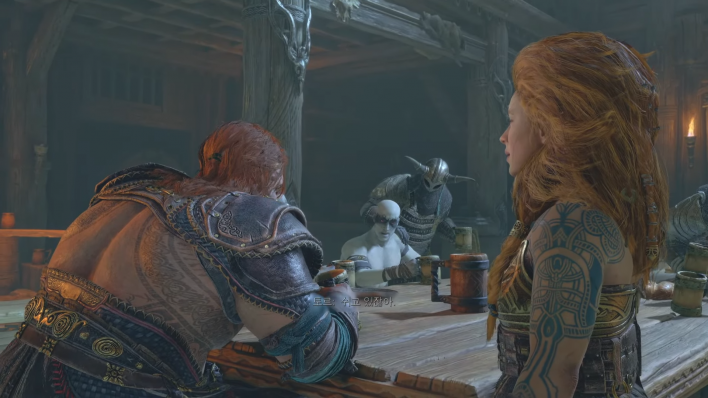
As the developers said, 'Thor,' a god as powerful and unrivaled as Kratos, functions as another possibility and a mirror for Kratos in the game. The narrative of Thor—a great warrior and god who achieved high military honors, but who lived only as he was told without making his own choices and eventually met a tragedy while covering his guilt—emphasizes the narrative of 'Kratos,' who awakens from a self-righteous warrior into a father, head of the household, and guardian through the many events he experiences in the game.
The interpretation of 'Odin,' the final villain of 'Ragnarök,' is also interesting. Despite being the main villain, Odin maintains a significant portion of the original settings without unexpected major changes. The original Odin is depicted as a very greedy wizard god full of thirst for knowledge. He sacrificed one eye to gain knowledge, hung himself from Yggdrasil, offered himself as a sacrifice to himself to discover the runes, and even dressed as a woman to learn Seiðr magic, showing that he would stop at nothing to achieve his goals.
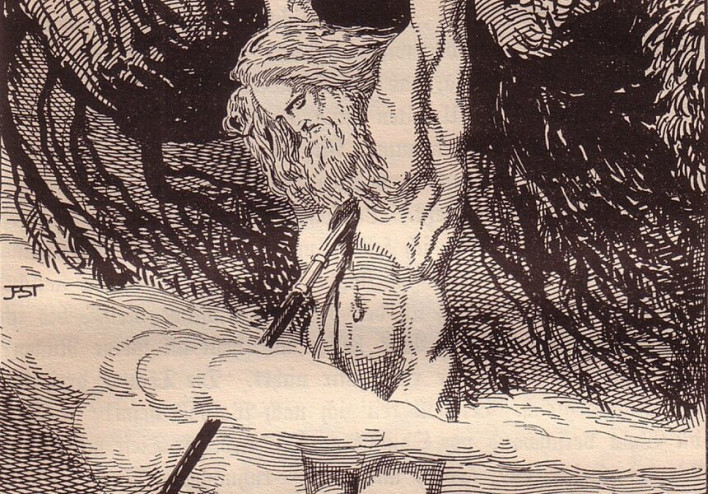
In this process, he foresees Ragnarök, falls into obsession, and becomes the protagonist of a self-fulfilling prophecy where he oppresses Loki's children and is eventually killed by them. The Odin in the game also maintains this personality of stopping at nothing for his goals and the mastermind attribute of knowing everything.
In the game, Odin's greatest goal is depicted as the 'monopoly of everything.' He collects all knowledge and prophecies for this reason, but there are still many things he does not know, and the existence of 'rifts' that he cannot see beyond also haunts him. The reason he tries to use Atreus is not to stop these things, but because Atreus is the only being who can find and interpret the 'mask' that allows one to see beyond these rifts.
Moreover, there is no such thing as 'good' for him. The many ravens Odin handles in the game are created by torturing the souls of children offered as sacrifices. The original Odin also showed a destructive personality no less than the game's depiction, intervening in human wars to manipulate victory or defeat and deliberately causing the death of heroes he liked to secure Einherjar (warriors of Valhalla).
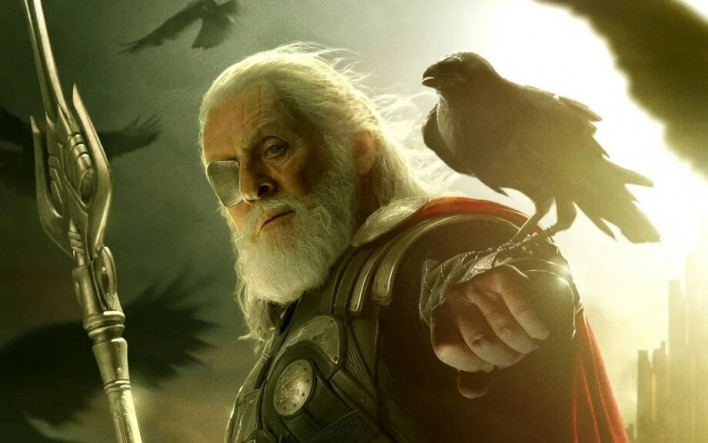
Many people are unaware of this due to the solemn appearance in the Marvel Universe or the wise image in other media, but Odin was a cold-hearted god in the original lore who prioritized only his goals, stopping at nothing. Because of this, unlike Thor, who was an object of respect among Viking warriors, Odin was considered a god closer to an object of fear.
The image of a solemn father teaching Thor, "Are you the god of hammers?" is just a Marvel creation. It means that the image of a god who stops at nothing for his goals and is somewhat distant from normal thinking is closer to the original lore.
Contrary to what people often think, Loki appears in the original lore not as Odin's son, but as Odin's blood brother, and the two are known to have encountered each other by chance during their travels. As the son of a Jötunn (giant, Fárbauti), he is of a different race from other gods from the start, is very handsome, and has the setting of being able to transform into every living creature in the world. That he is the troublemaker of the Nine Realms and the god of lies and deception is the same in the original lore.
Among the matters related to this 'Loki,' one of the most important is Loki's three children: 'Fenrir,' 'Jörmungandr,' and 'Hel.' These three children are one of the most important elements of 'Ragnarök,' the finale of Norse mythology. As mentioned earlier, Odin hears the prophecy of Ragnarök in the process of indulging in vast knowledge. This prophecy states that Loki's three children will oppose the gods of Asgard when Ragnarök occurs. Consequently, Odin and the gods of Asgard oppress and ostracize Loki's children. This leads to the flow where Loki, separated from his children, turns against Asgard, with whom he was once close.
It can be seen as one of the 'self-fulfilling prophecies,' a staple story structure that appears frequently in Greek mythology. Like the story of 'Oedipus,' where both father and son committed the very crimes they wanted to avoid by trying to escape the prophecy of their downfall.
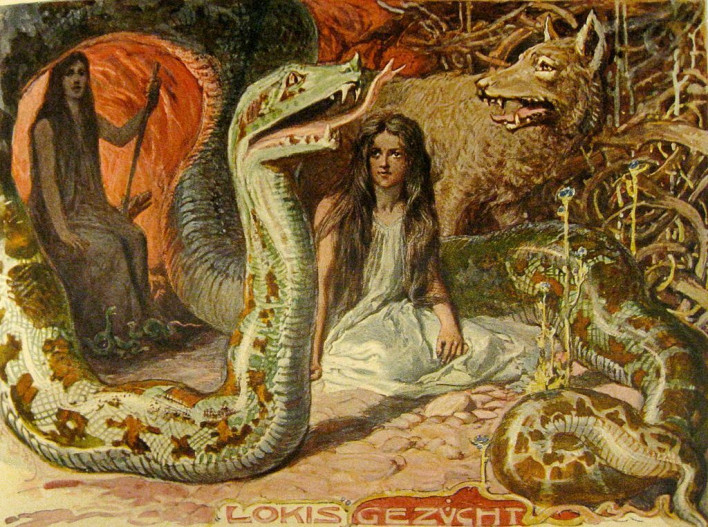
The Fenrir of the original lore appears as a gentler wolf than one might think. Although he is a wolf, he married a female giant and even had two children. These two children are 'Sköll,' who chases the sun, and 'Hati,' who chases the moon. As mentioned, he had a pretty good personality and got along well with the gods of Asgard, mainly enjoying a strange (...?) game of being bound and breaking free. However, the gods who saw the prophecy tricked Fenrir with Gleipnir, a chain that could not be broken. When Fenrir, suspicious, demanded a guarantee, Týr put his arm into Fenrir's jaw, leaving Týr one-armed, and Fenrir remained bound until Ragnarök. Of course, when Ragnarök comes, he achieves the feat of killing the highest god by swallowing Odin. Though he is killed by Odin's son, Víðarr, immediately after.
In the game's worldview, the first appearance of 'Fenrir' is the first scene of 'Ragnarök,' but there is also a presumption that it was Fenrir who led 'Kratos' to Midgard. This is a part not depicted in the game but known through the official novel. After Greece was mostly destroyed, three giant wolves appeared before the wandering Kratos, subdued (?) him, and dragged him to Midgard. Later, Kratos learns the identity of these wolves after seeing the lore about Sköll and Hati in Týr's treasure vault. About Sköll, Hati, and one giant wolf.
And, upon reaching 'Ragnarök,' the birth of 'Fenrir' is shown. He was an ordinary wolf, but at the moment of his death, Atreus unknowingly stores Fenrir's soul in a dagger. Later, in the process of subduing 'Garm,' the guard dog of the entrance to Helheim, he stabs the dagger into Garm's crown, allowing Fenrir's soul to enter Garm's body. Thus, a Fenrir is born who has a massive body and claws that can tear through dimensions, but acts like a country puppy. Though he doesn't swallow Odin like in the original lore.
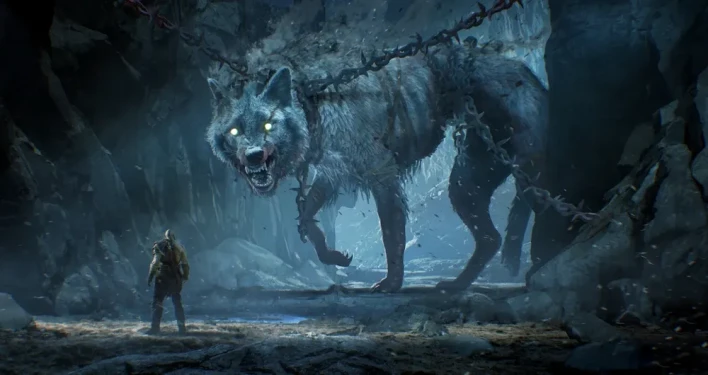
There is an interesting part of this 'Fenrir' setting that follows the original lore. If you look at the lore of 'Garm,' the guardian of Helheim, there is a description that Fenrir breaks his shackles and is freed when Garm howls loudly when Ragnarök occurs. In terms of words, it is correct. Garm is subdued with a single scream, and Fenrir regains his body and is freed.
Summarizing the situation, Fenrir is not depicted as the physical offspring of Loki (Atreus). However, both Loki and Angrboða make a significant contribution to Fenrir's birth: it is Loki who stores Fenrir's soul and transplants it into Garm's body, and it is Angrboða who inspires the soul magic by showing Loki the soul marbles of the giants. Though it appears that he uses his abilities unknowingly when storing Fenrir's soul.
'Jörmungandr' is also depicted in a similar form. The Jörmungandr of the original lore appears as a serpent that is abandoned in the deep sea as soon as it is born, grows endlessly, clashes with Thor, and eventually dies with Thor at Ragnarök.
In the game, it is depicted that while Atreus and Angrboða are searching the house of Angrboða's grandmother, 'Grýla,' they breathe the giant's soul they have into a giant serpent that is dying, giving it life. It is not a physical offspring born from the power of Atreus and Angrboða, but the reason Jörmungandr gains life and lives is created by the two of them.
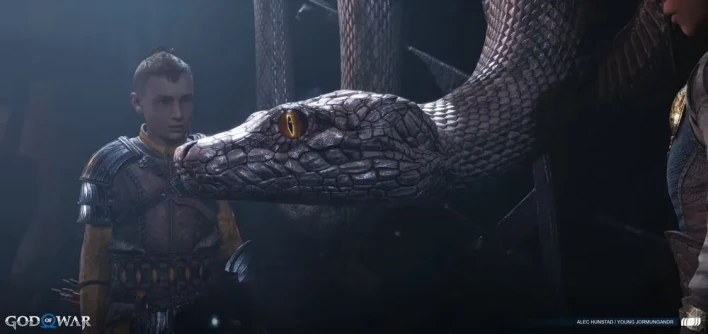
The original setting that both Fenrir and Jörmungandr are Loki's offspring thus leads to the setting that they are creatures born through the activities of Loki and Angrboða, even if they are not biological children. 'Hel,' the only daughter among the three children in the original lore, is not depicted in the game, and 'Hræsvelgr' holds the place in Helheim, Hel's realm, instead of Hel.
Various hypotheses follow this 'Hel,' and a very interesting game-only setting is added here. It is that both 'Fenrir' and 'Jörmungandr,' the creatures of Loki and Angrboða, are beings who have experienced time travel.
First, 'Fenrir' appears in the role of dragging 'Kratos' to Midgard, as mentioned above. In terms of time, it is before Fenrir, even before Loki existed, but Fenrir appears. Jörmungandr clashes with Thor like in the original lore with a body that has grown massively when Ragnarök occurs, but Thor's attack is so powerful that Yggdrasil (the World Tree) cracks, and Jörmungandr is blown into the past through space-time by this attack.
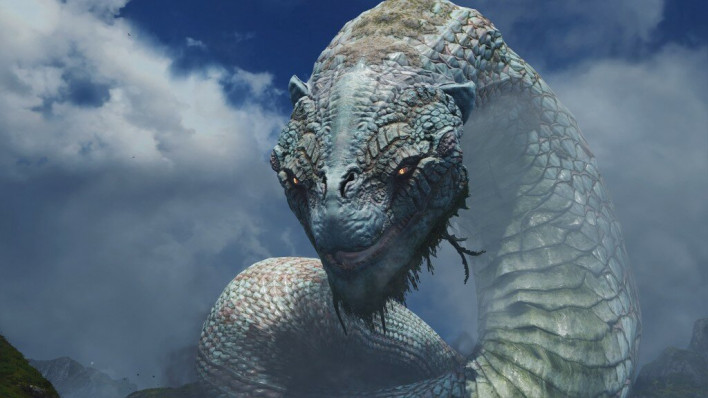
The giant serpent Jörmungandr encountered in God of War (2018) is the 'serpent that was hit by Thor during Ragnarök and flew away after tearing space-time.' Perhaps because of the memory of being hit by Thor, he tries to chew him up as soon as he sees Thor's statue, and he shows some activity in the final battle against Baldur. Later, in a conversation with Mimir, it is revealed that this Jörmungandr came from the future, saying that he came to the past while fighting Thor at Ragnarök. Perhaps to prevent a collision with his past self, the giant Jörmungandr does not show his face at Ragnarök.
'Hel' has not officially appeared yet, but considering that the other two offspring from the original lore appeared with the setting of time travel, there might be another form of narrative prepared for 'Hel.' No one knows if we will see her in the future.
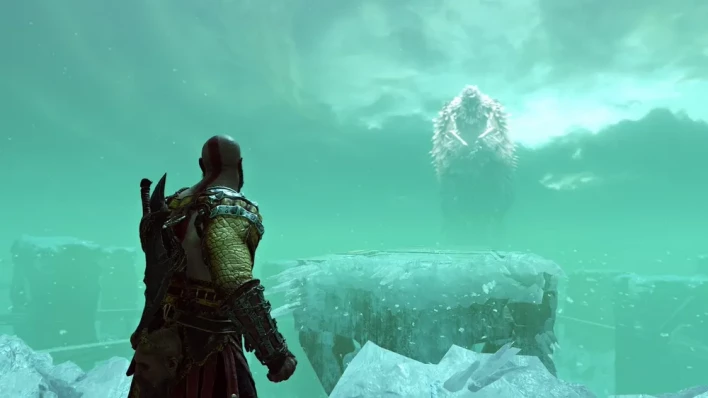
The Twilight of the Gods, 'Ragnarök,' the finale of Norse mythology, also has room for examination. The 'Ragnarök' of the original lore begins with four omens after the death of 'Baldur.' 'Fimbulvetr,' an extreme winter, lasts for three years; the 'Age of Wolves,' rampant with incest and fratricide, arrives; Sköll and Hati eventually swallow the sun and the moon; and as the three roosters of the Nine Realms and Garm begin to howl, the forces of Jötunheim and Valhalla are summoned.
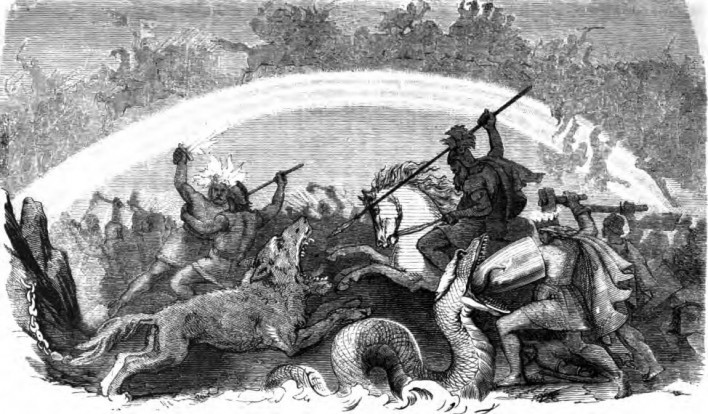
In God of War (2018), the 'death of Baldur,' which is the first omen of Ragnarök, is depicted. The process is very different, as he dies at the hands of Kratos, not Höðr, but anyway, it is Loki (Atreus) who causes Baldur's death with mistletoe, just like in the original lore.
In the following 'God of War Ragnarök,' you can see the full-scale signs of Ragnarök, and the time the game starts is already during 'Fimbulvetr,' the extreme winter. Later, Atreus and Kratos conflict over how to deal with the situation, and Atreus almost causes a big problem by transforming into a bear because he cannot control his emotions, showing the 'Age of Wolves' somewhat briefly.
Sköll and Hati were imprisoned by Odin's scheme, and even Hati's goal, the 'moon,' was hidden, but Kratos and Atreus retrieve the moon in Vanaheim and release Sköll and Hati. In this process, the problem of Vanaheim, which was suffering from plants overgrowing because only daytime continued, is also solved. The roosters are not particularly depicted... well, Garm howls. Because he was beaten so much by Kratos.
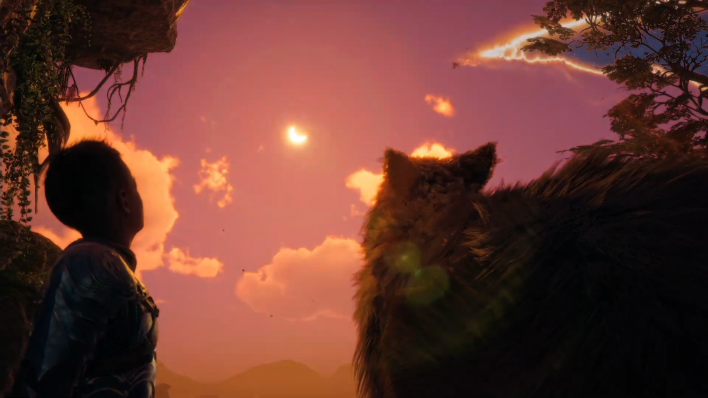
However, the result of this 'Ragnarök' is completely different in the original lore and the game. If the Ragnarök of the original lore led to the end of the entire world and the opening of a new era, the Ragnarök of the game is reduced to the 'end of the order built by Odin.'
To properly see this change, you must think about two attributes. One is the 'prophecy' that is the original start of Ragnarök, and the other is the 'message' the game wants to convey.
In the original lore, the being who first made the prophecy of Ragnarök is an unnamed prophetess, written as 'Völva' in Old Norse. In the first poem of the 'Poetic Edda,' 'Völuspá' (Prophecy of the Völva), Odin hears from the prophetess about the birth of the world, the fate of the gods, Ragnarök, and the world after that. Afterward, Odin's preparations, stopping at nothing to prevent Ragnarök, begin, and he acquires a paranoid and ruthless aspect.
In the game, Odin perceives Ragnarök through the prophecy of a character named 'Gróa.' However, Gróa conveys only an incomplete prophecy, and the real prophecy is hidden in his sanctuary in Alfheim. Like 'Fárbauti' and 'Laufey' earlier, they made a character with no major narrative in the original lore a key character.
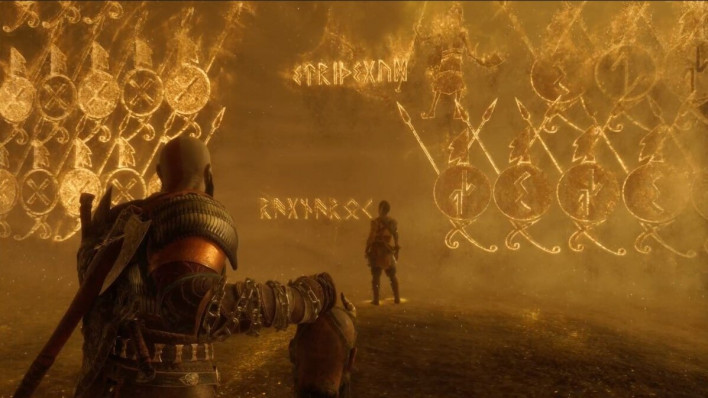
And there is another device. The three Norn sisters you meet during the game are prophets who read the past, present, and future, respectively, according to the game setting, and they say this about prophecy: "Prophecy is not seeing the future. It looks like that because you always make the same choices."
Ultimately, the concept of 'prophecy' in the game is closer to the 'most likely reality' inferred based on a person's tendencies and essence, rather than an incomprehensible power that looks into the future. And here, the core message the game wants to convey is added.
'We must be better'
This is the ultimate message the Norse two-part series of 'God of War' wants to convey. Kratos, who used to coercively point out to 'be better,' begins to acquire an altruistic appearance to become a better person himself, and finally even smiles. Kratos, who would have turned Thor into Thor/r with his original personality, says to Thor, who self-deprecatingly says that we are just destroyers.
"Not anymore. We must stop now. We must be better, if only for our children."
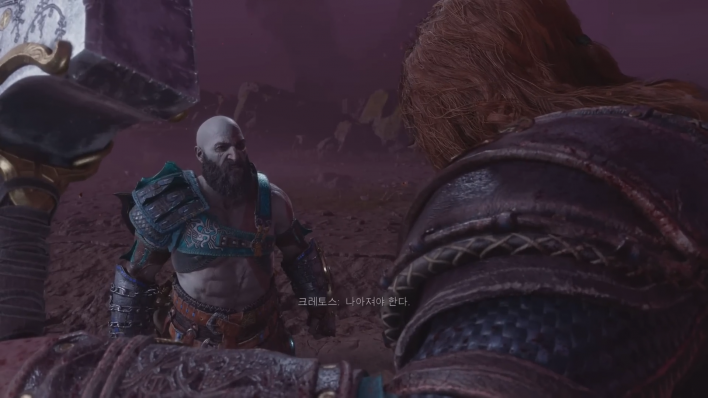
As such, by becoming a 'better being,' the prophecy in the game is naturally broken. Because the essence has changed from the Norns' prophecy method of 'inference based on a person's essence.'
Freya lost her son, but she became a better being by suppressing her desire for revenge and stepping forward for a greater cause and the Vanir gods. Atreus blindly followed the prophecy and set out to find 'Týr,' but he turns away, rejecting the prophecy in the mural of Jötunheim that he would remain by Odin's side. 'Týr' is a god of war, but he does not want war. He, who appears after the ending, has already become a 'better being' and is active (?) as Kratos' psychological counselor.
In this process of Kratos and Atreus becoming better beings together with many people through their journey, only Odin does not change. Throughout the game, he searches for knowledge, stops at nothing for it, and views all others only as tools.
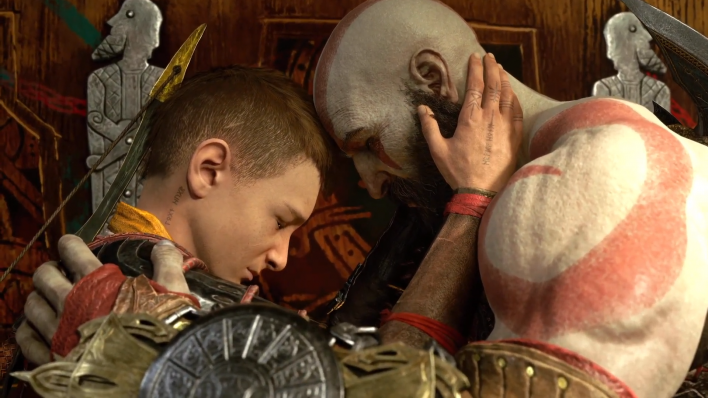
Because he could not change, Odin meets his ruin without even being able to stop the realization of the fake prophecy. However, those who chose to become better beings meet a result different from the prophecy. 'Laufey' damaging the prophecy of Jötunheim was because she wanted her husband and son not to believe in the prophecy but to become better beings by their own choices, and the fact that the god 'Kratos,' who was not worshipped by anyone, finally becomes the guardian god of the Nine Realms, not death, is also because they did not follow the prophecy but became better beings by their own choices.
Therefore, the Ragnarök of the original lore, which is an unavoidable ruin, struck only Odin, who was the only one who could not change.
'Becoming a better being, and that only then can you create a better future' was ultimately the message this game wanted to convey, and it was the core of the grand narrative spanning two episodes.