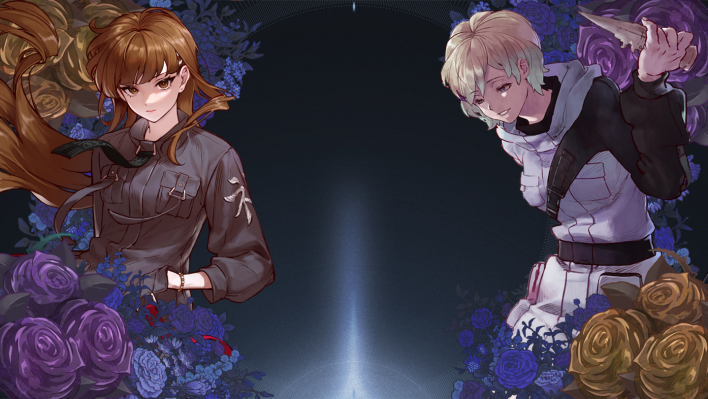
'Shikhondo: Blue Pieta', a new fantasy bullet-hell shooter developed by the Korean indie studio DeerFarm, is set for official release on May 18.

'Shikhondo: Blue Pieta' is the latest entry in the 'Shikhondo' bullet-hell series, which debuted in 2017. It serves as a direct sequel to 'Shikhondo: White Flower', which was released on Steam in 2024 and on the Switch in 2025. This is the first title in the series to adopt a side-scrolling format, and it also features support for ultrawide resolutions, allowing players to enjoy the game on a broader screen.
CEO Ko Young-jin, who leads the one-person development team known as 'DeerFarm' (literally 'Deer Farm'), has been creating shooting games as side projects for the past 15 years. In an interview ahead of the new game's launch, we heard his story of how he evolved from a fan developer of 'Touhou Project' games into a creator with his own original IP.
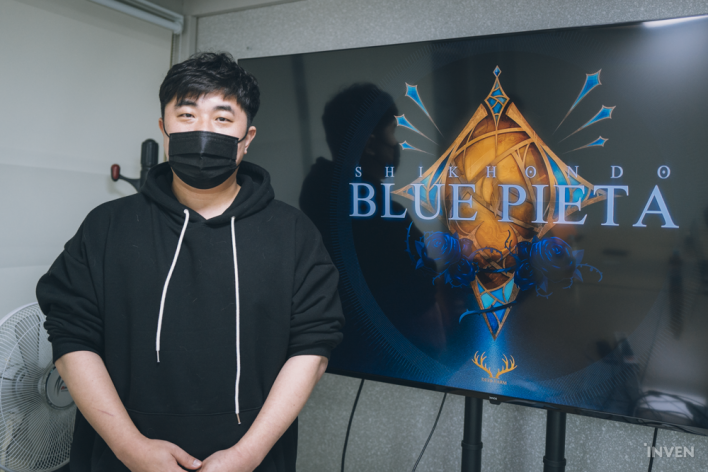
First, I heard that DeerFarm is a one-person team. I'm curious about how it actually operates.
" To be precise, it's a one-person team, but not a one-person development project. The team itself is just me, but I have separate people helping with art and sound. They are friends or colleagues, but they aren't officially part of DeerFarm. My day job is as a client programmer at a game company, and DeerFarm has been a side project I've maintained all this time. You could say that making and releasing games is just a part of my life cycle.
I'm curious why the team is named 'DeerFarm'. Is there a story involving deer?
" My father used to raise deer as a hobby back in the day... so it's a name I chose without much deep thought.
At the time, there was a trend among fan game teams to give themselves unique names, like 'Team Shanghai Alice', 'French-Bread', or 'Watanabe Seisakusho'. So I just thought, 'We have deer at home, so I'll call it DeerFarm.' That was nearly 15 years ago. Personally, I think it's better to write one more line of code than to spend time on titles or naming, so I suppose that tendency is reflected in the name (laughs).
I recall the 'Shikhondo' series first appeared in 2017. Bullet-hell shooters are a rare choice in Korea; could you briefly look back on the motivation for starting the series and your nine-year journey?
" DeerFarm originally started as a team making 'Touhou Project' fan games. We released our first title around 2010 or 2011. Back then, the genre range for fan games was very narrow. Most domestic fan games were visual novels.
On the other hand, shooting games were a kind of 'training project' among developers at the time because they were more accessible than other genres. Personally, I liked shooters, and since my day job is as a programmer, I could make them without much pressure. I made a shooter as a side project while working at a company, released it as a Touhou Project derivative work, and by using those base resources and code to make sequels, I eventually arrived at 'Shikhondo'.
After releasing two Touhou fan games under the 'DeerFarm' name, I made a 'Love Live!' fan game. Around the time I released that game at Comic World, there was the so-called 'rating incident.' It was a period when indie and fan games were included in the rating requirements, which caused a huge controversy. I got a rating to avoid trouble, but to get a rating, I needed to be a sole proprietor.
I asked my company for understanding, registered as a sole proprietor, got the rating, and went to Comic World, but—oops. I found out then that, according to the rules, sole proprietors were not allowed to participate. I ended up being banned from participating in future events, and from that point on, I started making original IP works.
After receiving global acclaim, I'm curious about the starting point for conceptualizing 'Blue Pieta'. Which aspects of the previous work determined the direction of the new one?
" Honestly, I don't think too deeply about business results or things like that. It's more of a stream of consciousness: 'The game came out well, so I should release a sequel.' However, 'Blue Pieta' had a somewhat unique starting point.
Originally, after the console port of 'Shikhondo', I was making an action game using the Shikhondo IP. I thought I'd played enough shooters and wanted to try a different genre. In fact, all the development costs for my side projects come from my salary. But as I was making the action game, I could see that the scale was something my salary could never cover.
I do want to finish that action game someday, but I needed a detour. I reached the conclusion that I should make a shooter that bridges the gap between the first 'Shikhondo' and the action game. I thought, 'If I make a shooter as a prequel for the new character who will appear in the action game, I can introduce the character early and expand the IP.' That's how 'Shikhondo: Blue Pieta' began.
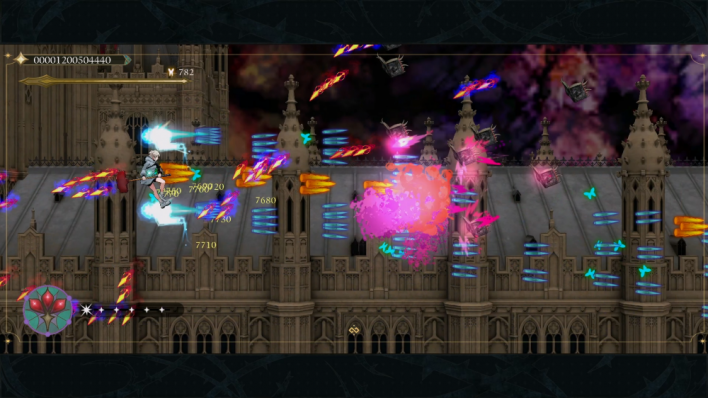
The Western style, especially the gothic horror atmosphere like Dracula, has become stronger than in the previous work. Does the subtitle 'Blue Pieta' have a meaning.
" Since the first 'Shikhondo' was an Eastern-style fantasy, I thought I should bring the new character for the sequel from the West. I had already decided that the second playable character would be Western, and to make a prequel for that character, the setting naturally had to move to Europe.
The subtitle 'Blue Pieta' wasn't something I thought about very deeply either. There's an arcade version of 'Shikhondo' with the subtitle 'Red Purgatory'. Since I used red there, I thought I'd use blue this time. In RGB order, green is next, but green is a bit ambiguous (laughs).
Also, I needed a boss concept that fit the European setting. I'm Korean, so I naturally know Eastern settings, but I don't know much about the West. While thinking about the most famous things, I thought of Michelangelo's Pieta. As it happens, I'm also a Catholic, so I decided to make the Pieta statue the final boss and set the subtitle to 'Blue Pieta'. As I said before, I'm the type who thinks it's better to write one more line of code than to spend a long time on titles.
Another major change in this work is the side-scrolling format. Was there a special reason for the switch?
" Actually, I don't have much to say about this. The two Touhou Project fan games by DeerFarm were developed as side-scrolling and vertical-scrolling respectively, and the Love Live! fan game was side-scrolling. And since 'Shikhondo' was vertical-scrolling, it was just time for side-scrolling again.
There's no special meaning; you could say it was just the turn for vertical-scrolling? I've been alternating them like this. As an aside, the fact that side-scrolling definitely has many advantages for showcasing characters also played a role.

I heard the reason for supporting ultrawide monitors was also unique.
" I bought an ultrawide monitor while I was making the side-scrolling game. If you buy one, wouldn't you want to support it? (laughs).
On top of that, there's the 'Darius' shooting game series (produced by Taito). A certain arcade version is famous for connecting three monitors, and the most recent work supports ultrawide resolution by connecting two monitors. There was a light motivation of 'Darius supports ultrawide, so I should too.
'Shikhondo: Blue Pieta' has letterboxing at 16:9, and the letterboxing disappears on ultrawide, revealing bonus space on the sides. The character can't move into that space, but the sense of intensity is definitely different.
Personally, I think shooters are a genre where difficulty balance is subtle. I'm curious about the process of designing the bullet patterns in 'Shikhondo'.
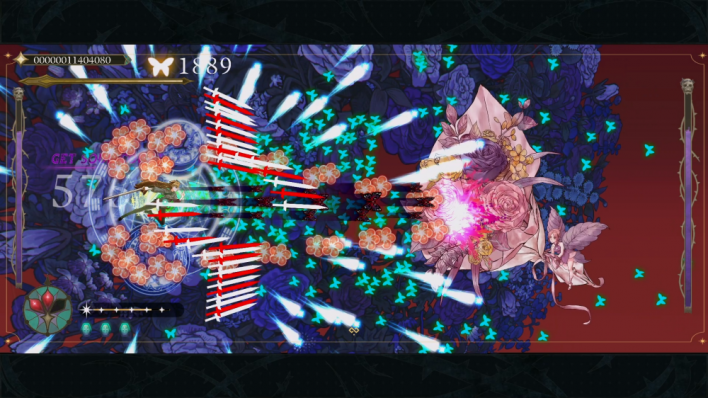
" I learned a lot of the know-how by following the bullet patterns when I was making Touhou Project fan games. In the case of the 'Shikhondo' series, each boss has a concept. The spider boss in the first game sprays bullets in the shape of a spiderweb.
The tooth fairy that appears in this work sprays bullets from above and below to express the look of teeth clashing. The flower spirit in Stage 1 sprays flower-shaped bullets. I decide on the boss' identity first and then design the bullet patterns to fit that concept.

It seems like creating a path to dodge within those bullets is also a key part of the design. It was impressive that you marked the hitbox with a small circle in the center of the character.
" In bullet-hell shooters, it's too harsh if you don't show the hitbox. Since it's a genre where the screen is already filled with bullets, I create elements that allow for dodging somehow. The 'Soul Collection System' from the previous game is a feature that clears the screen without consuming a bomb, and the 'Counter Bomb' introduced for the first time in this work is a system where if you press the bomb button within 10 frames of being hit, you don't lose a life and it's treated as using one bomb. Even if there are sections that feel somewhat unreasonably difficult, I wanted to create several ways to survive systematically.
You have to use the Soul Collection System actively. Since it also includes a damage bonus, 'Shikhondo' intentionally has slightly higher boss HP than other shooters. It's a structure made to encourage active use of this system.
How do you set the difficulty standard.
" Actually, I tend to use myself as the standard. Since I made Touhou Project fan games, I can clear the (Touhou Project) Normal difficulty without continuing. I set the standard there. The level I can beat without continuing is Normal, and from there, I remove bullets and lower the bullet speed to make 'Easy' difficulty.
To be honest, I can't beat 'Hard' either (laughs). I made it, but I can't beat it. But surprisingly, 'Shikhondo' users can all beat it. So I thought, 'I guess it's okay to make it like this.'

It's also impressive that the game proceeds without special power-ups; was that intentional.
" Shooters without power-ups are surprisingly common. Even the 'DoDonPachi' series, the most representative bullet-hell shooter, stopped having power-ups at some point.
The biggest reason is that it's cumbersome to make (laughs). The biggest advantage of a hobby project is that 'you don't have to do what you don't want to do.' The moment you add a power-up system, the variables you have to manage in stage balance increase exponentially. New development elements, such as when to give power-up items after you die and power down, appear endlessly.
I decided it was better to spend that time on bullet patterns and gameplay, so I excluded it. In DoDonPachi, bombs are given during the game, but in 'Shikhondo', I didn't even give bombs and made them a reward choice after the game ends. It's a kind of choice and focus to reduce the time spent on system balancing and focus only on gameplay and bullet patterns.
The fact that popular Japanese voice actors like Yoshino Aoyama participated is also a hot topic. I'm curious if there's a behind-the-scenes story regarding the casting.
" As you can guess from my fan activity history, I'm a total 'otaku.' When porting 'Shikhondo: White Flower' to the Switch, the publisher offered to support Japanese voice actor casting. They asked me to send a list of desired voice actors, so I filled one side with 'Love Live!' voice actors I personally like, and the other side with the most popular voice actors at the time. I was happy with whoever I got.
I was contacted saying that one of the voice actors I put as my first choice was too busy, but Saku Mizuno (Ryo Yamada from 'Bocchi the Rock!') from the same agency was available. Since I liked 'Bocchi the Rock!', I naturally said yes. When I asked, "What happened to the other person?", they said Ikumi Hasegawa (Ikuyo Kita from 'Bocchi the Rock!') had already been cast. Since it was Kita and Ryo, I thought, 'I absolutely have to go with them,' so I brought both of them on board.
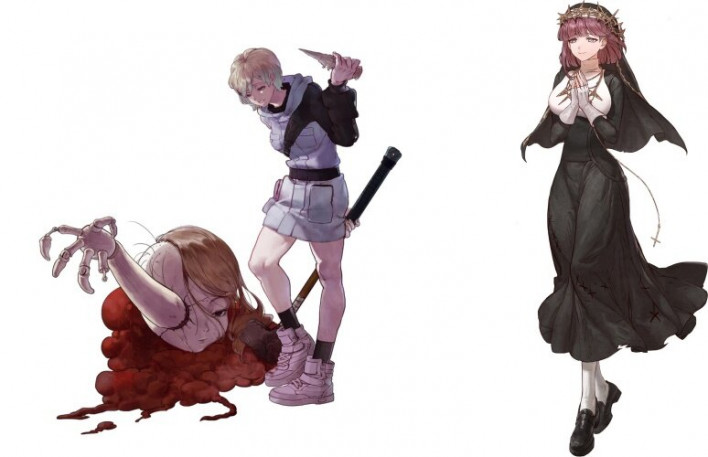
While making 'Blue Pieta' after the release of 'White Flower', I had to cast voice actors for the new character Sister Maria and one other character. When the publisher asked for my opinion, I asked, "Since it's come to this, let's try for the other two from 'Bocchi the Rock!' as well." Since it was right after the announcement of 'Bocchi the Rock!' season 2, Yoshino Aoyama and Sayumi Suzushiro were at the peak of their popularity, so I didn't think it would work, but fortunately, both said yes. In the end, I gathered all four (laughs).
You've been presenting the 'Shikhondo' series in collaboration with CFK. I'm curious how the collaboration with the publisher affects development.
" First of all, the best part is being able to use Japanese voice actors? (laughs) I can contact Korean voice actors directly through acquaintances in the music industry, but there's practically no way for an individual to approach Japanese voice actors. I think having them handle that is the biggest advantage for an otaku.
Also, in the game industry, it's practically difficult to form partnerships with Nintendo or PlayStation as a sole proprietor. It's a matter of policy, and if your email address is Naver or Gmail, you can't even apply for a partnership. So, going through a publisher is a much easier path for console porting. You don't get development tools just by becoming a partner; you have to buy them, and the costs are not trivial. It's better to spend that money on development costs.
From a programmer's perspective, store management or paperwork are the things I hate the most. Even at work, I really hate doing them, but for a personal project, it's a one-person team, so someone has to do it eventually. I'm very satisfied that the publisher handles 90% of those parts.
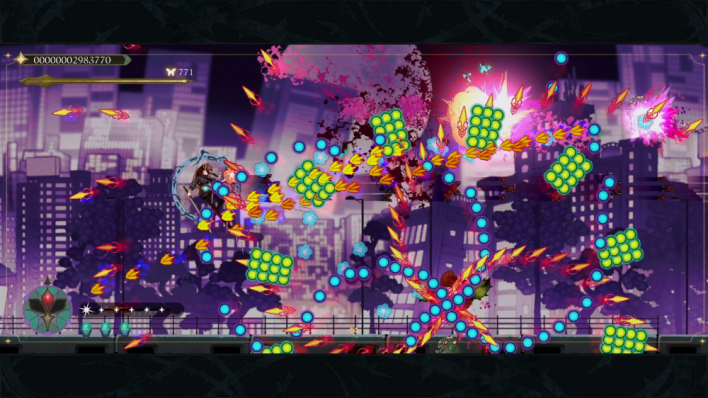
You've continued the 'Shikhondo' series for nine years. Have you personally felt any changes in the Korean bullet-hell shooter market?
" If anything, it’s decreased; I don’t see any real change. Colleagues at the company joke that since I’ve made six or seven shooters, I must be a "master" of the genre in Korea, but my answer is always the same: "It’s not that I’m a master, it’s just that I’m the only one left making them."
Bullet hell shooters are actually an easy genre to get into. It’s almost the only genre where you can build a complete game from start to finish with just three types of resources: a player, enemies, and a background. You can always swap out the art later. That’s why you do see new titles pop up occasionally. But it’s incredibly hard to find a company that makes more than two.
No matter how I think about it, it's not a market with high business potential, and honestly, I don't really know why the publisher is interested in my game (laughs). The first 'Shikhondo' has four versions: the Steam version, console version, arcade version ('Red Purgatory'), and the recent remastered version ('White Flower'), and the total sales are barely over 100k copies. If a bullet-hell shooter sells 100k copies, shouldn't we consider that practically all the genre users in the world have bought it.
Nevertheless, 'Shikhondo' is building a consistent fan base globally. I'm curious about how you want to expand the series in the future.
" I want to expand the 'Shikhondo' IP and worldview further. For that to happen, 'Blue Pieta' needs to sell well (laughs). The shooting game market is becoming high-end these days. Since new titles themselves don't come out well, a business model of selling expensive limited-edition packages with flashy designs has become common. It's based on the premise that 'only those who play will buy it.' I think 'Shikhondo' is getting attention because, in such a barren land, a shooter of a certain quality is being released consistently.
Actually, there are advantages. For mobile games or action games, downloads drop to near zero the moment they fall off the charts, but bullet-hell shooters have a fixed user base and new titles don't come out often. So, there are definitely 'people who will buy it someday.' There is that stability.
There are about ten days left until the release. What are you focusing on most at this stage?
" The game build is already complete. I'm currently working on console porting and additional content in parallel. The PS5 port is almost finished, and I plan to start the Nintendo Switch port next month. After the release, a dual mode and two new difficulty levels will be added.
Many 'Shikhondo' fans are waiting for the new game. Just before the official release, if you could pick the charm points of this work yourself.
" I put a lot of effort into the last stage and the last pattern. It's fine even if you use infinite continues, so I really hope you enjoy the last pattern of the last stage.
Anyway, these days, bullet-hell shooter users play with a focus on scoring because the score becomes 0 if you use a continue. That's why I didn't put a limit on continues. I hope you watch it to the end with a comfortable mind.
I'm also curious about your plans after 'Blue Pieta'. When can we see the action game you mentioned briefly earlier?
" I think I'll decide after seeing the sales figures following the Nintendo Switch 1, 2 and PlayStation 5 release of 'Shikhondo: Blue Pieta'. Personally, what I really want to make is an action game with the Shikhondo IP. I already have a prototype. It's a Metroidvania style combined with bullet-hell elements. I hit a wall once and put it aside, but I definitely want to finish it someday.
Lastly, is there anything you would like to say to your Korean fans?
" As long as I am working as a developer, games will continue to come out under the 'DeerFarm' name. I ask for your continued love and support.