
Krafton has begun taking steps to enter the fintech business directly in India. Beyond merely investing in Indian fintech firms, the company is reportedly assembling a dedicated team to develop its own payment services.

Krafton has recently been recruiting personnel for payment service development through its Indian subsidiary. The core roles include backend engineers, frontend engineers, and an infrastructure team manager. All three positions require prior experience in the fintech and payments sectors.
Their mission is to build infrastructure for India's Unified Payments Interface (UPI). The team's primary tasks are reportedly to develop the full spectrum of UPI services in-house, including peer-to-peer (P2P) transfers, person-to-merchant (P2M) payments, QR payments, and Autopay. The company is also seeking expertise in direct integration with the National Payments Corporation of India (NPCI) UPI stack, payment service providers (PSPs), and banks, as well as a deep understanding of Reserve Bank of India (RBI) regulations. This indicates that Krafton is looking for talent well-versed in the regulatory landscape of the Indian payments market.
Until now, Krafton's Indian operations have been driven by two pillars: gaming and investment. Battlegrounds Mobile India (BGMI) has established itself as a leading game in the country with 260 million cumulative downloads, and the company has invested approximately $250 million since establishing its Indian subsidiary in 2020.
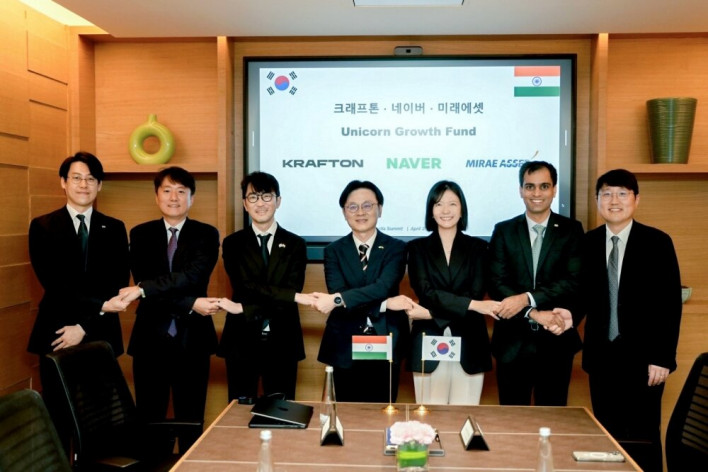
In April, Krafton partnered with Naver and Mirae Asset to launch the 'Unicorn Growth Fund (UGF),' a fund exceeding ₩500 billion, to invest in promising Indian companies, primarily in the AI, fintech, and content sectors.
This latest move differs from its previous role as an investor. It is seen as a signal that Krafton intends to become an operator that designs and manages its own payment services.
India is the world's largest UPI payment market, with monthly transaction volumes reaching into the billions. Domestic and international players like Google Pay, PhonePe, and Paytm are competing fiercely. For a foreign company to provide UPI-based payment services directly, it must obtain separate authorization under RBI regulations. It remains unconfirmed whether Krafton is pursuing this authorization directly or plans to structure its services through a partner.
Krafton previously envisioned a larger strategy for India: launching a 'super app' that would integrate an app store, voice chat, social media, and payment functions. The plan was to leverage the high brand recognition of BGMI to create a platform covering all aspects of daily life, similar to KakaoTalk or Tencent's QQ. However, this plan has reportedly been scaled back, though the specific reasons remain unknown.
The development of a specialized payment service has effectively taken the place of the super app strategy. It is possible that the company has reorganized its strategy to focus on independently developing payments, which was one of the core features of the original super app concept.