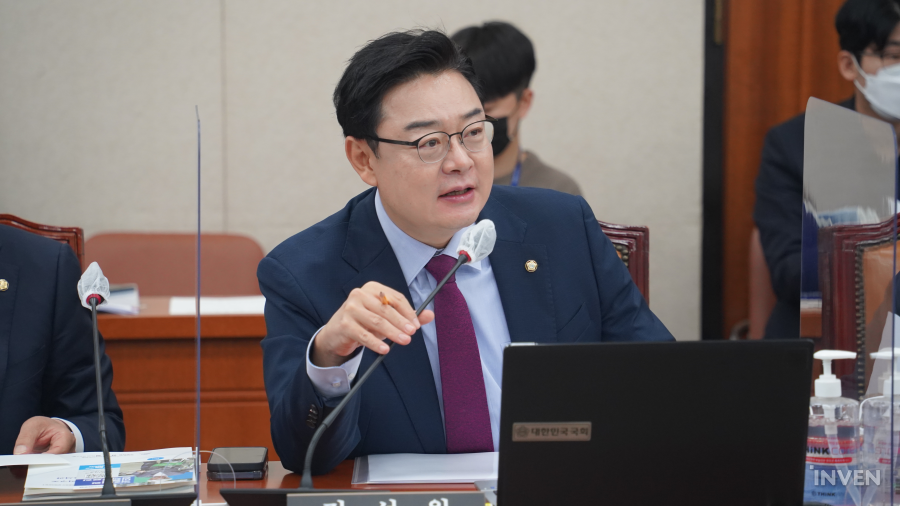
People Power Party lawmaker Kim Seong-won on the 4th introduced a partial amendment to the Game Industry Promotion Act as the lead sponsor, aiming to clearly spell out game-related operators’ obligations to protect user data.
Under the current law, there has been no explicit legal basis addressing the transfer of user information when a service is discontinued or when a contract ends. As a result, if an online game service is shut down or a contract between a game developer and a publisher is terminated, there is a risk that the usage records and payment information accumulated by users could be lost.
The proposed amendment would newly establish Article 14-2, requiring that users’ gameplay records and payment information be securely protected. If game service provision is halted or a contract ends, the operator must, with the user’s consent, engage in consultations and take measures necessary to transfer the relevant information.
Operators would not be permitted to refuse such consultations or measures without justifiable cause. The goal is to prevent user harm arising from disputes between businesses and to provide meaningful, practical protection for users’ rights and interests.
The backdrop to this legislative push is the recently surfaced dispute over Dragon Sword between HOUND13 and WEBZEN. As the issue—sparked by an alleged non-payment of a minimum guarantee (MG)—unfolded, concerns were raised about potential service disruption and the possibility of a change in publisher. In the process, new purchases were halted across the board and full refunds were announced, pushing the game’s service into a state where it effectively became non-functional in practice.
In connection with this, attorney Lee Cheol-woo, head of the Game Users Association, characterized the situation as a chronic structural vulnerability in Korea’s game industry. He argued that the industry must break the vicious cycle in which, whenever a cooperative project between a publisher and a small-to-mid-sized developer begins to fracture, users end up bearing the damage with no protective measures in place. The association also pointed out that similar issues have recurred—from last year’s controversies involving My Home for Kakao and Goddess Order to the recent Dragon Sword case—contending that a fundamental solution is needed.
With this amendment, if procedures such as a publisher transfer proceed after a dispute is resolved, it is expected that users’ data can be stored safely. The amendment is sponsored by Rep. Kim Seong-won as the lead, with Ahn Cheol-soo, Kim Seon-gyo, Lee In-seon, Koh Dong-jin, Kim Ye-ji, Park Chung-gwon, Jung Dong-man, Han Ki-ho, and Lee Jong-wook participating as co-sponsors.
This article was translated from the original that appeared on INVEN.