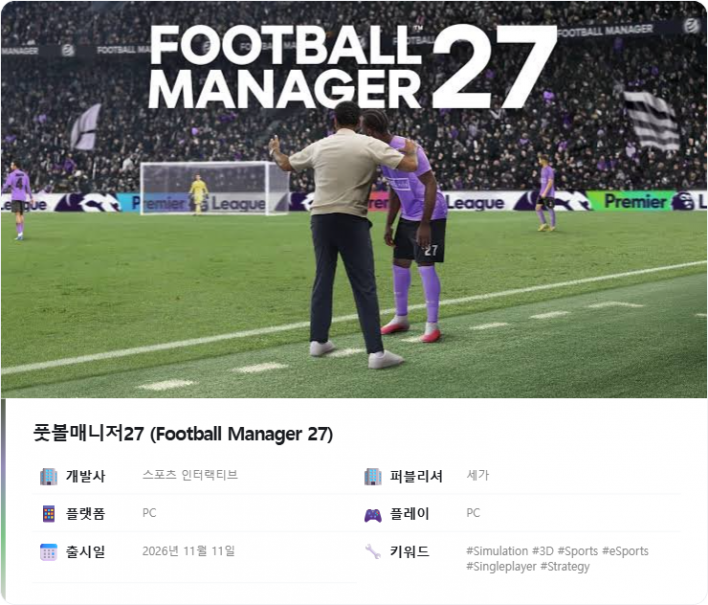
Officially released on the 11th, 'Football Manager 27' (hereafter FM27) is developer Sports Interactive's (SI) second main title since switching game engines to Unity. After the unprecedented turmoil of FM25's canceled release, last year's predecessor FM26 received unprecedented criticism from series fans. This was due to completely overhauling the long-standing user interface (UI) in the process of migrating to the Unity engine. The 'Football Manager (FM)' series revolves around exploring vast amounts of data and synthesizing it to build a better club. Simply losing one's way looking for menus created immense fatigue for players.
Determined to turn things around, SI conducted extensive overhaul work throughout FM26's live service. Even up to the final PC update in June, just four months ahead of FM27's launch, the team pushed out patch after patch in an effort to assuage player frustration. Built on nearly a year of accumulated fan feedback and continuous updates, the final product brought to the world is FM27.
In the automotive industry, there is a common saying that one should avoid buying the first year of a completely overhauled, redesigned model built on a new platform. Initial models designed from scratch inevitably suffer from various minor and major defects. Conversely, model year updates or facelifted versions released a year later—reflecting driver feedback—resolve most early flaws and deliver a far more stable, refined experience overall.
FM27 is likewise a new entry arriving after enduring a grueling year with the new engine. As such, expectations were high for improvements over its predecessor, and the game handsomely meets those expectations.
A UI Returned to a Familiar Layout Open a report to see the player; receive offers and compare them on the spot
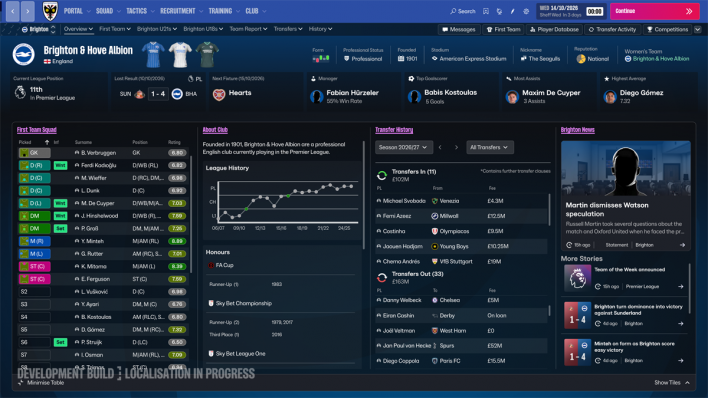
FM27's UI removes the tile-centric structure that tangled navigation in the predecessor and restores an intuitive top navigation system front and center. Core categories that managers use most—Portal, Squad, Tactics, Recruitment, Training, and Club—are arranged side-by-side at the top of the screen, with sub-menus designed below them to toggle between the First Team and Youth Teams. In the previous game, tiles scattered across the screen served as both information summaries and navigation links, forcing players to memorize which tile opened which window. This time, tiles are dedicated solely to reading information. For example, the Team Meeting button is placed on the Squad screen, and the Transfer Budget Adjustment button sits on the Recruitment screen. The inbox has also been overhauled so scout recommendation reports unpack directly inside the message body, and when multiple clubs bid for a single player, managers can compare terms at a glance within a single message. Quality-of-life additions have also been heavily reinforced, including bookmark reordering, key remapping, and setting how frequently the 'Continue' button pauses on news and inbox items.
In an interview held before launch at GGX in Dongdaemun, Seoul, the developers highlighted the rationale behind the UI overhaul. Rémy Boicherot, Associate Game Director at Sports Interactive, cited 'efficiency, familiarity, and predictability' as the three main criteria for this redesign. Director Boicherot explained that while some players preferred FM26's tile layout, they retained its advantages while broadly adopting the controls familiar to long-time fans. Noting that no one wants to relearn how to use chopsticks every time they visit a new restaurant, he stressed, "What matters is the food, and what matters to us is the gameplay." In other words, players must be able to predict which screen will open when clicking a menu so their gameplay flow remains uninterrupted.
Indeed, the first impression upon encountering the updated UI is undeniably 'familiarity.' With the return of the familiar screen layout and control flow, managing the game feels much smoother. Quite a few players skipped FM26 and stayed with FM24 because they couldn't adapt to the previous game's unfamiliar UI, but for managers whose sole barrier was the interface, this edition is good enough to switch without hesitation.
New features blend seamlessly into this familiar backbone. Comparing multiple transfer offers in the inbox simultaneously or reading scout reports that unfold immediately feels fluid and makes gathering information effortless. Additionally, the return of real-time in-match heatmaps, pitch coverage areas, and player pass networks (pass maps) inside the Data Hub—which were missing at FM26's launch to much player uproar—from day one is a welcome sight.
At the same time, the benefits of the engine switch experienced in FM26 have been fully preserved. Loading speeds when processing game data feel crisp, and tables and lists scale seamlessly to fit whatever monitor size or resolution you use. While individual layout preferences may vary, the navigational stress that was the biggest barrier to entry in the previous title has been effectively eliminated.
Match Visuals and Graphics The weight of a goal resonates all the way to the stands
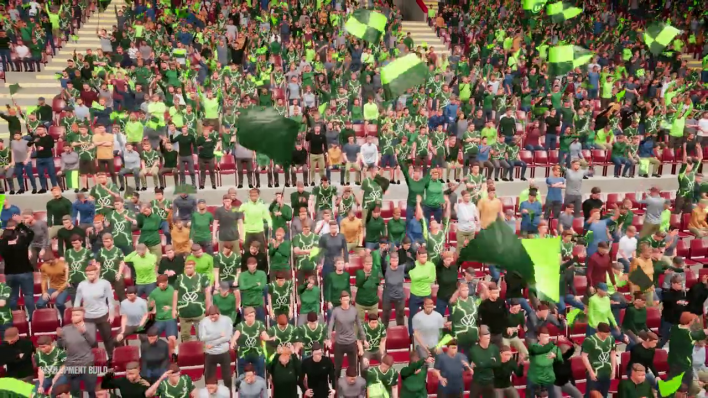
Matchday visuals and stadium graphics have also gained significant polish. Time progression and weather changes are reflected in stadium scenery in real time. Afternoon kickoffs transitioning into the second half see the sun dip as floodlights switch on naturally, while cleared pitch grass gradually accumulates snow over the 90 minutes. Architecturally, stands and roofs vary more widely across stadiums, and camera angles during player walkouts adjust according to match importance. On the pitch, attacker feints as well as defender jockeying and physical battle animations have been heavily enhanced using real match footage and new motion-capture data. Furthermore, the flow of play between attack and defense looks far more natural.
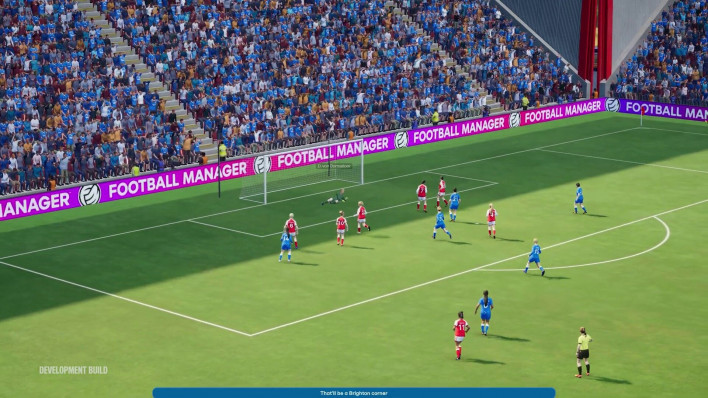
The area the developers poured the most effort into for this visual update is the crowd filling the stadium. Director Boicherot stated that the art and animation team's top priority was improving crowd representation, explaining that details ranging from what clothes fans wear to where supporters of the same team are seated together were painstakingly refined. Andrew Sinclair, Senior PR & Product Executive, who joined the interview, added that spectator clothing reflects season and weather conditions, meaning matchday stands look markedly different between midsummer fixtures and rainy or freezing winter matches.
Playing through matches directly, the most striking visual change is undoubtedly in the stands. In FM26, spectators felt like static background dressing, as if the development team lacked the bandwidth beyond rendering on-pitch graphics. In FM27, however, fans don matching club kits and wave flags, while the position and colors of away sections stand out clearly from home areas. Notably, when a team is suffering a heavy defeat, disappointed fans can even be seen packing up and leaving the stadium before the final whistle.
Truth be told, player motion and match rendering in FM26 were already significantly improved over earlier titles, making pitch action decent to watch. With FM27 adding vibrant life around the stadium perimeter and stands, it finally feels like managing a real football match. Elevating immersion by allowing managers to feel the weight of victory or defeat through crowd reactions is a genuinely welcome upgrade.
Tactical Depth Tactical Effectiveness changes everything from training schedules to the transfer market
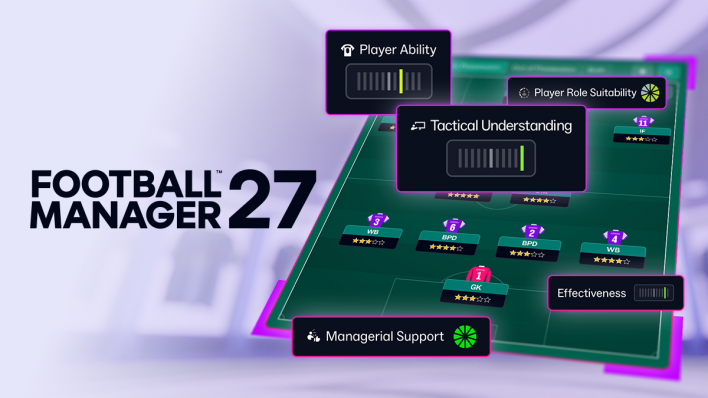
In the tactical system, a new 'Tactical Effectiveness' mechanic has been introduced to replace the former 'Tactical Familiarity.' Tactical Effectiveness is calculated by comprehensively evaluating players' comprehension of tactical instructions, their individual ability to carry out specific roles and positions, their adaptability to the manager's philosophy, and pre-match intelligence gathered on upcoming opponents. Giving more detailed instructions to the squad and individual players increases 'Tactical Complexity,' and to match this, dedicated first-team training sessions have been added to refine specific matchday movements such as high pressing or playing out from the back. Scout reports also allow managers to see in advance how well a target fits into their current tactical setup.
Director Boicherot explained that the simple familiarity system of the past failed to capture the intricate process of a manager instilling their vision into players and having them execute it on the pitch. For instance, wanting to play a counter-pressing style—winning the ball back immediately after losing it—takes only seconds with a button click on the tactics board. In real football, however, when the first player steps up to press, teammates must be prepared to close gaps and offer cover. Director Boicherot emphasized that if team cohesion is not yet mature, managers must assign pressing sessions in weekly training; if a tactic exceeds the current squad's capacity, managers must scale back instructions or seek players with high tactical intelligence in the next transfer window—a decision-making chain he wanted to bring into the game.
Experiencing the Tactical Effectiveness system firsthand, it definitely raises the bar. Previously, once Tactical Familiarity was maxed out, players could run a single proven 'overpowered tactic' for seasons on end without making major adjustments. Now, for a tactic to unleash its full potency, managers must manage training schedules, team cohesion, player attribute nuances, and Tactical Complexity across multiple dimensions. With more variables demanding attention, the game feels noticeably more challenging.
On the positive side, it feels much closer to being a real manager. Rather than leaving a set tactic on autopilot, adjusting training and tweaking instructions based on opponent and squad conditions provides satisfying hands-on control. However, as a newly introduced mechanic, opinion among players may divide over time. Even minor tactical adjustments can cause effectiveness to wobble, leading to frustrating transition periods, while managers who enjoy frequent tactical tweaks might find it tiresome. It is too early to pass final judgment. As an inaugural feature, balance hiccups and early flaws are inevitable, and upcoming patches will determine whether this system becomes a valuable asset for the franchise.
From Tactics Boards to Managerial Wallets: FM27 Expanded by Mods Coaches reading tactics, managers spending salaries, and AI mods answering journalists in your own words

The FM series has traditionally enjoyed an inseparable relationship with user-created mods. Before embarking on a new save, installing various mods—such as 'facepacks' for real player portraits, graphic patches for club crests and competition logos, and font or skin color tweaks for readability—has long been a rite of passage for veteran fans.
The developers are well aware of this community ecosystem's value. In the interview, Sinclair noted that SI is fully aware of how passionately fans enjoy custom skins and mods. He drew a clear line, stating that while official mod support is difficult for the studio due to complex IP and licensing ties with numerous clubs and leagues, SI has no intention of intentionally blocking or restricting voluntary modding by players.
With this open environment combining with recent technological trends, the FM27 community is seeing a steady stream of clever, useful mods previously unimaginable. For interface customization, even though default controls became smoother with top menus restored, die-hard fans attached to the legacy vertical left sidebar saw fast-emerging skins that restore FM24-style navigation. Broadcast-style overlays for club management immersion and editor-based utility tools are also being selectively adopted according to player preference.
Above all, the most striking shift is the emergence of mods integrating generative AI. A prime example is 'RegenerateFM,' which renders portraits for generated youth players (regens). Beyond generating high-quality AI portraits based on nationality, appearance, and physical build for wonderkids in deep saves, it automatically updates portraits as players age or transfer—adding facial hair or a more mature look. It lets managers track a teenager signed at 18 maturing into a 30-something veteran right through their profile photos.


Interactive AI mods drawing passionate responses among domestic players are also transforming the game. Powered by the real-time editor 'FMLE,' the AI head analyst 'Eri' reads squad data from active save files in real time. Opening the chat window via hotkey while viewing the squad list allows managers to inquire about key player contract renewals or replacement recommendations, receiving tailored analysis and transfer targets suited to the club's financial and tactical status.
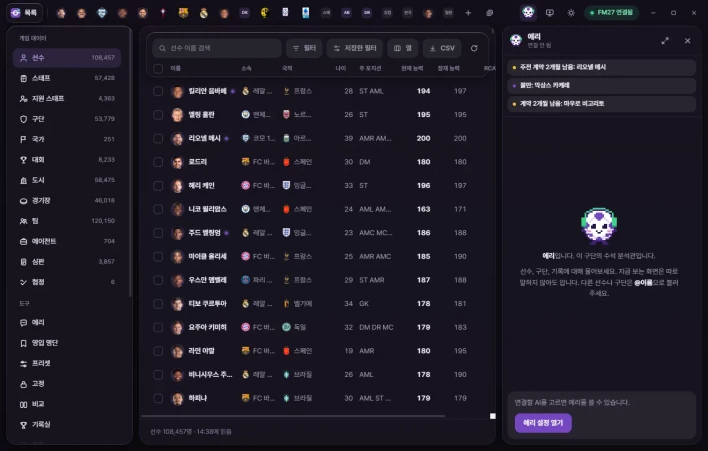
Furthermore, 'AI FM Chat' expands press conferences and team talks—previously limited to fixed dialog options—into fully custom player input. Operating via external APIs or paid subscription models without directly altering save file values, journalists and players respond dynamically in context to words managers type or speak, generating custom news articles and fan commentary in return. It opens a perfect role-playing stage for managers seeking more depth than pre-set text.
These evolving mods meticulously fill niche preferences that the base game cannot fully cover. FM27 has reclaimed its foundational strength as a 'football management simulator base' with a familiar UI and crisp optimization, ushering in an era where players can layer their preferred mods on top to craft a near-perfect experience.
Remarkably, all of this unfolded early during the pre-launch early access period. With global modders joining in earnest following the official release on the 11th, it is hard to even fathom how many more diverse and inventive mods will surface. The core foundation has been solidly refined, and a stage has been set for every manager to customize their experience through endless mods. Even fans who hesitated after last year's harsh reception are encouraged to pick up FM27 and experience the evolved thrill of football simulation.
- Menu layout that FM24 players can adapt to in no time
- Atmosphere elevated by home/away sections and dynamic crowd reactions
- The golden era of FM mods ushered in by AI
- Steeper learning curve for newly introduced tactical changes
- Added workload of managing both training and tactical adaptation simultaneously
Review Platform: PC (Full Release)