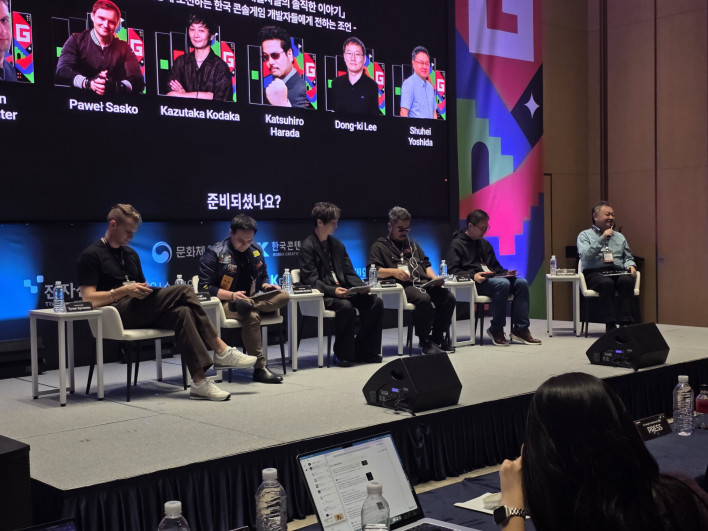
As the Korean gaming industry, which has grown predominantly around PC and mobile, expands its footprint into the console market, six globally proven developers gathered in one place to candidly share the realities and technical insights of console game development. The discussion took place as the closing session of the global track at the 'Console Game Developers Conference 2026', held on the 9th at the SKY31 Convention in Lotte World Tower, Seoul.
The panel discussion was moderated by Shuhei Yoshida, former Head of Indies Initiative at Sony Interactive Entertainment (SIE) and currently founder of Yosp and advisor for indie publishers and developers. Joining as panelists were Shift Up CTO DongKi Lee ('Stellar Blade'), VS Studio CEO Katsuhiro Harada ('Tekken' series), Too Kyo Games CEO Kazutaka Kodaka ('Danganronpa' series), CD Projekt Red (CDPR) Associate Game Director Paweł Sasko ('Cyberpunk 2077'), and Ludeon Studios CEO Tynan Sylvester ('RimWorld'), who engaged in an unreserved conversation covering multiplatform design standards, optimization trade-offs, and advice for Korean console games.
What kind of games have you developed so far, and from what background did you enter console game development?
" Shift Up CTO DongKi Lee: I have been developing PC MMORPGs and mobile games since the early 2000s, and 'Stellar Blade' is my first console title. I think I have followed a development path very similar to many Korean developers.
" VS Studio CEO Katsuhiro Harada: I have worked as a developer since the original PlayStation era, mainly producing the 'Tekken' series, 'Soulcalibur', some VR software, and various other titles.
" Too Kyo Games CEO Kazutaka Kodaka: I have been making narrative-driven games, including the 'Danganronpa' series. I've mostly produced games of a somewhat subtle scale—neither strictly indie nor AAA, but roughly Single-A or Double-A.
" CDPR Associate Game Director Paweł Sasko: I've been in the industry for just over 20 years. Even before joining CDPR, I worked on several PC and console games, and at CDPR, I've handled every single platform including Switch, Mac, PlayStation, Xbox, and PC.
" Ludeon Studios CEO Tynan Sylvester: I developed 'RimWorld' as a PC game back in 2013. When we later released the console version, I was involved in rebuilding the entire UI system from scratch to fit the console environment.
Most developers build games with multiplatform releases in mind. What did you use as your main lead platform, and what was the reason for that choice?
" CTO DongKi Lee: We envisioned multiplatform right from the start of development. We connected when former Head Shuhei Yoshida visited Shift Up, leading to our initial launch as a PlayStation exclusive, but our goal was always to deliver the same game experience and charm across all platforms.
However, looking at the actual development workflow, all developers work in PC environments, so we set up the PC environment first before starting development. These days, thanks to DualSense driver support, features like haptic feedback can be implemented fully on PC as well. Starting from PC and expanding one platform at a time allows you to create multiplatform games without major hurdles.
" CEO Harada: Since 2009, we've covered Xbox, PC, and Nintendo platforms, but from the 1990s up until around 2008, our team worked so closely with Sony—almost feeling a political bond as we fought alongside them against Sega and Nintendo—that PlayStation was always our baseline. The release order put arcades first followed by home PlayStation consoles, but the core design had to fit home hardware specs. Arcade boards had twice as much memory as the PlayStation, so even if we relied on arcade performance, we designed around PlayStation as the baseline so we could downscale (reduce) for home consoles later.
Even with recent 'Tekken' titles spanning PC, console, and arcade, everything is still designed around consoles. The reason is clear: whether it's Xbox or PlayStation, consoles have strict, detailed usability regulations like 'you cannot leave the screen completely blank for more than a set number of seconds.' If you adhere strictly to these guidelines, porting to any platform goes smoothly with nothing missing, enabling user-friendly option design.
" CEO Kodaka: While we also build PC versions recently, our revenue splits roughly one-third in Japan, one-third in China, and one-third in the US. Because Japan makes up a high proportion and physical (boxed) copies sell very well there, our business model revolves around attaching store-exclusive bonuses to physical releases for character-driven games that resemble anime or manga. Although we release Steam and digital download versions, our heaviest focus remains on console physical editions.
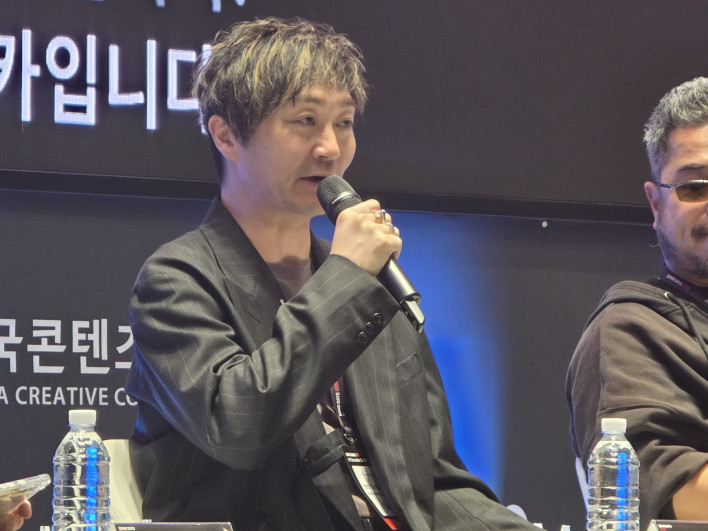
Physical versions require submitting the master build much earlier. Does factoring this into the schedule make it easier to launch other versions?
" CEO Kodaka: It does, but nowadays 'patches' exist (laughs). Honestly, we approach it with the mindset of finalizing the master via patches. Collector's editions in North America or Europe take an enormous amount of time to pack with figures, so the master submission deadline is absurdly early. To be frank, we sometimes submit builds where we think, "No one should ever play it in this state." We barely pass platform certification requirements and release it while believing no one plays games without an internet connection these days.
" Moderator Shuhei Yoshida: You submit the disc master early, but in practice, you launch while praying no one plays that build and everyone downloads the Day 1 patch instead (laughs).
" CEO Kodaka: That's right. I'm not sure if I should be making such risky confessions in a venue like this (laughs).
CDPR releases on both PC and console. How do you determine your main lead platform?
" Director Paweł: Originally, PC-first development was our approach, but through the launch of 'Cyberpunk 2077', we learned the hard way how painful it is to adjust game scope to strict console guidelines. So now we've adopted the approach Harada mentioned: we build the game on PC, but we benchmark against the most restrictive rules of the lowest-spec platform among our targets. If we're targeting the Switch, the Switch becomes that standard.
Additionally, an approach that has worked well for CDPR is designing with high scalability in mind. For instance, on high-end PCs, we make it scale up according to hardware capabilities so players can fully enjoy path tracing and advanced lighting and reflections.
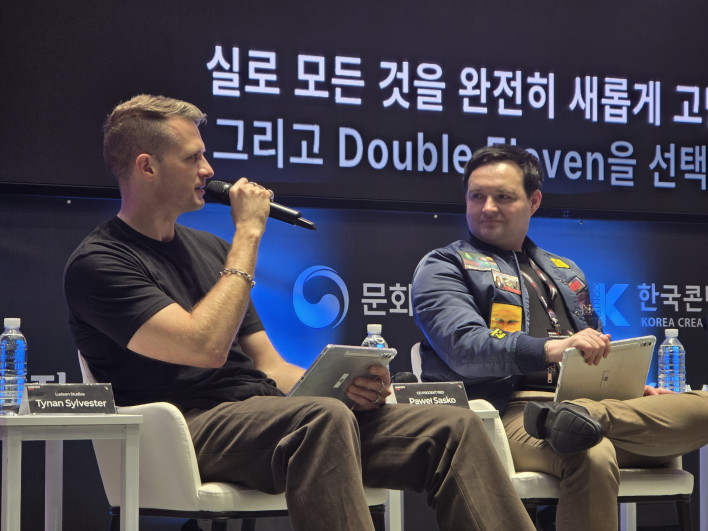
With performance gaps ranging from lower-spec hardware like Switch, Switch 2, or Xbox Series S to high-end PCs, do you have strategies to reliably ensure multiplatform releases?
" Director Paweł: A great strategy is to think from initial design about systems whose scale can be naturally adjusted. For example, in-game crowd density or vehicle traffic are easy elements to scale down organically. Reducing the number of vehicles and pedestrians even slightly delivers significant performance gains on certain platforms. Designing this in advance allows us to respond flexibly—like turning a knob—on both low-spec and high-end hardware, producing impressive visuals on any platform.
Recently, the Switch 2 version of 'Stellar Blade' was released looking gorgeous. Porting a game originally launched only on PS5 and PC without even a PS4 version to Switch 2 must have taken tremendous effort. Where did you place your focus, and were there internal disagreements over what to compromise on?
" CTO DongKi Lee: We didn't keep the Switch platform in mind from the beginning, but decided on the Switch 2 port during the process of expanding the game. As everyone knows, the Switch 2 falls behind the PS5 in performance. So we focused on balancing portable handheld play in bed with docked TV play to suit the hardware's nature. Even if we had to pare down visual details, our goal was to preserve the feeling of lying in bed and playing on a handheld device.
Rather than internal disputes, we focused on identifying where to scale back to boost performance while keeping overall quality intact. We cut back background details as much as possible, but we absolutely could not compromise on the rendering of the main character 'Eve'. We worked to avoid any compromises on Eve's polygon count, visual silhouette, and texture resolution. That said, it is unfortunate that hair rendering suffered somewhat as full-screen resolution dropped.
(Editor's Note: At the event, the simultaneous interpreter mistranslated the main character 'Eve (EVE)' as 'Chapter 2', leading moderator Yoshida to ask "What is Chapter 2?" Once cleared up, the panels burst into laughter.)
" Moderator Yoshida: It wasn't Chapter 2, but the protagonist 'Eve'! That means you never compromised on Eve's rear (laughs).
" CEO Harada: Well, they are the company that made 'Goddess of Victory: Nikke' (laughs). "We can never reduce the polygon count on the rear"—CEO Hyung-Tae Kim would never have allowed it.
" CTO DongKi Lee: CEO Hyung-Tae Kim, who excels at portraying attractive characters, along with our countless fans, wouldn't have tolerated it (laughs).
'RimWorld' was released first on PC and only came to consoles much later. Did you consider a console port during PC development, and what changed in the console version?
" CEO Tynan: During the first few years of the project, I couldn't imagine a console version at all. It was a game I started alone in my bedroom, a time when I was worrying about my immediate dinner rather than consoles (laughs). The console version was developed after the PC version was virtually finished, in collaboration with a UK studio called Double Eleven. They had experience porting 'Prison Architect' to consoles.
The two hardest parts of making the console version were: first, mandatory achievements. I held out against adding achievements to the PC version because I believed dictating goals to players blurs the self-directed goals they set for themselves. But on console, achievements are a mandatory launch requirement, so we struggled to design about 20 achievements that wouldn't distort player motivation.
Second was completely rebuilding the UI. On PC, you operate with a keyboard and mouse right in front of a high-resolution monitor, whereas on console, you play with a gamepad on a couch in the living room while looking at a TV from a distance. The viewing angles and screen space are entirely different, and tiny text becomes unreadable. We had to redesign everything from scratch so all operations worked using controller buttons without a mouse.
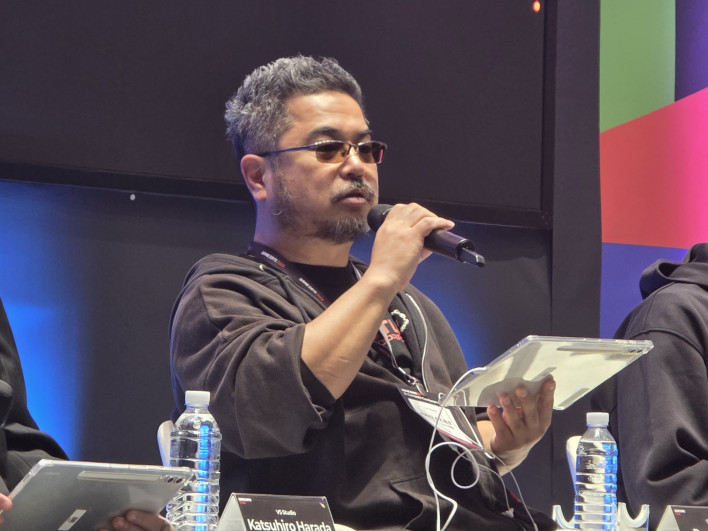
Conversely, what are the clear advantages of console platforms compared to PC, or the practical challenges you face during development with specific examples?
" CEO Harada: Rather than a development benefit, in fighting games like ours, consoles hold an overwhelming advantage when hosting esports tournaments. Hosting a tournament on PC requires setting up 100, 200, or up to 500 PCs with identical specifications at the venue, which is costly and prone to troubleshooting. In contrast, consoles offer standardized hardware that reduces tournament operation costs, provides stability, and allows players to practice at home on identical hardware.
That said, there's something I really want to say while I have the floor. Since a senior Xbox official is actually in attendance here today, I wish hardware like the 'Xbox Series S' wouldn't be released (laughs). I want to ask Director Paweł personally—honestly, weren't you upset inside because of Series S?
" Director Paweł: (bursts out laughing) It constantly throws challenges at us and forces us to optimize our code very cleanly.
" CEO Harada: You just used a very polite and elegant way to say "Xbox Series S sucks," right? (laughs) Low memory is an issue, but the hardest part is that it's a device so similar to Series X while having awkwardly lower performance. When porting to Switch 2, developers can shift their mindset to "Switch 2 is a distinct device for Nintendo fans!" But with Xbox, after delivering your absolute best output, it feels like having to do extra work for a slightly weaker child.
Furthermore, in markets like the US, there are more Series S users than Series X users, so we can't just cut corners. Yet after launch, Series S users direct their complaints at us developers rather than Microsoft, asking "Why is texture resolution lower only on Series S?"
" Director Paweł: Harada speaks a lot of truth. Players don't fully understand the technical context behind why fewer characters appear on screen or why visuals are downgraded. However, intensely optimizing for lower-spec platforms definitely brings the benefit of making the game run significantly better across all platforms—including PS5, high-end PCs, and handhelds like Steam Deck and ROG Ally. Recently, with Cyberpunk 2077 Version 2.5, we applied optimization breakthroughs gained while preparing the Switch 2 launch title (which involved a team of 80 to 100 people for over a year) back to all other platforms with great effect.
And the biggest advantage of Series S is that its affordable price makes it accessible. Not every gamer can buy expensive high-end hardware, so from a developer's perspective, even if the strict constraints are painful, there is a silver lining in expanding market penetration to deliver the game to more players.
" CEO Harada: Director Paweł packaged Series S so gracefully that the Microsoft representative in the audience keeps nodding along. I'm worried they'll feel reassured and release a successor like 'Helix S' for the next-gen Xbox as well (laughs).
" CTO DongKi Lee: Personally, I am looking forward to the next-gen Xbox 'Helix'. From an engineer's standpoint, if you provide us with a dev kit first in Korea as early as possible, we will put in our best efforts to develop for it.
Do you also notice differences in player preferences depending on the platform?
" CEO Kodaka: 'Danganronpa' originally debuted on the PSP, so many players enjoy it comfortably lying in bed like reading a book. While Steam (PC) feels like sitting upright in front of a monitor to play, handheld consoles like the Switch let players lounge around, which pairs very well with our games.
" CEO Tynan: The console version of 'RimWorld' reached a smaller audience than PC, but player preferences overlapped significantly. Players seeking a deep simulation where unanimated 2D characters bump into each other and wander around are a very specific niche of enthusiasts who exist across platforms, whether console or PC.
" CTO DongKi Lee: While mobile and PC players are accustomed to collection, competition, and progression, console players tend to focus a bit more on the intrinsic fun of in-game gameplay itself. Meanwhile, PC players enjoyed creating numerous mods, and the development team was amazed when users recently created a co-op multiplayer mod on their own. In addition, in China, where PC accessibility is higher than consoles, the PC version of 'Stellar Blade' resonated strongly when combined with our strengths in character design.
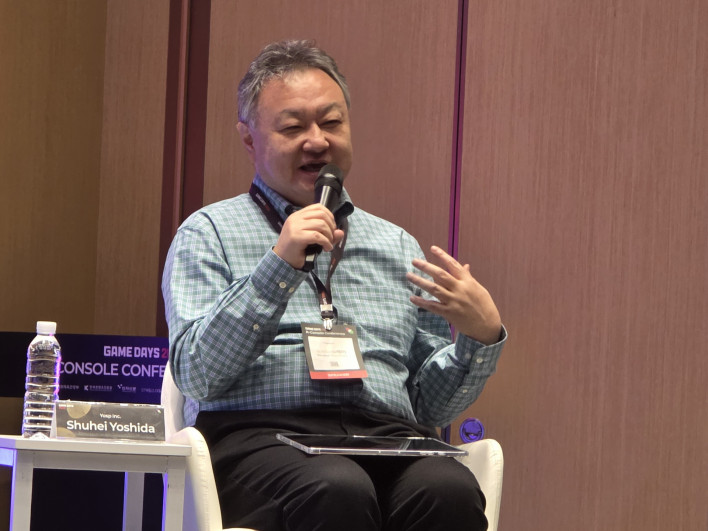
Lastly, besides 'Stellar Blade', what Korean console games left an impression on you, and what advice would you give to Korean console developers?
" CEO Kodaka: From indie-style titles like 'Dave the Diver' to blockbusters like 'Crimson Desert', a wide range of games is coming out, which I feel creates a really good balance. For my generation, Korea had a strong impression as a country of online games, but over the past few years, single-player console games have surged, showing tremendous momentum.
" Director Paweł: 'Crimson Desert' is a fantastic example of what could become one of Korea's first massive hit titles. Success breeds success, so I expect even more titles to emerge in the future.
Beyond that, I'd like to share the lesson CDPR learned when making 'The Witcher'. At the time, we constantly asked ourselves, "How can we make this the most Slavic game possible? How can we make it feel distinctly made in Poland?" That unique, distinct perspective became the secret to achieving worldwide popularity.
Korea has already led the cosmetics industry for decades and conquered the music industry with K-POP. Now, I believe the next breakthrough for Korean games lies in digging deeper into Korea's deeply rooted culture, history, political landscape, and unique standing in the world to find their own distinct angle.
" CEO Tynan: I completely agree with Director Paweł. However, one challenge is presenting that deeply rooted 'Koreanness' in a way that outsiders can digest. The Polish mythology embedded in 'The Witcher' maintained an appropriate distance from familiar Western fantasy tropes like British legends or 'The Lord of the Rings', coming across as fresh without being completely alien. Because Korean themes could potentially feel too unfamiliar to global audiences, I believe the key challenge lies in finding cross-cultural touchpoints that provide context while remaining fresh and intriguing to foreigners.
From opening ceremony to five sessions, panel, and game hands-on
Q&A on lead platform criteria, optimization, and porting experiences
Early English/gamepad support and the roles of AI and creativity
Designing quests driven by emotion and intent
Walls, autonomous living, and tactical combat carried over from failed projects
Validation process fixing ammo scarcity and combat telegraphing
Sustaining a long-standing IP through pricing, distribution, and community