TiMi Studio Group's 'Monster Hunter Outlanders' (hereinafter referred to as 'MH Outlanders') welcomed attendees at TGS 2026 once again this year, following its appearance last year. Having recently wrapped up its 3rd CBT, 'MH Outlanders' offered virtually no new content additions in its TGS 2026 build. Looking solely at its systems and content structure, it was practically identical to the previous CBT.
That is not to say there was nothing to see in this hands-on demo, however. Attendees were able to go head-to-head with Ruger Aidal, the recently revealed core monster and original Elder Dragon of 'MH Outlanders'. In this build, players could form up to a four-player party with NPC companion Adventurers to challenge Ruger Aidal, while also directly testing out the newly added Starter Mode and Adventure Mode.
Since the game's fundamentals have already been established through multiple CBTs, this impression focuses more on the changes felt during gameplay rather than revisiting every system from scratch. In particular, it examines how the two control schemes differ in actual hunts and what it feels like to battle Ruger Aidal, 'MH Outlanders'' flagship addition.
Prior to the hands-on session, a presentation provided a detailed introduction to 'MH Outlanders', spanning its world, key systems, Adventurers, and monsters. Here is a brief summary of what was shared during the presentation, followed by impressions from the hunt itself.
A New Protagonist: Adventurers, Not Hunters Inherits Hunter Combat Action, Differentiates with Crafting and Active Skills
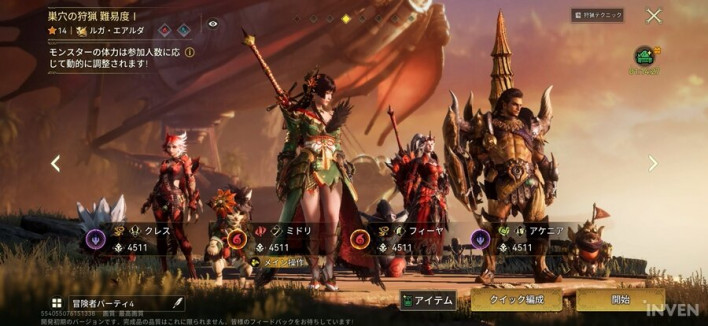
'Monster Hunter Outlanders' is a mobile title developed by TiMi Studio Group under official license from Capcom. Rather than playing as a traditional 'Hunter' from the main Monster Hunter series, players step into the role of an 'Adventurer' to hunt various monsters across Aesoland.
As a mobile game, it supports both single-player and multiplayer modes, and will be released as a free-to-play (F2P) title. Plans are also in place to continuously expand content through post-launch updates.
Four locales have currently been revealed on Aesoland, the primary setting of the game. Each locale features distinct environments and characteristics, allowing players to roam around the island to hunt monsters and explore. Additional locales will be added in future updates.
In particular, players can utilize the crafting system while exploring the field. For instance, players can set up ziplines in specific locations or place wind-generating devices to make traversal much more convenient. Once installed, these devices remain in place even after leaving and returning to the area, continuing to assist player exploration.
Various mini-games are also scattered across the map. By allowing players to enjoy a variety of mini-games alongside monster hunts, the overall gameplay experience is made much more diverse.
Enhanced Accessibility via Two Control Modes Adventure Mode for Deep Action, Starter Mode for Simplified Play
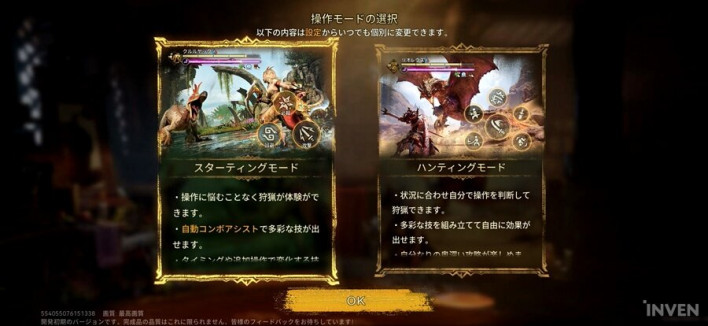
The hunting system offers two control options—Starter Mode and Adventure Mode—allowing players to choose based on their familiarity with action games.
Adventure Mode is based on traditional Monster Hunter controls, designed for players accustomed to mobile action titles. It maps the diverse attacks of each weapon class from previous games onto a button system, enabling players to execute a wider range of attacks on mobile. Taking the Long Sword as an example, separate buttons are assigned to overhead slashes and thrusts, allowing players to handle the weapon with a feel very similar to the original series.
Starter Mode is tailored for newcomers or players unfamiliar with mobile action controls. Its biggest feature is that, unlike traditional schemes that assign different buttons to specific animations, all attack animations are bound to a single attack button. Simply mashing the single attack button executes context-sensitive combos, while the overall control scheme centers on three main buttons—Attack, Dodge, and Ultimate—allowing players to perform various actions without complex inputs.
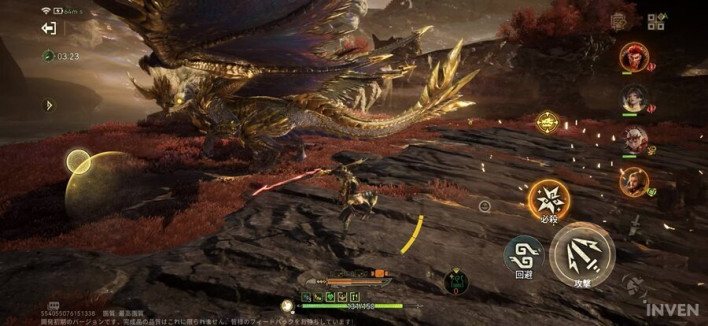
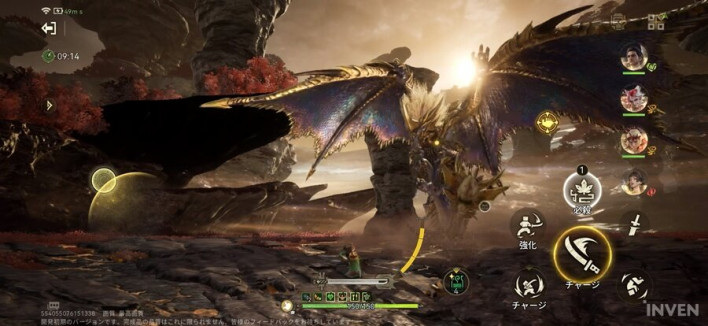
Hunting systems optimized for mobile devices are also in place. During a hunt, the camera automatically tracks the monster, and holding down the lock-on button brings up a radial menu. By steering the wheel, players can select targeted body parts such as the head, left/right wings, left/right forelegs, hind legs, or tail. However, selecting a part via the radial menu does not guarantee hits on that specific spot automatically. To land hits properly, players must still manually reposition themselves, just like in mainline Monster Hunter games.
To lower the difficulty curve on mobile, visual cues—such as monsters glowing prior to certain attacks—have been introduced. These act as telegraphs, making it easier for players to gauge attack timing and dodge accordingly.
7 Weapon Types and 3 Roles DPS-Style Assault, Debuffing Disruptor, and Support-Focused Support
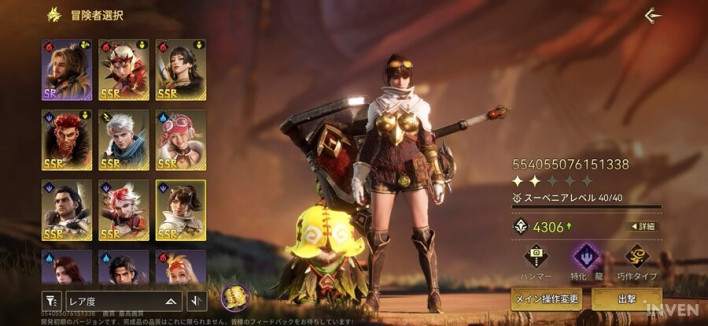
The main protagonist Adventurer introduced at the start is fully customizable and capable of wielding every weapon implemented in the game. A total of seven weapon types are currently available, with plans to continuously add more in future updates.
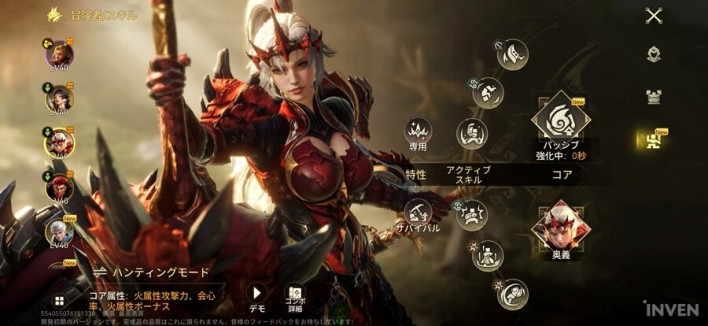
Adventurers fall into three primary role categories: Assault, which focuses on high damage output; Disruptor, which inflicts debuffs on monsters; and Support, which specializes in aiding allies.
Here, 'Adventurer' serves as the collective term for playable characters in this game, akin to how players and companions were called 'Hunters' in traditional Monster Hunter titles. In addition to the customizable base Adventurer, there are companion Adventurers with distinct personalities who have been highlighted across various trailers. These companion Adventurers can also be selected as playable characters.
The default protagonist Adventurer serves as the player's customizable avatar, offering complete freedom to swap weapons and roles. Companion Adventurers, on the other hand, feature limited customization but possess preset roles, weapon types, and unique Ultimate abilities (active skills), making them specialized for specific roles. Consequently, they can outperform the base Adventurer in certain situations.
A Roster of Returning and Original Monsters New Elder Dragon Ruger Aidal and Monster Hunter Online's Estrellian Join the Roster
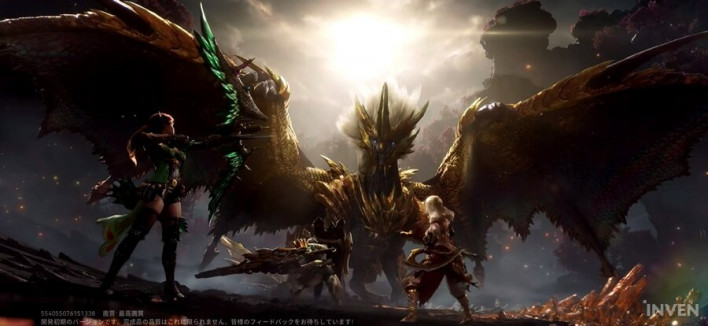
Monsters are naturally a cornerstone of 'Monster Hunter Outlanders'. In particular, players will encounter Radiant species—monsters transformed by the influence of a special substance found on Aesoland. Radiant monsters feature altered visual appearances and movement patterns compared to their original counterparts, along with distinct animations when casting certain attacks.
Alongside Radiant species, numerous returning monsters from across the Monster Hunter franchise make an appearance. Dozens of species were included as of the 3rd CBT, with more planned for post-launch updates.
Additionally, brand-new original monsters unique to this title will appear. The flagship addition is the Radiant Elder Dragon, Ruger Aidal, which was unveiled in a previous trailer. As the signature monster of 'Monster Hunter Outlanders', it boasts an appearance that looks as though it is clad in golden armor made of scales. Ruger Aidal occupies a central role in the game, and its background story—alongside the overall lore and narrative of Aesoland—will be fully revealed upon official launch.
The Original Elder Dragon: Ruger Aidal Testing Exclusive Attack Patterns — Less Bizarre Than Expected
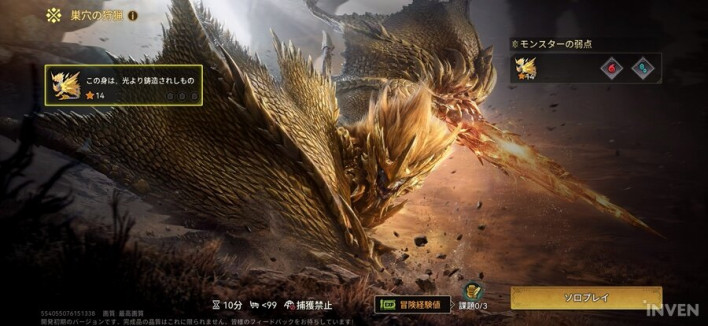
This hands-on demo consisted solely of a single hunt mission against Ruger Aidal. Before diving into the details of the hunt itself, let's examine the control scheme. Players could select between two options: the mobile-optimized Starter Mode or Adventure Mode, which closely resembles the traditional Monster Hunter control feel.
Truth be told, there were plenty of concerns prior to picking a control mode. Monster Hunter is known for requiring precise inputs—players regularly i-frame dodge monster attacks down to individual frames or roll through roars without Earplugs skills. However, those expectations stem from PC and console environments. Outside of 'MH Outlanders', touchscreen controls on mobile devices inherently struggle with precision. From accidental touch inputs to slowed reaction times caused by relying mostly on two thumbs, physical limitations are unavoidable.

As a result, there were genuine worries about whether 'MH Outlanders' could be played properly regardless of mode, or whether it had been oversimplified. Yet those concerns quickly vanished during gameplay: combat in 'MH Outlanders' felt surprisingly well-crafted. Because Adventure Mode stays faithful to classic Monster Hunter controls, playing Long Sword required alternating between two separate buttons to execute overhead slash → thrust → rising slash combos. Filling the Spirit Gauge required tapping a dedicated Spirit Blade button to level up the spirit gauge color—which kept fingers busy, but felt remarkably natural in execution.
Evading was similarly well-handled. Timely dodging is crucial in Monster Hunter, and likely owing to the mobile platform, dodge invulnerability windows felt fairly generous. This made successful dodges feel extremely satisfying, giving players the impression of flawless execution. What personally stood out was the brief slow-motion effect triggered upon a successful dodge, providing instant, intuitive feedback that the attack was successfully evaded.
The lock-on feature was another welcome addition. Holding down the lock-on button opens a radial wheel showing targetable body parts—head, left/right wings, left/right forelegs, hind legs, and tail. Being able to select target parts freely made focusing on specific monster hitzones manageable even on a touchscreen.

Starter Mode, on the other hand, compresses multiple attack inputs into a single button. While the Long Sword in Adventure Mode requires two buttons for overhead slash → thrust → rising slash plus a separate Spirit Blade button, Starter Mode handles all of this with one button. Simply tapping the attack button three times automatically strings together the overhead slash → thrust → rising slash combo.
Up to this point, everything worked smoothly. The issue arose afterward. In this playtest, Starter Mode was paired with the companion Adventurer Ryunosuke, who turned out to be far more unique than anticipated.
It was already known that companion Adventurers feature distinct visual designs, active skills, and ultimate abilities rather than standard Monster Hunter armor skills. Still, one expected them to adhere somewhat to base weapon playstyles. Midori, revealed earlier, is a prime example: a classic Yamato Nadeshiko-style character wielding a Long Sword who uses an exclusive skill instead of standard Spirit Blade strikes to expend gauge levels on timed iai draw attacks. In essence, her Spirit Blade is replaced by draw attacks, keeping her control feel in Adventure Mode largely consistent with base Long Sword. Ryunosuke, however, was a completely different story.

To begin with, his attack animations were entirely different. Whether this stemmed from Starter Mode or Ryunosuke's personal moveset was unclear, but instead of the expected overhead slash → thrust → rising slash combo, he suddenly paused mid-combo to perform a unique animation that looked like eating meat, leaving one wondering if a completely different weapon was being used. If it were merely a visual difference it would have been fine, but mashing the single attack button under the assumption of continuous attacks triggered unexpected skill animations that left vulnerable openings, making the initial experience somewhat jarring.

Ultimate abilities were activated by tapping the character portrait in the top right corner of the screen. As combat progresses, a gauge builds around the portrait, allowing the ability to be unleashed once fully charged. These abilities were universally potent, with some guaranteeing a major flinch on the monster. Depending on the situation, they serve as excellent tools to interrupt specific monster attack patterns or create offensive windows.

Meanwhile, a welcome improvement regarding Ultimates was noted: the cutscene presentation. Previously, unleashing an Ultimate triggered full-screen cutscenes reminiscent of anime action RPGs, which disrupted combat pacing. In this build, it was redesigned into a small character camera PIP in the top left corner. Maintaining skill visibility without interrupting combat flow felt like a clear step forward.
Telegraphed attack patterns were another positive addition. While dodge timings are generous, players can still miss subtle wind-up animations due to the nature of mobile screens. As a countermeasure, 'MH Outlanders' provides clear visual telegraphs before monster attacks. Put simply, monsters glow red prior to attacking, giving players an intuitive indicator that it is time to dodge.
That said, the system was not 100% flawless. Visual cues did not always immediately precede the actual strike. While some attacks followed instantly, others involved flying into the air before charging. The issue was that the red telegraph appeared while on the ground before taking flight, rather than right before the aerial charge itself. This occasionally created confusion around dodge timing. Still, this feels like something easily tuned through future timing adjustments rather than a fatal flaw. Overall, having an early warning system for incoming danger remains a welcome feature.
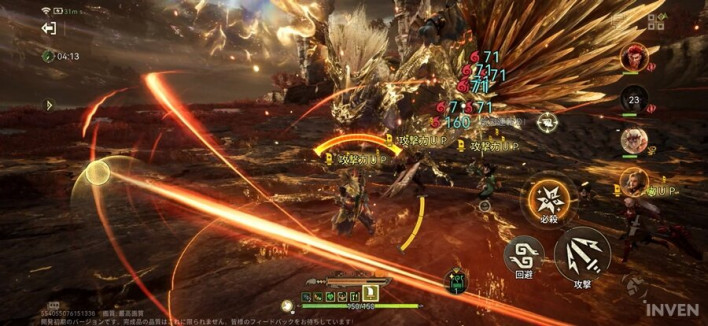
When it comes to Ruger Aidal, it is better to focus on its most defining attack patterns rather than listing minor moves one by one. Detailing every move—such as swiping three times with its forelegs before a sudden tail swipe—would hardly offer much insight in a hands-on impression.
Before delving into attack patterns, its visual design—which drew criticism upon its initial reveal—did not feel nearly as strange in-game as expected. While the smaller mobile screen makes fine details less obvious, the awkward impression from early previews was diminished thanks to improved angles and framing. If anything, the intended concept of a "golden-armored Elder Dragon" stood out much more prominently.
Two signature attack patterns defined the fight with Ruger Aidal. The first involved its wingarms, which formed spear-like constructs out of golden crystals to thrust forward. Getting hit by this attack was devastating enough to cause an instant faint.

A unique aspect of this move is the ability to trigger a counter-attack. Attacking right as Ruger Aidal strikes initiates a parry/counter animation that shatters the crystal spear and inflicts a major flinch on the dragon. Rather than simply dodging a high-damage attack, landing a well-timed counter turns a threat into a major offensive opportunity.
The second signature move was a wipe-mechanic attack. Ruger Aidal takes to the sky and begins charging energy; failing to deal sufficient damage within a given timeframe to interrupt the charge results in a party-wiping attack.
In summary, this hands-on session demonstrated that extensive thought went into adapting 'Monster Hunter Outlanders' for mobile platforms. Some purists may still worry that mobile devices cannot capture the core Monster Hunter experience, or dismiss the inclusion of companion Ultimates by asking, "How can it be Monster Hunter if you're using active skills?"
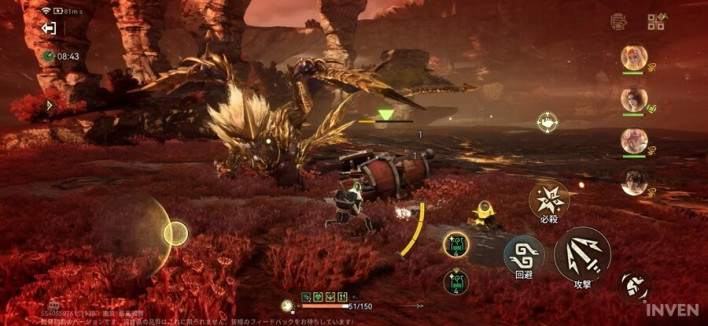
Setting personal preferences aside, 'MH Outlanders' delivered combat worthy of the Monster Hunter name—at least in this demo build. The core thrill of facing formidable monsters with complex attack patterns while managing offensive and defensive timing remained faithfully intact. The additions designed for mobile convenience—such as control options, attack telegraphs, and lock-on targeting—were equally impressive.
'MH Outlanders' has entered its final polish ahead of its global release on October 29. Reassuringly, most grievances noted during this session felt like areas for fine-tuning rather than fundamental flaws. While elements like telegraph timing could use refinement, there is ample time before launch to make those adjustments.
It remains to be seen how well the launch version will address these minor flaws and what final shape this mobile Monster Hunter experience will take.