Crystal Dynamics and Amazon Game Studios have released new info for Tomb Raider: Legacy of Atlantis, this time looking at how the team rebuilt the game's Egypt level.
Legacy of Atlantis is a reimagining of Lara Croft's first adventure, the original Tomb Raider, which launched in 1996. Egypt was one of that game's best-known locations. It was also the level shown off during a recent Nintendo Direct, Nintendo's online showcase for upcoming games.
The new video is the tenth episode in the series. Earlier episodes covered the game's versions of Peru and Greece, its puzzles and traps, combat, traversal and the characters of Lara and Natla. "Egypt will be recognizable," said Jeff Adams, Experience Director at Crystal Dynamics, according to a release. "There's going to be a lot of locations that fans will see from the first game. We have made some creative choices here and there to not only make sure it's respectful but furthering the story we're telling."
Crystal Dynamics, the US studio that has developed the Tomb Raider series since 2006's Tomb Raider: Legend, said Egypt is where the game's larger story starts to open up. "By the time Lara reaches Egypt, she knows there is a larger story to uncover, but Egypt begins to reveal just how deep that story goes," John Stafford, Narrative Director at Crystal Dynamics, said in a blog post accompanying the video.
New puzzles built around Egyptian gods
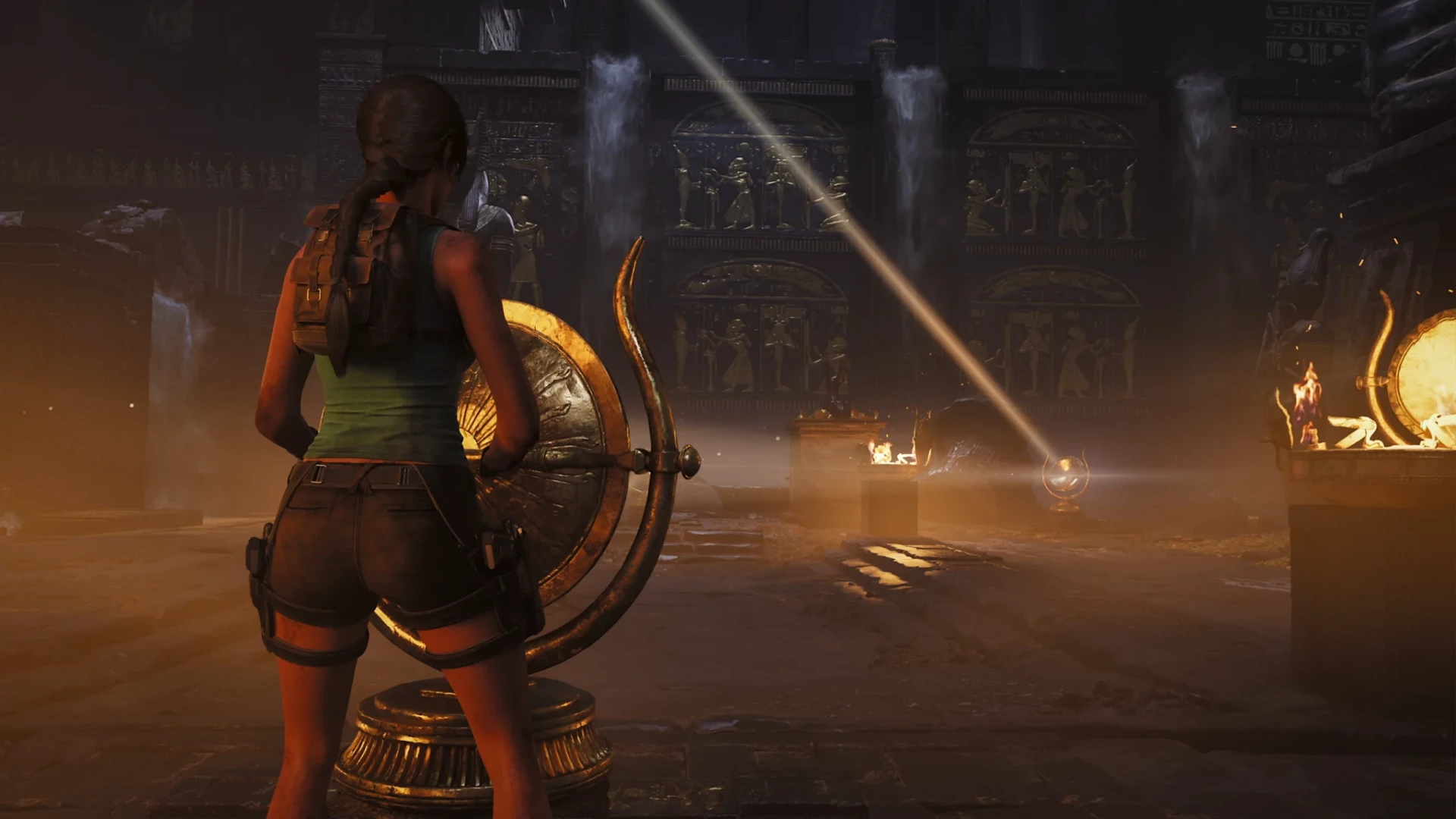
According to the studio, Egypt will be the most puzzle-heavy area of the game, as it was in the original.
"In keeping with the original, Egypt is the most intellectually challenging of the Atlantis levels," said Jason Epps, Design Director at Crystal Dynamics. "The puzzles are more complex and involved. Unlike the original game, we have recreated new puzzles centered around the Egyptian pantheon, to remove a lot of repetition."
Epps added that where Peru and Greece focus on open views, Egypt has players moving through a ruined complex of narrow tunnels that lead into large chambers. One example he gave was a temple to Anubis, the god said to weigh the hearts of the dead, where Lara must raise and lower a set of scales to move forward.
Raul Siqueira, Game Director at Crystal Dynamics, acknowledged that the setting is familiar ground. "Egypt has been done before, so we're not charting new territory," he said. "But the way we do Egypt is what makes it unique."
A city that never existed
Polish developer Flying Wild Hog, best known for its Shadow Warrior games, also worked on the level.
In the documentary, Mateusz Dzięcioł, Level Designer at Flying Wild Hog, explained that the team's research into the city of Kamun (spelled Khamoon in the 1996 game) turned up very little. After going through a large number of books and sources, including interviews with the original developers, he concluded that Kamun had been invented for the first game.
Dzięcioł said his aim was to make the level feel like a real dig. "You find the leftovers of robbers, so you know you're not the first one there," he said.
He picked out the Osiris trial, a trap-and-puzzle room based on the myth of the god being cut into pieces, as the part he was proudest of. "There is a story, there is a trap, there is a puzzle, and everything combined into one cohesive piece," he said.
The team also said it studied the meaning of the hieroglyphs used in the level so they would read correctly. In the video, one developer explained that the symbols were carved directly into the level's geometry, so light catches and reflects off them.
Tomb Raider: Legacy of Atlantis will launch on February 12th 2027 on PlayStation 5, Xbox Series X|S, Steam and Nintendo Switch 2. Pre-orders are live for Standard and Deluxe editions. Crystal Dynamics has said more mini-documentaries will follow in the months before launch.