The K-Content Industry Council, uniting Korean organizations across all content genres, officially launched by holding a vision declaration ceremony at the National Assembly, setting concrete targets to achieve 220 trillion won in industry revenue and $27 billion in exports by 2030.
On Tuesday, September 15, the Council held the "K-Culture 400 Trillion, K-Content 220 Trillion Vision Declaration Ceremony" in the main auditorium of the National Assembly Members' Building, hosted by Lee Jae-jung, Chair of the National Assembly's Culture, Sports and Tourism Committee, and sponsored by the Ministry of Culture, Sports and Tourism. Through this event, 11 industry associations spanning games, film, and other sectors officially converted the voluntary body established in May 2025 into a formal council. According to the unveiled "K-Content 220 Trillion 2030 Vision Report," the industry's ultimate targets for 2030 were set at 220 trillion won in revenue, $27 billion in exports, 750,000 employees, and 146,000 companies.
This scale requires an average annual growth rate of 6.4 percent based on the projected 2025 revenue of 161.5 trillion won. The export sector in particular aims for an average annual growth of 12.6 percent—double the rate of overall revenue growth—demonstrating a strong drive to expand into overseas markets. This figure accounts for a massive 55 percent of the government's national agenda target of "K-Culture 400 Trillion". The Council stated, "Content is the core engine of K-culture, and K-culture cannot grow without the growth of the content industry." It also plans to review annual performance based on officially approved statistics from the Korea Creative Content Agency (KOCCA) and publish a "K-Content 220 Trillion Implementation Progress Report."
A realistic analysis was also presented, indicating that reaching these massive numerical targets would be difficult under current policy directions. If the budget remains at its current level, projected revenue for 2030 will reach only 205.9 trillion won, falling short by 13.3 trillion won; even if the budget increases by 10 percent annually, revenue would only reach 215.3 trillion won, leaving a deficit of 3.9 trillion won. The export target would also fall short by $7.8 billion even under the assumption of a 10 percent annual budget increase.
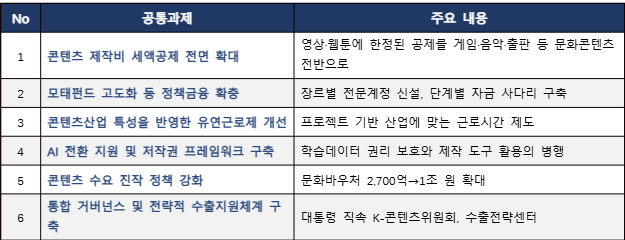
Taking the stage as presenter, Kim Seung-wook, Executive Director of Policy at the Korean Publishers Association, emphasized, "Failing to reach the target even with a 10% annual budget increase means financial investment alone cannot achieve this goal. Bridging the gap requires designing a policy mix that integrates fiscal, tax, financial, and legal frameworks". He added, "The solution is not merely expanding existing projects, but shifting the paradigm. While the industry proposed the goal, the conditions to achieve it must be created together by the government and the National Assembly. Once these conditions are met, 220 trillion won becomes an achievable target." To this end, the Council proposed a comprehensive overhaul in tax, finance, and legal affairs, along with six key shared policy tasks.
Event host Lee Jae-jung, Chair of the National Assembly's Culture, Sports and Tourism Committee, said, "This is a meaningful occasion where 11 content industry associations, having grown in their respective fields, gather together for the first time to discuss the future of the entire content industry. What matters is not the numbers themselves, but the industrial foundation that will actually generate that growth". She noted, "Institutional systems built around CRT displays and arcade games cannot function in the same way in the era of AI, OTT, and global platforms. We must carefully inspect whether any regulations have lost their effectiveness or are unnecessarily blocking new endeavors in this changed environment." She also promised, "I will closely review the visions and policy proposals presented today, and ensure the National Assembly fulfills its role so that necessary legislation, budget allocations, and institutional improvements follow."
Kim Young-soo, First Vice Minister of Culture, Sports and Tourism, similarly remarked, "In an era where a single IP expands infinitely, new opportunities are created when we break down boundaries between genres, connect organically, and combine boldly." He asked the Council to serve as "a channel of communication gathering diverse voices, a bridge leading cross-genre collaboration, and a reliable partner connecting the government and the industry." Vice Minister Kim emphasized, "We believe that our target of 'K-Culture 400 Trillion' is far from easy, but entirely achievable. Reflecting this commitment, the Ministry of Culture, Sports and Tourism's proposed budget for next year has been set at a scale 22.6% higher than this year's." He added, "We will actively support global expansion and adaptation to new technologies by creating an industrial environment where creators can freely take on challenges and companies can operate without constraints."
In the second half of the event, co-presidents Kim Tae-heon, Cho Young-gi, and Woo Seung-hyun read the vision declaration in person. Through the declaration, they pointed out, "Contrary to its external status, the industry's growth has remained in the 2 percent range for three consecutive years," emphasizing the urgency of policy redesign by stating, "The gap between targets and reality cannot be narrowed solely by pouring in more capital, nor by the industry's efforts alone. The issue is not how much to invest, but how to design the framework."
They added, "In the age of artificial intelligence, the content industry is both the rights holder of training data and the user of new creation tools. Protecting creators' rights and leveraging technology are not opposing demands, but two sides of the same industry." Meanwhile, prior to the vision declaration ceremony, the Council completed its structure as a networked body during its inaugural general meeting by electing Kim Tae-heon, President of the Korean Publishers Association; Cho Young-gi, Chairman of the Korea Association of Game Industry; and Woo Seung-hyun, President of the Korea Pop Music Industry Association, as its inaugural co-presidents. In the following policy roundtable, practical items were addressed, including cooperation with the National Assembly, the 2027 budget, creator protection measures during the AI transition period, and the expansion of tax support.