As it marks its 40th anniversary next year, the Mega Man series has walked a long and winding road. Looking at the mainline series alone, it has been beloved as an iconic run-and-gun platformer since the Famicom/NES era, alongside numerous spin-offs and storylines such as Mega Man X, Zero, ZX, and Battle Network. At the same time, it is also a franchise that once left fans waiting for a long period without a proper new installment.
Now, Mega Man is finally returning with a brand-new entry in the mainline series. That title is 'Mega Man: Dual Override', set to launch in 2027 to coincide with the 40th anniversary. Capcom has teased a transition to its flagship RE Engine, a new system utilizing Custom Chips and the titular Override mechanic, and vastly enhanced visual presentation.
The demo version of Mega Man: Dual Override played at Gamescom 2026 media sessions fully reflected those promises. Going a step further, it also confirmed that the game still fully retains the core elements of classic Mega Man.
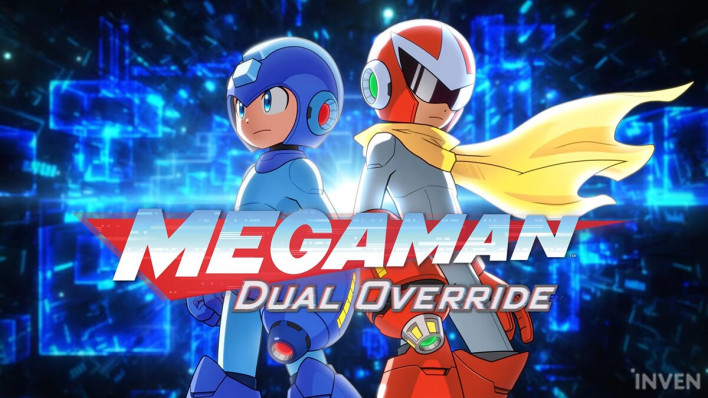
Title: Mega Man: Dual Override Developer: CAPCOM Co., Ltd. Key Tags: #Action #Platformer #SideScroller #Robots #Singleplayer+ The 40th-anniversary title 'Mega Man: Dual Override' is a mainline run-and-gun platformer built on the RE Engine. By dividing stages into three areas, it offers compact stage progression and fits in more boss encounters. Introducing a customizable 'Chip System' that enables difficulty adjustments alongside a high-risk, high-reward 'Override' mechanic, the game preserves the series' classic feel while delivering broader build variety and significantly upgraded visual presentation.
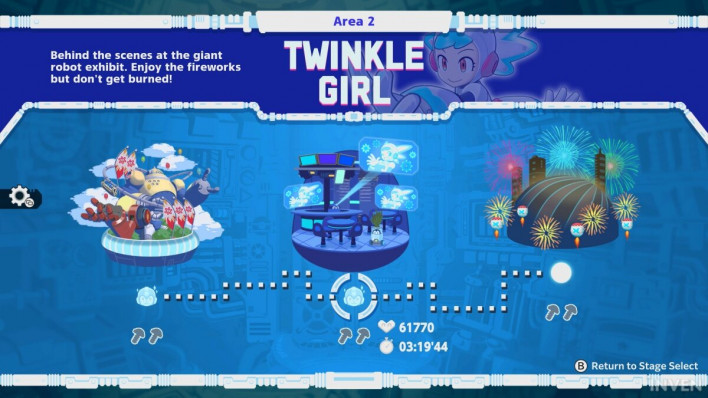
The fundamentals of Mega Man: Dual Override remain identical to the mainline Mega Man games. There are eight primary bosses, and players select one to tackle their respective stage. However, there is one major structural twist: each stage is divided into three distinct areas.
Each individual area within a stage isn't the size of a full standalone stage from past games, so it would be inaccurate to call it "triple the content." Because only one stage was available in the demo and not all content was unlocked, it was difficult to evaluate the full scope based on this trial alone.
What was clear, however, is that these shorter individual stages offer a compact and focused gameplay experience. While the three areas share a stage's overarching theme, each segment demands different gimmick management from the player. In a way, this structure reduces the frustration of overly long levels, making it easier for newcomers to acclimate to the series' notoriously high difficulty curve.
Another system clearly designed with accessibility in mind is the Chip System.
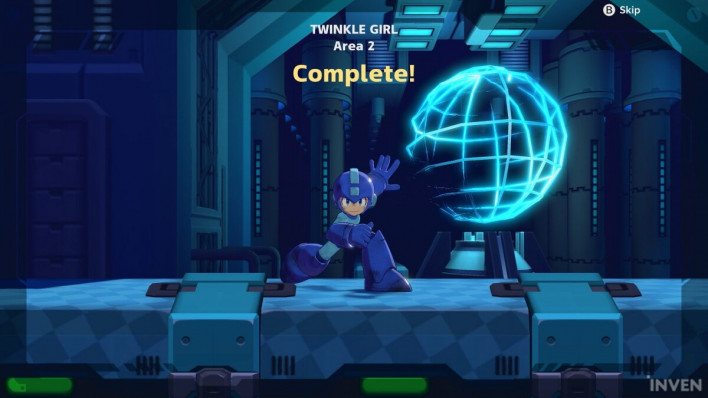
In this demo, players could choose from three preset chip configurations before entering a stage. One was a defensive support setup that creates a shield, another was offensive-focused, and the third was a no-support option. The defensive support chip generates a shield capable of blocking enemy projectiles. This was particularly effective against Twinkle Girl—the only boss featured in the demo—whose attack pattern relied heavily on firing barrage after barrage of firework-like projectiles.
However, the offensive support chip set proved even more impressive. It automatically charges shots without requiring the player to hold a button, allowing for non-stop heavy damage. Pressing the RB (R1) button activates the support ability, executing two attacks in quick succession for a set duration. Charged shots are also fired twice while charged, which was enough to instantly defeat most regular stage enemies. Once the effect wears off, it can be reactivated after a brief cooldown. The surprisingly short cooldown made it possible to play far more aggressively.
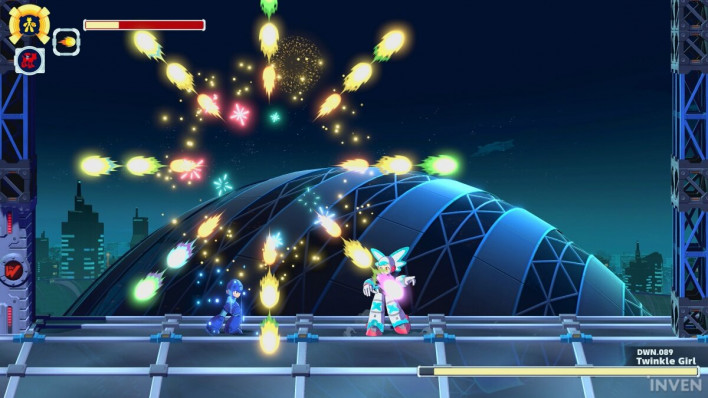
Choosing the chip set with no special support abilities deprives players of offensive and defensive buffs, but brings back Rush. Equipping this summons Rush Coil, allowing players to bounce high into the air. With a very short cooldown, it could be used liberally. Twinkle Girl's stage features numerous hazard mechanics designed to knock Mega Man back into pit traps or down to lower platforms upon taking damage, and Rush Coil made it relatively easy to navigate past these dangerous zones.
Of course, compared to the offensive or defensive chip sets, playing without support makes the game significantly harder. In fact, many journalists during the media preview failed to beat Twinkle Girl before their session ended. While her patterns are clear once memorized, players who haven't fully grasped Mega Man's traditional mechanics and systems can easily find themselves stuck in an endless loop of deaths.
In other words, the Chip System serves as a mechanism that allows players to ease their progression and customize the game's difficulty to their liking.
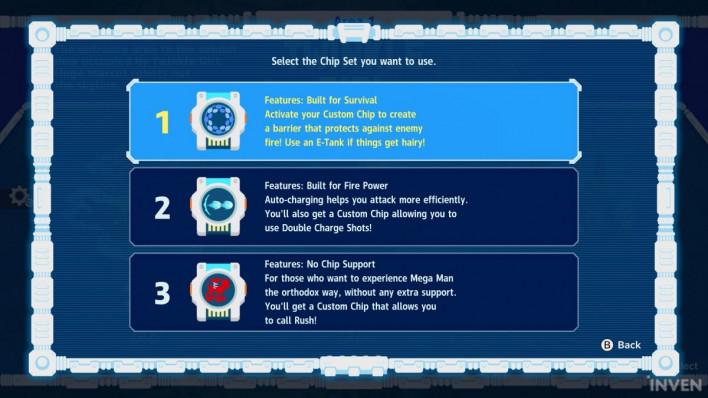
Although the demo only allowed players to select preset chips, the full game—as shown in reveal trailers—will allow players to freely combine various Custom Chips to build custom loadouts suited for attack, defense, or survival.
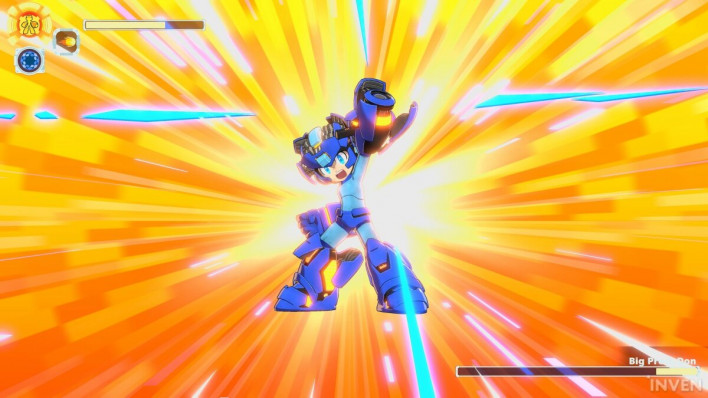
Opposite the support chip button, pressing LB (L1) activates the game's titular mechanic: Override. Taking damage builds up a gauge, which can then be spent to activate a temporary power boost. Mechanical panels open across Mega Man's body like a transforming mecha, unleashing devastating attacks for a short window. In the demo, this provided a reliable window to land heavy combo damage on bosses.
However, players shouldn't trigger Override thoughtlessly just because the gauge is full. Once the Override state expires or the gauge runs out, Mega Man enters a severely weakened state. Charged attacks become unavailable, and rate of fire drops dramatically, making it difficult to maintain consistent damage output. This tradeoff ensures that high power comes with a tangible risk.
On the flip side, dividing stages into three distinct areas makes it much easier to incorporate more than just eight bosses. For instance, Astro Man—referred to here as a copy—appeared as a mid-boss in the second area of the stage. As Capcom hinted at returning bosses to mark the 40th anniversary, the three-area structure provides the ideal framework for placing additional boss encounters across the stages.
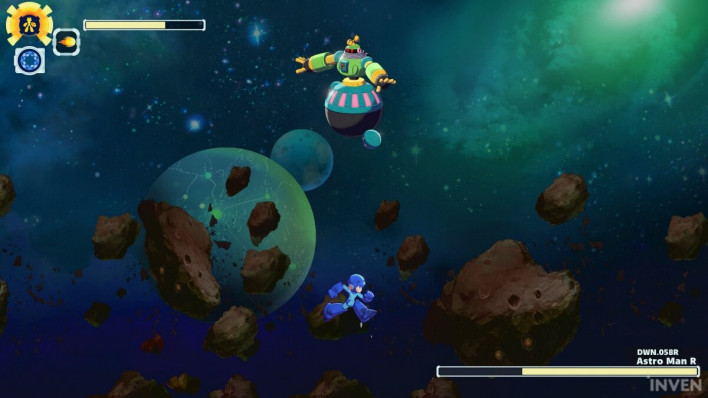
Additionally, when health drops low from taking hits, battle damage visual effects appear on both enemies and allies, adding to the overall immersion. Visual improvements are evident throughout, notably in how the 3D character models harmonize with the detailed background environments.
While this demo offered only a taste of Mega Man: Dual Override's core mechanics, the gameplay felt thoroughly satisfying. The potential for more stages, returning classic bosses, and expanded content is clear. If Custom Chips are fully implemented to let players craft custom builds, it could effectively resolve the slight repetition that historically affected the mainline Mega Man series.