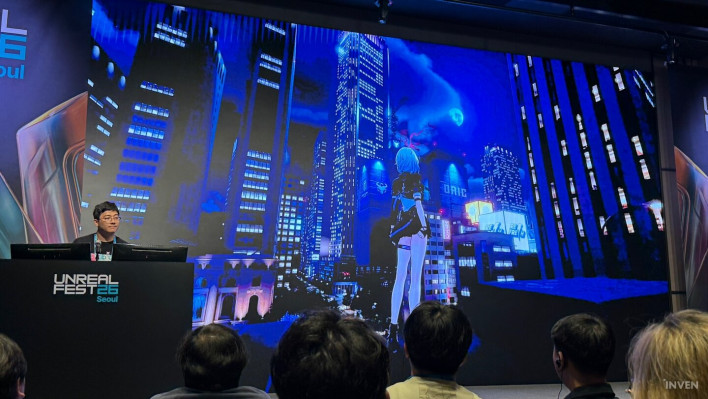
Neverness to Everness, an anime urban open-world RPG released by Perfect World on April 29, has been receiving consistent praise for its portrayal of a modern city, supernatural anomalies, and charming characters. By successfully delivering a modern metropolis as a seamless open world on mobile as well as PC and PS5, it has drawn close attention from both players and developers. Regarding this, Liu Zhenyang, Senior Engineer at Perfect World, and Feng Tianli, Senior Engineer at Perfect World, shared their know-how with Unreal developers at Unreal Fest Seoul 2026.
"Trigger Early, Handle Late": The Policy for Smooth, Seamless Loading

Senior Engineer Liu Zhenyang explained how World Partition and crowd systems in the seamless open world of Neverness to Everness are handled smoothly without loading screens as players move around. Hethereau, the main setting of Neverness to Everness, is populated not only by the player but also by numerous NPCs living out their daily lives in the city. Beyond simply exploring the space, players frequently travel quickly between locations using telephone booths. While this is a perfectly natural action from a player's perspective, it presents a challenge for developers. Attempting to reload portions of the city each time through conventional methods inevitably results in long loading times.
To address this, Hotta Studio, the developer of Neverness to Everness, established the principle of 'Trigger early, handle late.' Before the player moves to a specific zone, virtual cameras and streaming sources are created early at the target destination, securing terrain and data in the background in advance so that triggering happens first and actual processing happens later.
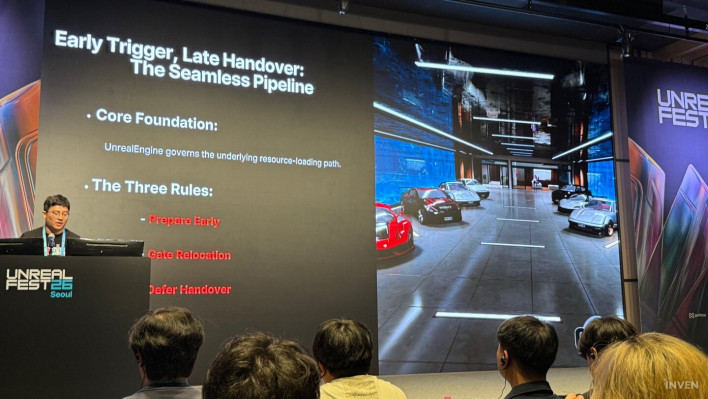
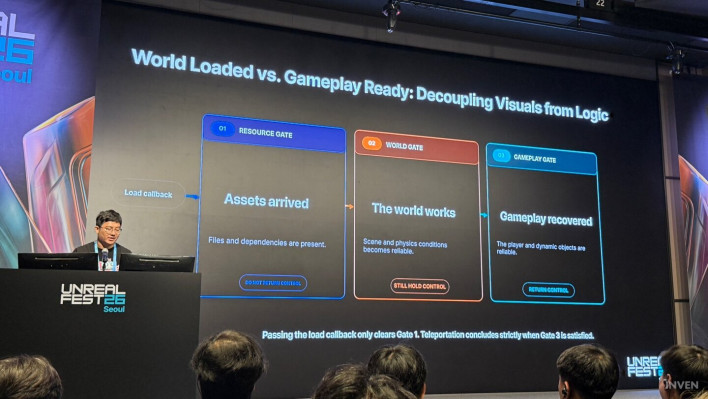
The teleportation and zone transition process goes through three main gates. The first gate verifies whether the destination data has loaded safely, the second gate validates that the gameplay environment can be restored, and the third and final gate returns control to the player only when dynamic objects—such as surrounding NPCs and vehicles—and the world are completely settled. Senior Engineer Liu Zhenyang explained that through this approach, instances of an incomplete world being exposed to the player were completely eliminated.
Memory management methods used during zone transitions were also disclosed. First, strict budgets were established to prevent out-of-memory (OOM) errors during the 'dual co-existence' phase, where both the departure and destination areas reside in memory simultaneously. Instead of loading every object as a heavy full Actor, a lightweight batch representation approach was applied to minimize memory footprint and activation overhead.
As for optimizing the large-scale crowd system that adds vitality to the city, it was the result of actively adopting the Mass framework when updating from Unreal Engine 5.5 to 5.6. Senior Engineer Liu Zhenyang explained that by managing numerous entities with different behavioral patterns, such as pedestrians and vehicles, as lightweight data units, they were able to maintain high world density.
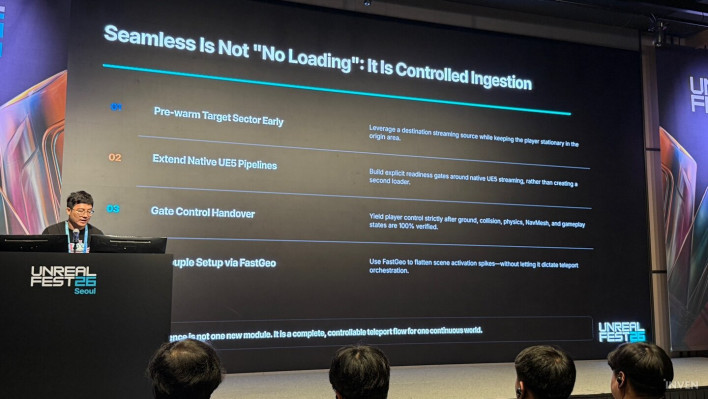
However, the key to crowd optimization lay in how to resolve hitches caused when numerous NPCs request heavy computations simultaneously in the same frame. To prevent this, Hotta Studio adopted a queue management approach that deliberately delays Actor creation even when an NPC comes into view, waiting until streaming and collision conditions are fully met rather than immediately spawning it as a full Actor.
Furthermore, to prevent data conflicts that could occur during sharp camera rotations, entities were evaluated based on a single view-state snapshot, and triple buffering was applied. On top of this, a triple runner budget system was constructed comprising Update Rate (controlling logic execution frequency), Pending Range (limiting the scope of evaluation targets), and Submission Caps (restricting the number of spawned Actors per frame).
Simulating 300 agents on an actual Android device following this design demonstrated that applying Submission Caps control drastically reduced frame drops, achieving stable performance close to 60 fps.
"Mobile Is Not a Degraded PC Version, but a Structure Requiring Dedicated Redesign"
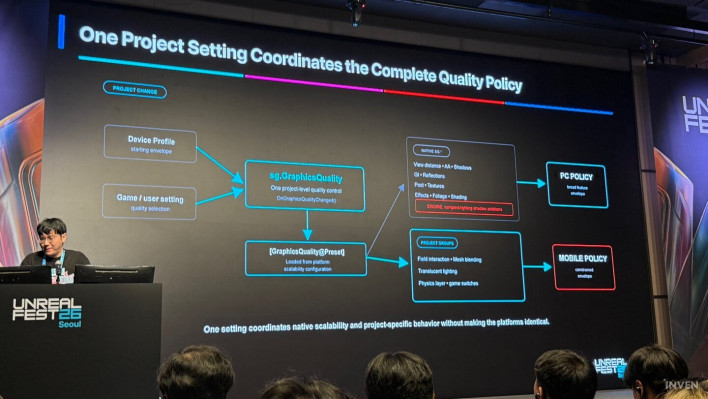
Taking the stage next, Engineer Feng Tianli introduced scalability policies designed to bridge the hardware gap between PC and mobile. He emphasized that "the mobile pipeline is not simply dialing down the graphics sliders from PC settings," highlighting that the architecture was completely redesigned specifically for mobile environments, taking into account heat generation, throttling, and bandwidth limitations during extended gameplay sessions.
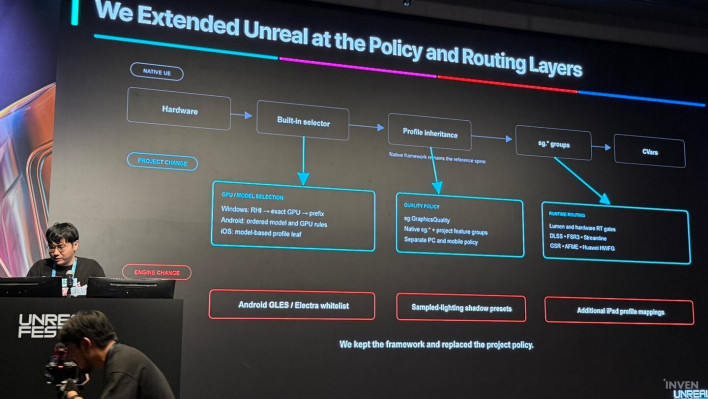
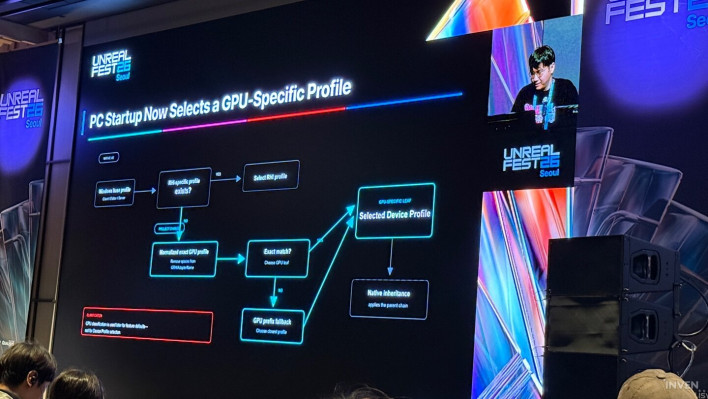
To accomplish this, Neverness to Everness extended Unreal Engine's default framework to build a precise device-aware profile system. Particularly in the highly fragmented Android environment, a multi-tiered selection structure was applied—ranging from broad platform profiles to GPU families down to specific device mappings—and model-specific rules were configured to be evaluated before generic GPU rules.
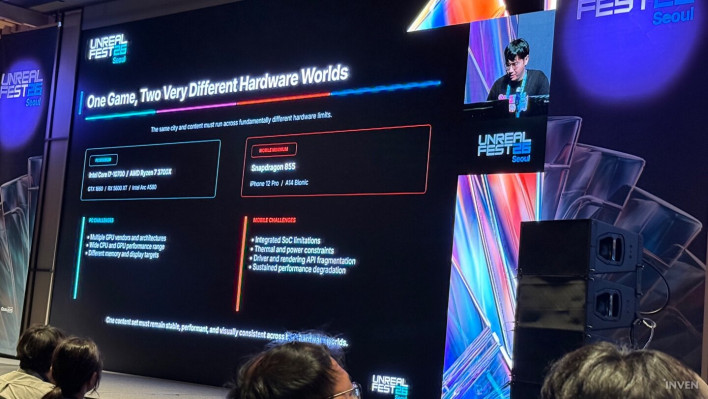
A 'verification-based trust' system was also built to prevent indiscriminate activation of high-end features. Even for devices assigned Epic or Cinematic profiles, Lumen GI or hardware ray tracing is designed to turn on only if they pass all three runtime checks: GPU vendor, rendering path, and internal CPU classification.
Noting that while Android's default graphics API is Vulkan, certain devices run more stably under OpenGL ES or with specific features disabled, a separate whitelist for 135 devices is managed. Through this, a two-tier coverage model was completed: a base fallback layer providing a 100% safety net across all devices, and a second layer optimizing 90–95% of target devices using over 390,000 detailed profiles.
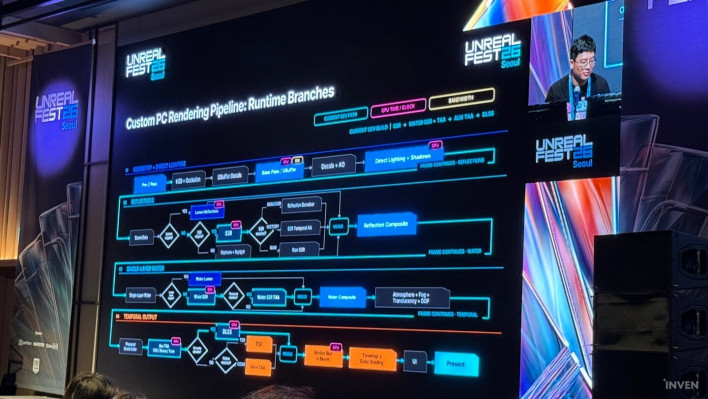
Next, optimization for directional light shadows—which account for the heaviest load in an urban open world—was presented. Neverness to Everness divides the 24-hour time-of-day progression into 12 segments and freezes the sun's position within each segment. This creates headroom to safely reuse cached distant shadow maps without redrawing them every frame while the sun remains static.
In the PC environment, cache invalidation issues caused by massive instanced objects were addressed. Previously, even minor camera rotations would invalidate the entire cache if a large bounding box overlapped, causing draw calls to spike. This was improved by converting the camera view frustum into a 2D footprint, selectively updating only the area actually visible on screen. As a result, unnecessary full shadow updates were reduced by 90%, cutting GPU costs by 20–30%.
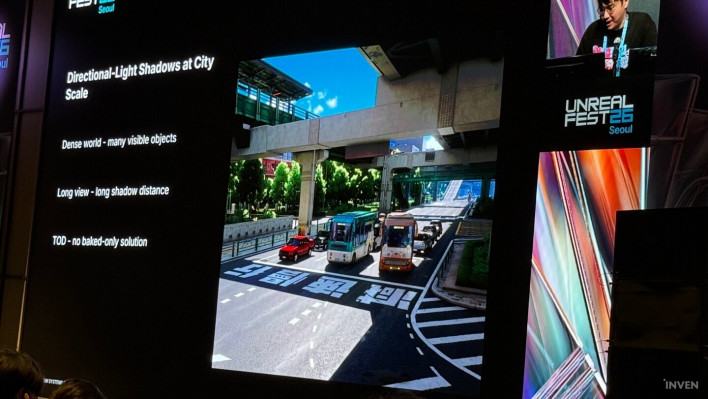
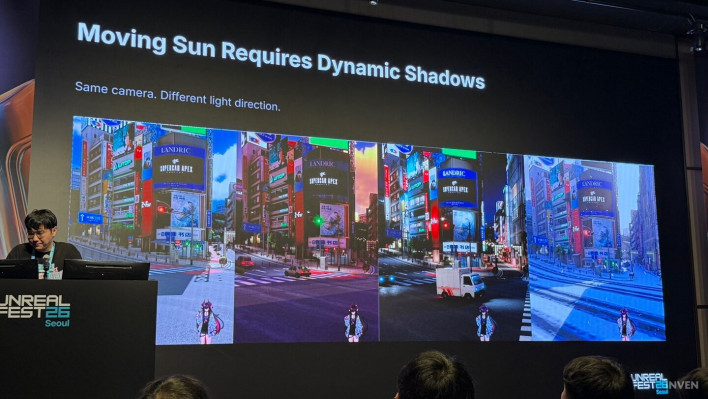
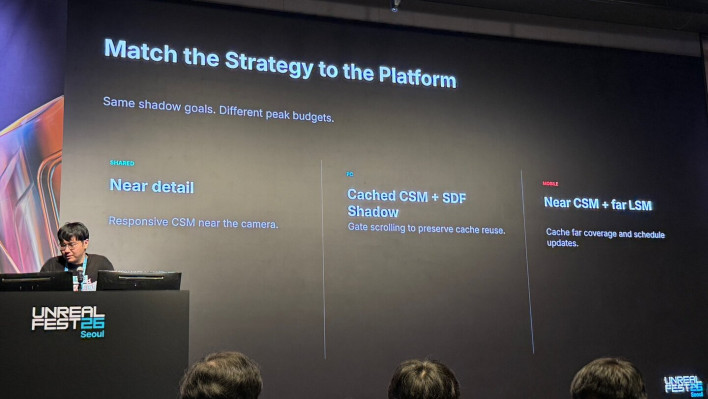
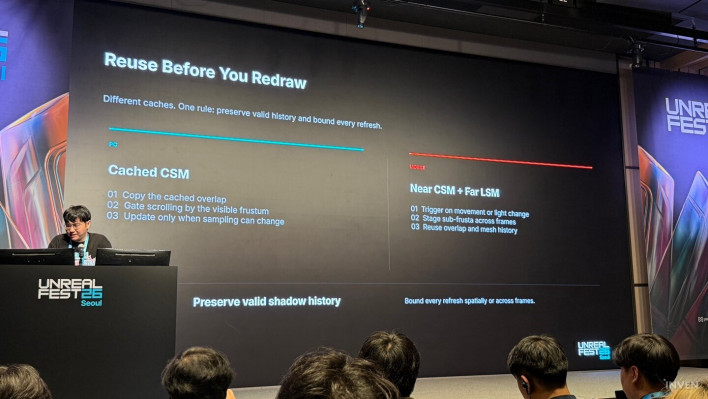
In the mobile environment, a hybrid pipeline was built using highly responsive CSM for short distances and Layered Shadow Maps (LSM)—which anchor solely to camera position—for long distances. Unaffected by camera rotation, LSM incurs zero re-rendering cost during turns, and splits the region into N×N tiles that update incrementally across multiple frames only when the player moves.
In addition, when traversing areas, existing shadow pixels are copied and reused while tracking the mesh ID list contributing to the cache, selectively rendering only newly appearing objects to completely prevent graphical artifacts. Senior Engineer Feng Tianli concluded the lecture by showcasing capture footage from an actual iPhone 16 Pro, stating, "While PC and mobile architectures differ, the core goal remains the same: maximizing cache reuse and constraining all update tasks within the frame budget."