'An exhibition is a reflection of the industrial structure at any given point in time'
The G-STAR Organizing Committee, which announced details for G-STAR 2026 during a press conference on the 13rd, defined the game exhibition in exactly those terms. They explained that the Tokyo Game Show (TGS) focuses on console games because the Japanese market itself is console-centric, and that G-STAR similarly mirrors the current state of the Korean game industry. It is not a bad definition for a moment of self-reflection. However, if we apply that same logic to today's announcement, we must also accept what G-STAR is showing us today.
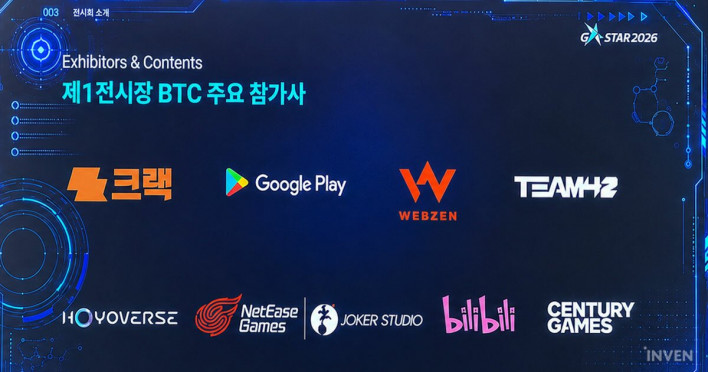
The list of exhibitors for the BTC (Business-to-Consumer) hall reveals this clearly. The BTC hall is a space for visitors to see and enjoy games, stripped of business consultation functions. Yet, among the major member companies of the Korea Association of Game Industry (K-GAMES) that hosts G-STAR, Webzen is the only one setting up a booth in the BTC Hall 1. Instead, the floor is filled with booths from companies like HoYoverse, NetEase's Joker Studio, Bilibili, and Century Games. In effect, the composition is closer to a convention for Chinese publishers.
In reality, the event felt more like a hearing than a press conference meant to signal the direction of the show. With domestic giants absent, concerns over the event's fading status, and fears of a loss of identity, the atmosphere was far from friendly as sharp questions were exchanged.
In particular, as the booth lineup suggests, critics pointed out that the floor is dominated by Chinese game companies. The only response provided was the mention of Sega and Koei Tecmo participating in the second exhibition hall with demo zones. While the committee claims more domestic companies will be added, there are only about three months left until the event. If they couldn't reveal them at a pre-event press conference—the face of the show—it is hard to expect a significant influx of major domestic game companies beyond what has already been announced.
This state of G-STAR did not happen overnight. Concerns over its declining status and the exodus of major game companies have surfaced every year. Organizing Committee Chairman Jo Yeong-gi even admitted that these are 'questions he always receives.' To read that phrase differently, it is an admission that he always gives the same answer and has failed to find a solution. After another year of time, the result—the list released at this press conference—is that answer.
The explanations offered by the committee fail to account for the G-STAR of today. They argue that G-STAR is an event focused on the premiere of new titles, and therefore, there is a limit to the companies they can attract when there are few major new games to unveil. However, major domestic companies are already taking their new titles to global game shows. NC, KRAFTON, and Pearl Abyss participate in Gamescom, either through the Opening Night Live (ONL) pre-show or via independent/joint booths. Furthermore, companies like Nexon, NC, Netmarble, and Smilegate exhibit their games or host independent booths at TGS to meet local fans. These are companies that have been attending TGS for years.
With the exception of Pearl Abyss, which is participating with Crimson Desert, almost everything—from titles nearing release to unannounced projects—is heading overseas. A vast array of new titles from major domestic companies, which the committee claims are 'non-existent' at G-STAR, are being unveiled at Gamescom and TGS. It is not that there are no new games; it is that the companies with those games have chosen not to pick G-STAR. Therefore, the committee's talk of 'expanding the scope' does not ring true as a strategy. Filling the booths and content spaces vacated by game companies with automotive collaborations and long-form online content feels less like expansion and more like substitution—patchwork rather than growth.
The continued success of G-CON, the conference event, feels paradoxical. Having bolstered its standing by attracting world-class developers, G-CON has promised another stellar lineup this year. Industry titans are taking the stage, from the Witcher 3 development team to Final Fantasy 7 Remake's Yoshinori Kitase and Naoki Hamaguchi, Shinji Mikami, and Hades' Greg Kasavin. They have even drawn in creators from outside the gaming world, such as directors Lee Byung-hun and Jang Hang-jun, Yumi's Cells author Lee Dong-geon, and Pixar animators, painting a picture of true expansion.
This achievement actually corners the committee. The secretariat has already proven its capability and network to bring leading global developers and creators to Busan. If, despite that capability, they could not fill the booths with domestic game companies, the blame cannot fall on the event organizers, but on the association that failed to bring even its own member companies to the table.
Chairman Jo Yeong-gi, who took office in April last year, serves as both the head of K-GAMES and the G-STAR Organizing Committee. As this is the second G-STAR he has overseen while holding both positions, one would expect the membership of the association and the participants of G-STAR to overlap. Yet, the results are clear. The number of vice-chair companies has dropped from 12 to 9, as Netmarble, Com2uS, and WEMADE have returned their seats, which carry an annual fee of ₩120 million. Microsoft Korea and Epic Games Korea have withdrawn entirely, and Blizzard Korea has been demoted from an executive board member to a general member. On the BTC participant list, Webzen remains the only major member company.
During the event, Chairman Jo touted the addition of 6-7 new member companies since he took office as a success. While the math of replacing departing giants with a higher number of smaller members might work on paper, it is not evidence of leadership. When faced with questions about the exodus, the answer was simply that 'there are many concerns, but it is not easy to find a clear solution.' At the same event, the city of Busan pledged ₩39.1 billion and discussed the completion of a third exhibition hall by 2030. One side has set firm numbers and completion dates, while the other is still 'thinking.' If the only answer the industry's representative body has offered in a year is that it is 'thinking,' then the dual-role appointment has not served to consolidate power, but rather to erase accountability.
If an exhibition is meant to reflect the structure of an industry, then this year's G-STAR has done its job perfectly.