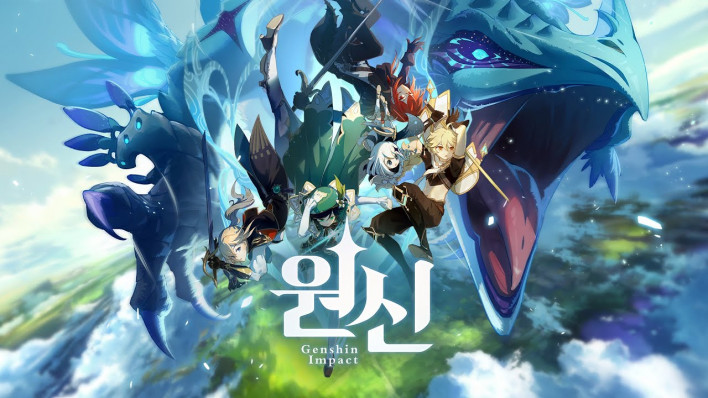
It was 2020 when Genshin Impact first mentioned the name 'Snezhnaya.' Now, nearly six years later, the Traveler is finally stepping into the final nation of Teyvat. Snezhnaya is a pivotal region in the game's narrative. Given the current shifts and generational changes in the subculture gaming market, the upcoming version marks a critical juncture for both Genshin Impact and HoYoverse, both internally and externally.
One might ask, "Why now?" While office workers might relate to the feeling that every day—from hiring to retirement—is a crisis, one could argue that the game has always been in a state of "crisis." However, Genshin Impact has been in service for nearly six years since 2020.
Despite this, the current atmosphere of the game is quite calm. Long-time players are likely enjoying the current version. The 'Song of the Moon' version has seen high overall satisfaction, and information about 'Snezhnaya,' where the journey will soon continue, is being revealed bit by bit. In a way, we are currently in the eye of the storm. Today, I would like to examine the reasons for this and explain why the next update for Genshin Impact is so significant.
Act 1Archon Mission: Finally, into the Enemy's Stronghold
The first reason is the in-game Archon Mission and story progression. The current version is the eighth of the 'Song of the Moon' cycle, which would traditionally be the .7 version. Since the 'Song of the Moon' version, official numerical versioning has been dropped, changing the notation. Regardless, after this version, the Traveler is set to depart for Snezhnaya.
Snezhnaya is also the home base of the Fatui, who have been the Traveler's adversaries and a constant source of conflict since Version 1. You will finally come face-to-face with the Tsaritsa, the Archon who has been collecting the Gnosis from all the Archons across Teyvat, and learn her true intentions.
Of course, this process hasn't been defined solely by conflict. While we have seen them seize power through violence, there have also been instances of negotiation and rational choices. Thus, while some Fatui like Signora and Dottore are encountered as pure villains, others, represented by Arlecchino and Tartaglia, occupy the position of collaborators. The important thing is that after nearly six years of clashing with the Fatui, the journey is finally moving to their 'home base.'
Throughout this process, the Traveler has learned the truth about the world of 'Teyvat,' the meaning of their own existence, the truth about the Heavenly Principles, and the history of the world. A massive turning point and a core objective in the Traveler's journey are now right before us. Furthermore, we will finally be able to witness the 'Winter Night's Lazzo' that has been cryptically hinted at since Fontaine.
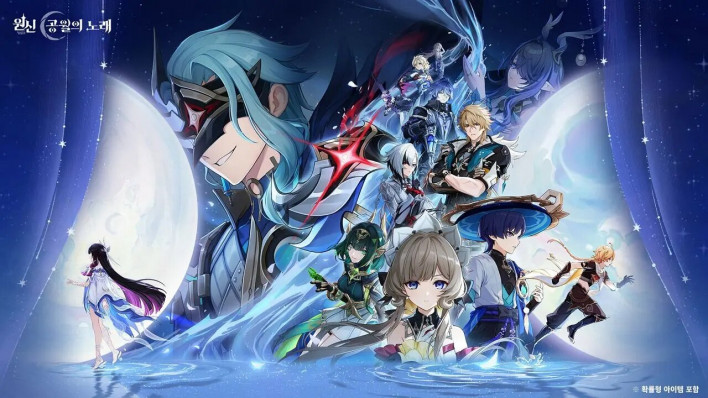
Even the Archon Mission (story), which could rarely escape the criticism of being "a bit childish," moved with a serious tone throughout the "Nodecry" arc. From start to finish, a clear and distinct villain played a stellar role, which helped resolve the previously subtle conflict structures and cooperative relationships. It was a version that neatly wrapped up future goals as well. From the development team's perspective, they successfully established a serious flow for the Traveler's story leading up to Snezhnaya and solidified the conflict dynamics and objectives.
Snezhnaya is not a place the Traveler can visit lightly; it is the heart of enemy territory. Perhaps that is why the tone was set to be heavy from the start. An atmosphere has been created where the Traveler cannot simply approach it with a "What shall we do in this new country?" mindset. It deviates from the start of previous versions. As it begins differently from a story and world-building perspective, it is a version worth watching to see what kind of narrative Genshin Impact will deliver and how it will evolve.
Act 2Six Years of Service: A Changed Genshin Impact
Other in-game changes cannot be overlooked. While the game has been consistently updated and improved since launch, there are periods where that flow accelerated. Especially since the 3 Sumeru version, it felt like Genshin Impact began replacing and improving systems in earnest. That flow of change accelerated significantly in 5 Natlan, and starting with the 'Nodecry' arc of the 'Song of the Moon' version, the improvements have piled up to the point where it is no longer the same game it once was. It has even been rebranded as 'Genshin Impact: Song of the Moon.'
While the changes were noticeable starting from Fontaine, they are undeniable after moving past the Natlan region. For those who only played up to around 2, the current Genshin Impact has changed so much that one might ask, "Is this really the same game?" Since there are too many to list, let's summarize them with categories and examples.
The completely revamped modeling is the most representative example. It is faster to see through images. Showing the changes in tall female characters across versions and the same characters transformed by skins would be the most definitive proof. There is even a preview of further improvements through the past 'Genshin Impact | Behind the Scenes—Towards Snezhnaya, and Towards the Future' video, and recent notices regarding specification changes make the future even more promising.
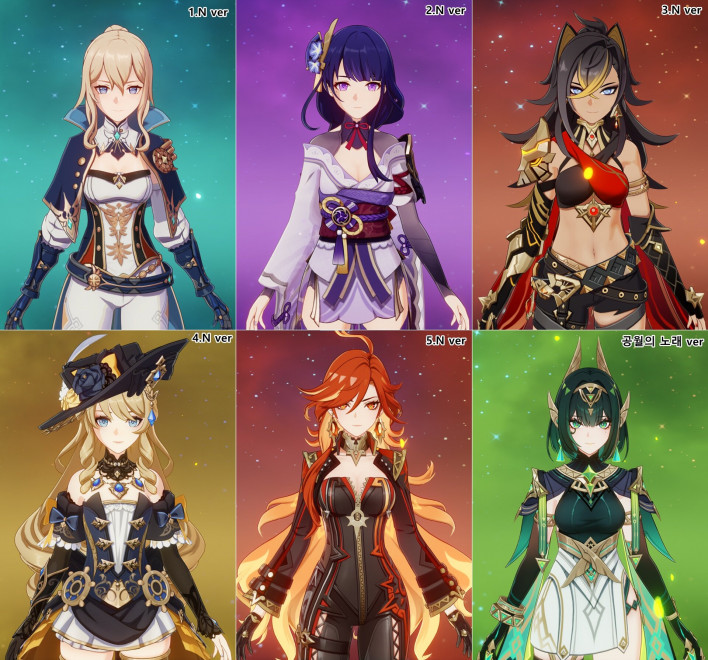
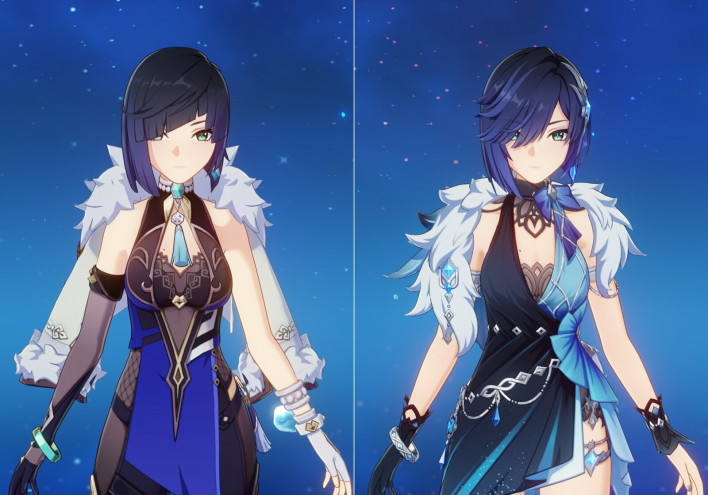
You can see the gradual changes just by looking at the models. As textures become clearer and details more varied, decorations and fine expressions increase. These subtle changes have accumulated, leading players to feel a clear difference between old and new character models. Furthermore, the NPCs, which once felt like a repetitive cycle of 'Dunyarzad,' are gradually being diversified, and unique models are even being introduced for important roles in World Missions. The world of Teyvat has become more vibrant, and the improvements compared to the past are clearly visible.
Beyond this, there are many things that have changed significantly compared to the early versions. It might seem obvious, but it is worth noting that most of these changes were applied suddenly and rapidly starting from the 5.N versions. Paimon even summarizes these details via the official cafe after every update broadcast. Overall, a summary of the major improvements that have significantly impacted gameplay and the business model is as follows.
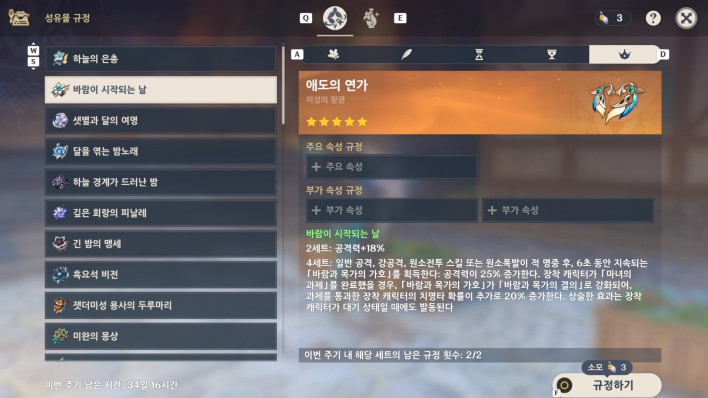
- Improvements to the farming system (Artifact stat selection, rerolling)
- Support for older characters (Witch's Gift)
- Convenience improvements for open-world exploration (Compass, exploration elements, map interactions, multi-layered structure improvements, etc.)
- Improvement and introduction of concepts for neglected elemental reactions (Bloom, Electro-Charged, Crystallize / Superconduct)
- Introduction of fast-forwarding dialogue, mission list, and replay features
- Optimization of client convenience features (key binding, official controller support, etc.)

- Expansion of end-game content (Imaginarium Theater, Ley Line Outcrop challenges)
- Major overhaul of in-game guides
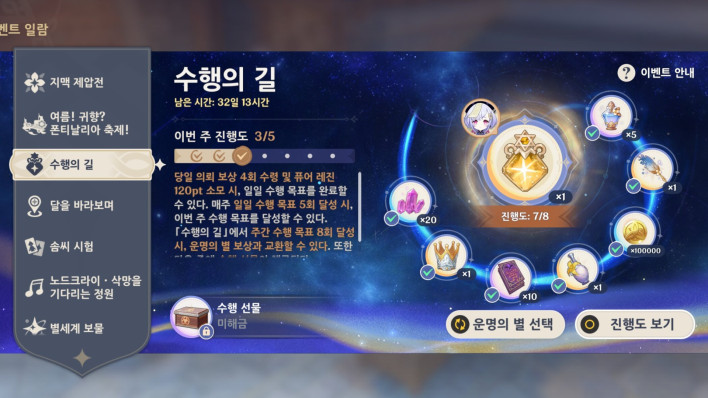
- Relaxation of the business model (Capturing Radiance, Fate Point reduction for Epitomized Path, Path of Performance)
- Introduction of UGC and sandbox elements (Imagarium Theater/Starry Sea World)
In a way, these changes were inevitable for Genshin Impact. Characters from long ago had to be brought up to speed because they were becoming unusable in the current power-creep environment. Inconvenient farming and various functions also needed modernizing. Furthermore, they could not stick to the same business model forever, and since the Spiral Abyss alone was insufficient for utilizing the vast roster of characters, two new types of end-game content were created.
Furthermore, by leveraging the vast array of game objects, effects, and characters that Genshin Impact has built up over time, the team has created 'Imagarium Theater,' a UGC mode that allows players to create their own content and experiment with various ideas. Whether players love it or hate it, Genshin Impact has truly tried many different things. Those experiences and their outcomes have accumulated, allowing the game to create new features and improve upon old ones. Through this, the team is striving to meet the high standards and expectations of today's players.
Act 3Change: The Evolving Subculture Market
These changes in Genshin Impact can be seen as a positive side effect of competition, with the background being that the industry situation Genshin Impact faces has changed. Games capable of threatening Genshin Impact's dominance have now emerged in earnest. In the past, Genshin Impact emerged with an 'open world' identity at a time when the genre classified in China as 'ACGN games' was being established as 'subculture.' As you know, it achieved great success, and analyzing the factors behind it became a global standard.
As a result, games challenging Genshin Impact's position appeared, but Genshin Impact remained firm. Even though other open-world games established their own territories, the massive castle that is Genshin Impact, built by HoYoverse, has stood for years without a scratch.
Now, years later, the market situation is different. A game has emerged with enough impact to give Genshin Impact a sense of urgency and a moment of self-reflection. It's not about who is better or worse, but about games that are in a position where they inevitably influence each other. That game is Wuthering Waves. Since the arrival of 'Wuthering Waves,' which brought intense action, excellent graphics, and more relaxed and improved systems, the acceleration of Genshin Impact's changes has been implicitly felt.
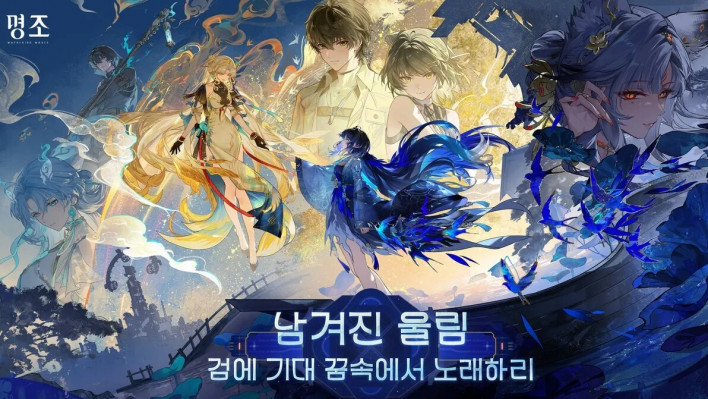
The update for 'Natlan,' where Genshin Impact's changes became clearly noticeable, was applied on August 28, 2024, while Wuthering Waves was released on May 23, 2024. Of course, there was a feeling that they were preparing for future competitors starting from the 4.N Fontaine versions. It feels as if they prepared from Fontaine and actively reflected those changes from Natlan to regain their competitiveness.
The sense of crisis and the need for improvement were felt not only externally but also within HoYoverse. Their 'family' member, Honkai: Star Rail, achieved a surprising success, and their 'younger sibling,' Zenless Zone Zero, showed flashy, intense action and a level of production quality that is hard to match. Although they had a slightly difficult time initially, they began to improve the game at a tremendous speed. Moreover, their competitor, Wuthering Waves, also fixed the game so much that players complained, 'Why are they patching every day?' The development team must have felt most acutely that if they rested on their laurels, the value and quality of the experience Genshin Impact sought to provide would decline, falling behind competing games.
From the end of the Fontaine version and the start of Natlan, there were so many changes that players could clearly feel the shift in the atmosphere of the Genshin Impact development team. Comments like "Yeah, it should have been like this from the start" or "This was a good change" were clearly visible, even amidst criticisms of remaining inconvenient or frustrating elements.
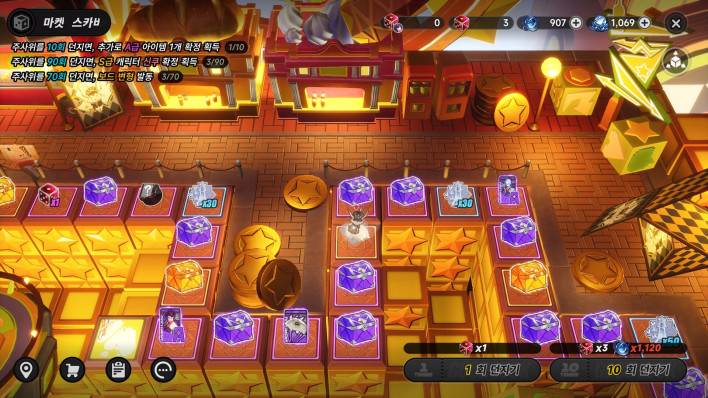
On top of this, another powerful bomb has been dropped on the market. There has been a change in 'gacha,' which is almost indispensable in subculture games. While Wuthering Waves also boldly improved its gacha, things that go a step further are emerging. Paradoxically, this is proof that HoYoverse's monetization system was a source of fatigue for players. Duet Night Abyss has removed gacha, and 'Infinite ANANTA' has confirmed there will be no character gacha. Echocalypse introduced a pity system without 'off-banner' pulls and turned the gacha format and presentation into a board game, offering 'fun to watch' and high satisfaction.
This has changed the concept of the HoYoverse-style 'pity' system that includes 'off-banner' pulls, significantly reducing stress. It has shaken the framework of subculture gacha that had been fixed for over a decade. Of course, it's not that there weren't games with pity systems without off-banner pulls before. Many have come out. But it is true that no game had as much impact as Echocalypse and Wuthering Waves. However, Wuthering Waves and Echocalypse have clearly signaled this to the market, and Duet Night Abyss and the yet-to-be-released Infinite follow a similar context. It can be seen as a proper declaration of 'generational change' in subculture games. They have provided the answer that 'games with less monetization stress' can also be successful, and that diversification and expansion of the business model can be another key.

Of course, these business models would naturally have lower revenue than games that rely solely on pure 'gacha.' Nevertheless, there is room for much better player reviews. Furthermore, as the opportunity cost of gacha itself decreases, players may show a more generous reaction to the 'performance inflation' issue that inevitably follows in subculture games, which must release many new characters.
Now is the time to keep watching. Even Wuthering Waves, which remains a good precedent despite some relaxations, is not a game without monetization stress. We must continue to watch the future of Echocalypse, which removed off-banner pulls, and Duet Night Abyss, which approached gacha in a different way. If they grow sufficiently and gain good reviews, the old-fashioned business model could become the biggest drawback of the game itself. The era is different from six years ago when Genshin Impact first appeared.
FinaleGenshin Impact Now Standing on the 'Stage of Proof'
Nevertheless, Genshin Impact remains firm because it still has a large loyal user base, and it has shown a quite satisfactory path to these users throughout the past versions. In fact, Genshin Impact has almost no direct communication. They release updates at set times, broadcast previews, test and refine new content with testers, and apply the updates.
And they have almost never missed these promised schedules for several years. In other words, they have properly created a 'routine' for players. At the same time, they have collected feedback through content satisfaction surveys and consistently held offline events and collaborations. Even if they don't communicate directly, they have consistently kept their service promises.
Still, what isn't easy are the traces of the long years. Because an absurd amount of content has accumulated, even if you start now, you couldn't finish it all in a year. This leads to the disadvantage that there is a performance gap between early 'standard' characters and pickup characters, and the convenience features of early regions are not very good. This can be seen as a daunting task that Genshin Impact has not yet refined but is difficult to touch immediately.
On the other hand, the operational know-how accumulated over the years, the steadily grown production quality, content composition methods, and experience in building stories, worldviews, and atmospheres are an impregnable, massive castle. And the memories the Traveler has built over nearly six years will be a powerful weapon that can never be ignored.
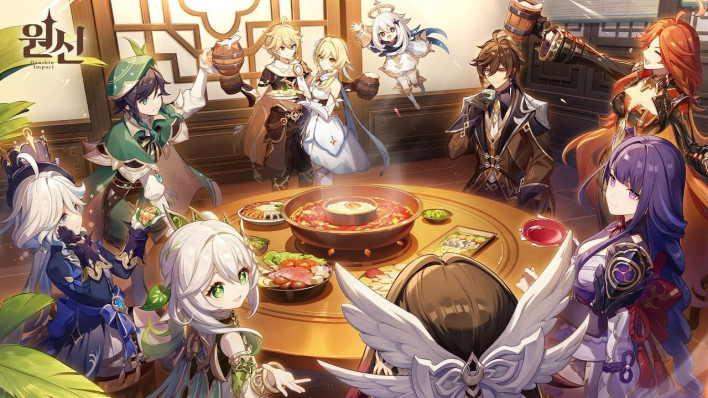
Looking back at the past years and the "Genshin Impact: Song of the Moon" version, it seems to have been a fun version with more good memories and experiences than bad ones. It started with the controversy of "Is Genshin Impact trying to make money?" and the approach to the unconventional level 100 breakthrough was disappointing, but the subsequent actions were actually not bad at all.
While releasing characters that help older characters pushed out by inflation, support for older characters was also provided. Furthermore, many convenience features were introduced, and the satisfaction with the core Archon Mission was high. The progress of the new region, Nodecry, was also excellent, and the ending, which could have been slightly unsatisfying, was grandly wrapped up by returning to Sumeru. Finally, even in the connecting version, which was a break, they showed a story that would satisfy Travelers.
Furthermore, although not part of the main Archon Mission, the Temple of Space that any Genshin user would admire, and the Frost Moon region revealed in the final version, naturally incorporated the unique atmosphere of space and dreamlike content that Genshin Impact had not shown before. The story with the Hexenzirkel was also used as a cheat key to revive memories of the early versions of Genshin Impact. And by consistently featuring protagonists from older versions in events or Archon Missions and updating content to see their daily lives, they constantly stimulated players' 'memories' and made them interested in Teyvat.
Of course, there may have been some slightly disappointing events, but overall, the new characters, Archon Missions, and World Missions all came out satisfactorily in ways that core Genshin Impact users would really love. Therefore, the 'Genshin Impact: Song of the Moon' version can be recalled as a version that deserves to be called a 'peak renewal' or a 'revival period.'
Therefore, the next version is the core point. As you can see if you look closely at the PV, while they previously mentioned and wrote 'Genshin Impact: Song of the Moon' as the full name, from the new version, it has returned to just 'Genshin Impact.' I see this as meaning that the 'first digit' has changed. And in HoYoverse games, a patch where the first digit changes is the biggest update, closer to an expansion pack concept that introduces new scales, including new countries (or regions), stories, and characters in earnest. It is a time when the interest and expectations of many users are poured out. This version can be said to be a time when HoYoverse is putting its greatest effort into making a leap forward.
In terms of the game's story and worldview, it is the point where the conflicts and events of the past few years are reignited the most. Looking at the industry atmosphere, powerful competitors armed with their own new weapons have already appeared and are signaling their arrival, so I see this as a time to show the potential of a veteran. Can't we have some excited expectations like "Is something big coming?"
The market today is completely different from when Genshin Impact first mentioned Snezhnaya about six years ago. And Genshin Impact has also changed, and is facing another change. Ultimately, the next version, which has been confirmed for release on August 12, is a kind of 'stage of proof' for Genshin Impact. The Traveler is standing in front of that door for the first time in six years.