With major platform holders like Sony and Microsoft raising console prices, Nintendo has finally announced price hikes for its own hardware.
| 📒 | - Price increases for Nintendo Switch 1 models take effect on May 25 - Nintendo Switch 2 prices are also expected to change in September - Hikes attributed to rising global component costs; Nintendo Switch Online service fees also increasing |

Nintendo announced the 'Changes to Product and Service Prices' on its official website on the 8th, confirming speculation that had been circulating among industry analysts.
The price adjustments apply to the Nintendo Switch 2, Nintendo Switch 1 and its variants, and Nintendo Switch Online subscriptions. In Japan, the Nintendo Switch 2 will see a ¥10k increase, rising from ¥49980 to ¥59980. Additionally, the Nintendo Switch OLED, Nintendo Switch, and Nintendo Switch Lite will increase by ¥10,000, ¥11,002, and ¥8,002, respectively, to ¥47,980, ¥43,980, and ¥29,980, effective May 25.
While there were no price changes for the global version available in Japan, international markets will see a price hike for the Nintendo Switch 2. The price will increase to $499.99 in the U.S., 679.99 CAD in Canada, and 499.99 EUR in Europe.
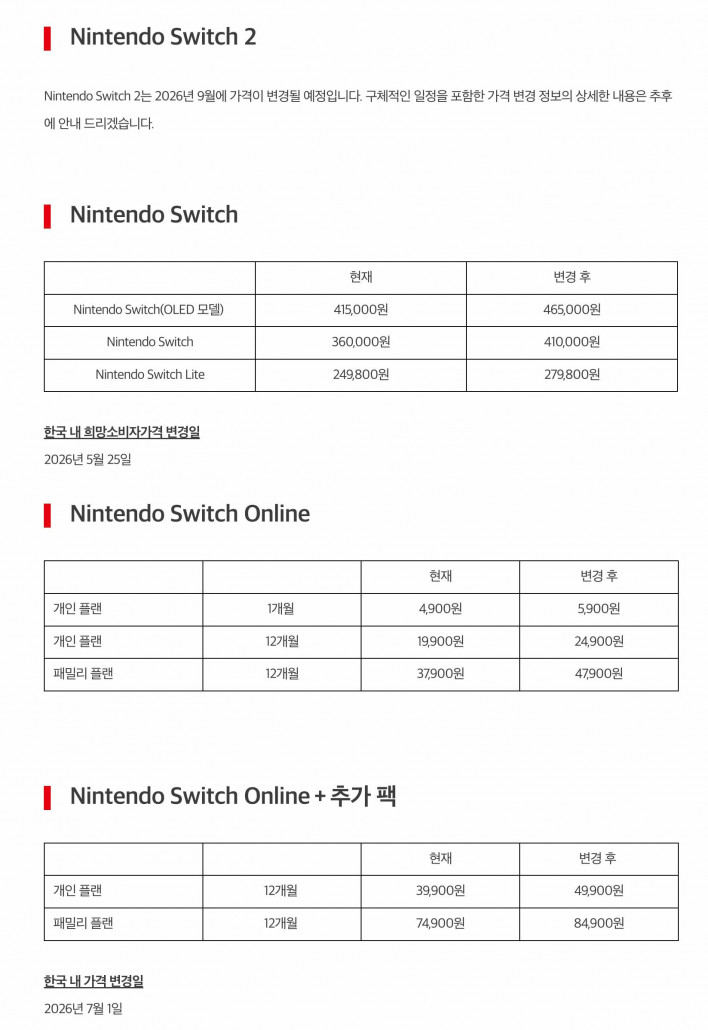
Price hikes are also scheduled for South Korea, where the Nintendo Switch OLED, Nintendo Switch, and Nintendo Switch Lite will be sold for ₩465,000, ₩410,000, and ₩279,800, respectively. The new pricing takes effect on May 25, the same date as in Japan.
The price of the Nintendo Switch 2 is set to change this September, with details to be announced at a later date. Given the volatility in inventory levels and the global semiconductor market, it appears Nintendo is planning for an increase but is still finalizing the exact amount
The annual individual plan for Nintendo Switch Online will increase from ₩19900 to ₩24,900, while the Expansion Pack will rise from ₩39900 to ₩49900. Unlike the console hardware, these service price increases will take effect on July 1.
Predictions of a Nintendo Switch 2 price hike have been persistent. As semiconductor costs for AI data centers and related industries have surged, console manufacturing costs have risen, leading to consecutive price increases for the PS5 and Xbox Series X.
With reports that the cost of RAM used in the Nintendo Switch 2 has risen by over 41% since the start of development, arguments that a price hike was inevitable have gained traction. The decision to set the September date for price changes in the U.S., Canada, Europe, and South Korea is interpreted as a move to align with the depletion of inventory produced with lower-cost components.