Godot Engine has seen explosive user growth in recent years, accompanied by an exponential rise in the number of games released on the Steam platform.
On the 6th, Godot Foundation developer Clay John released engine growth metrics on the official company blog, aggregating data on open-source game engine usage, community size, and game jam adoption rates. John analyzed the overall growth trajectory and achievements of Godot Engine by compiling data scattered across various channels.
According to the released metrics, each major stable version release reaches approximately 2 million downloads via the website. Users demonstrate a stable usage pattern, consistently maintaining major versions while quickly updating to minor versions as new patches are released. Cumulative installations via Steam and the Google Play Store are also showing a steady upward trend.
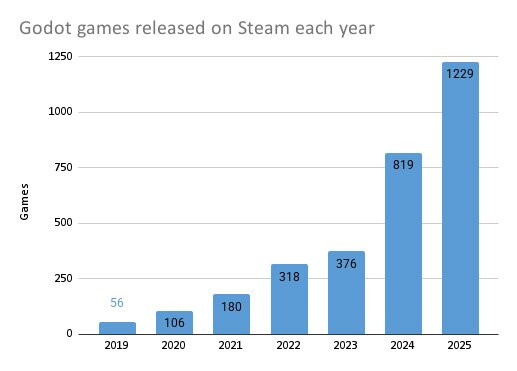
The most notable achievement is in game release metrics. According to SteamDB data, the number of Steam games built with Godot Engine has shown exponential growth. On itch.io, a platform focused on indie games, an overwhelming number of projects are also being consistently registered, thanks to the engine's low barrier to entry.
Engine adoption rates are also rising in major game jam events, which serve as a barometer for the influx of next-generation developers. Adoption rates have been steadily increasing at events like the Global Game Jam and the GMTK Game Jam; notably, the GMTK Game Jam saw an explosive rise in share between 2023 and 2024, with the engine now aiming to surpass a 50% adoption rate in the future.
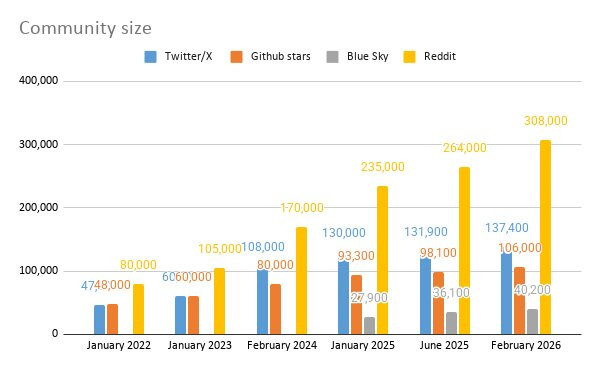
The size of the community, centered on Western social media, has also doubled in the last few years. Given that this data excludes Discord communities and growth in countries that primarily use other platforms, such as China, the actual global user base is estimated to have grown even more sharply.
Conversely, monthly recurring donations to the Godot Development Fund have remained stagnant despite the explosive growth in users. While there were temporary spikes in donations in October 2024 and during a fundraising campaign in December 2025, the overall scale of funding has seen little change.
The Godot Foundation attributes this phenomenon to new users perceiving the foundation's funding as already sufficient, or being satisfied with the current pace of engine development and thus feeling no need for additional support. It also identified a tendency for users to view the engine merely as a 'free alternative' to commercial engines.