Valve’s history is one of constant success, beginning with the late 20th century’s greatest masterpiece, 'Half-Life.' The company went on to redefine tactical shooters with 'Counter-Strike,' set the gold standard for class-based team shooters with 'Team Fortress 2,' turned space itself into a puzzle with 'Portal,' and brought the MOBA genre to near-perfection with 'Dota 2.'
These titles not only defined or redefined their genres but also exerted massive influence on the market. More importantly, they reveal the true nature of Valve as a game company. Counter-Strike began as a Half-Life mod and became a symbol of successful commercialization. Team Fortress was a mod team acquired and turned into an internal IP, and Portal was created by recruiting an entire student project team. Dota 2 even originated as a Warcraft III mod, which Valve eventually brought to market after navigating legal disputes.
Valve’s success strategy has always been to take proven concepts and build them onto their platform. This approach extended to the platform itself. By hosting and selling countless games, Valve evolved from a mere game developer into a platform holder, much like Sony, Nintendo, or Microsoft. Valve’s next strategy was clear: break free from the influence of Microsoft and the closed app store model that emerged during the Windows 8 era, and move the gaming market beyond the PC and into the living room as a console form factor.
In 2015, this expansion strategy failed completely. Yet, ten years later, Valve is attempting to turn that same vision into a success with a new Steam Machine and Steam Controller. And what made that change possible is none other than the Steam Deck. To understand that story, we must first go back a decade.
An Escape Route to Protect Steam
Valve’s Attempt to Bring PC Gaming to the Living Room
Although Steam saw record growth after the pandemic, it had already solidified its status as a mature, dominant platform by the early 2010s. With over 5 million concurrent users and rapidly increasing annual sales, it had no rival in PC game distribution. This is precisely why Microsoft’s Windows 8 app store strategy posed such a significant threat to Valve.
In 2012, Microsoft introduced the Metro UI in Windows 8, signaling a shift toward distributing apps exclusively through the Windows Store. While we now know this strategy failed quickly, the atmosphere at the time was different. Apple had already launched the Mac App Store in 2011, showing a clear trend toward the mobile app store model migrating to the desktop. Valve faced the risk of being blocked from direct distribution via its own client. For Valve, the potential damage if Steam were locked out of Windows was incalculable.
Valve CEO Gabe Newell expressed deep concern for the PC ecosystem and prepared an insurance policy against the worst-case scenario of Windows becoming a closed platform: Linux. As an open-source OS, Linux was effectively the only option that could function without Windows dependency. Newell himself described the Steam OS, customized for Steam, as a hedging strategy to mitigate potential losses.
In this context, Valve also envisioned an entry into the living room. Steam’s open ecosystem—where anyone can upload games, create mods, and set prices freely—was calculated to be competitive against the strictly closed console markets dominated by Sony, Nintendo, and Microsoft. While console platform holders today are more active in courting indie games and maintaining more flexible store policies, the market was entirely closed at the time.
Consequently, Valve’s living room strategy, which aimed to shed Windows dependency using a Linux-based Steam OS, materialized as the 'Steam Machine.' The Steam Controller, designed to be played with a gamepad rather than a mouse and keyboard, was also crafted to align with the goal of PC gaming in the living room.
Neither Console Nor PC
The 2015 Steam Machine: A Product Without a Home
This pivot to Linux and the subsequent attempt to compete for console market share failed completely. Looking back, it was a series of inevitable missteps.
The Steam Machines released in 2015 ran on Steam OS, requiring games to have Linux builds. However, game companies viewed the profitability of the Linux market as an unknown. It is estimated that only 2–3% of all games had native Linux builds at the time, and AAA titles were virtually non-existent. Even when games were available, Linux versions often suffered from poorer optimization and performance compared to their Windows counterparts.
Steam Machine sales could only be guaranteed if there were games to play, but that never happened. Because the hardware failed to gain traction, developers had no incentive to prioritize Linux versions. Regardless of the 'chicken or the egg' debate, Valve failed to create a self-sustaining cycle. This was the primary cause of the Steam Machine’s failure; the goal of breaking away from Windows remained unfulfilled.
The hardware was also fragmented. Valve did not manufacture the Steam Machines itself; it provided the Steam OS and design guidelines to OEMs, who then decided on the actual production. As a result, designs and specifications varied wildly, with prices ranging from $500 to $5,000. Unlike consoles of the same generation that offered uniform performance, the games you could play on a Steam Machine depended entirely on which model you bought.
The single-spec nature of consoles means more than just uniformity; it serves as a guarantee that if you buy the device, you can play every game released for it. Steam Machines offered no such assurance, leaving consumers confused about which model to choose.
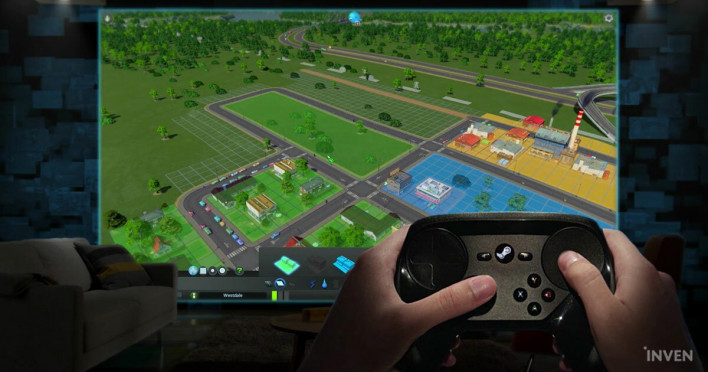
Price was another issue. The PS4, released in 2013, cost $400. Steam Machines, despite having a smaller library, started at $500 for the base model. Console platform holders can sell hardware at a loss and recoup profits through software sales and third-party fees. Conversely, third-party manufacturers of Steam Machines had to add margins to their costs to turn a profit, making the devices inherently more expensive.
Ultimately, the Steam Machine presented a high barrier to entry for console gamers, while PC gamers already had a cheaper, higher-quality alternative: the PC itself. The failure of the Steam Machine was essentially baked in from the start.
Beyond Handheld Success: A Shift in Direction
What the Steam Deck Truly Solved
You may have read that the success of the Steam Deck, released in 2022, was simply about the rise of handheld PC gaming or its role as a rival to the Nintendo Switch. However, when viewed through the lens of the 2015 failure, the success of the Steam Deck reads quite differently.
The core of the Steam Deck’s success lies in its ability to break free from Windows dependency while taking a completely different approach. It began with the arrival of Vulkan in 2016 and DXVK in 2018. Vulkan is a graphics API similar to DirectX, but unlike DirectX, which is Windows-exclusive, it supports Windows, Linux, and Mac. While complex for developers, it reduces unnecessary CPU overhead, making it ideal for low-spec devices. DXVK (DirectX to Vulkan) intercepts DirectX commands and translates them into Vulkan in real-time.
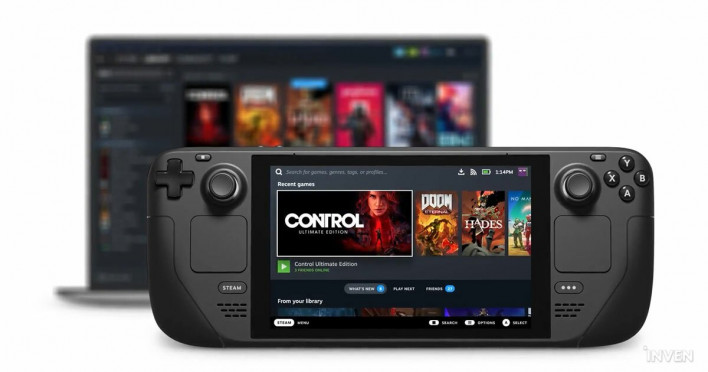
In short, it became possible to run DirectX and Windows-exclusive games on Linux. While 'Wine' had previously allowed Windows software to run on Linux, it was limited by poor GPU support and the heavy overhead of OpenGL. The addition of DXVK, based on Wine, boosted performance, while the Steam Linux Runtime reduced crashes within containerized environments. The resulting 'Proton' became the heart of the Steam Deck and Steam OS. It is not merely an emulator; it is a real-time translator that converts Windows software commands into instructions that Linux can execute.
Setting aside the technical details, thanks to DXVK and Proton, Windows games can now be played without needing a Linux port. Performance, which initially hovered at 70–80% of Windows levels, now sometimes exceeds Windows performance in certain titles. While translation at the kernel driver level remains impossible—making games with anti-cheat software difficult to run—Linux is no longer an obstacle to gaming.
Valve also took charge of the hardware design. Aside from storage capacity, every Steam Deck offers the same performance. This realizes the console strength of 'same device, same experience,' which in turn simplified software management. The 'Steam Deck Verified' program provides a system where Valve directly guarantees how well a game runs on the device.

Steam Deck users can now know for certain whether a game will run
The advancement of AMD APUs, which provide practical performance within a 15W TDP, also contributed to the Steam Deck’s success, ensuring at least an hour of gameplay. Furthermore, Valve’s position as a platform holder—earning commissions from software sales—allowed them to launch the Steam Deck at an aggressive $400 price point.
The Idea Was Right; The Conditions Were Just Missing
The Proof Completed by the Steam Deck
The success of the Steam Deck has transformed the market. A handheld PC gaming market that effectively didn't exist—with players like ROG, Lenovo, and MSI—began to form in earnest after the Steam Deck. It proved that the success of the Nintendo Switch was not just a unique case for Nintendo IP. The persistent rumors of a handheld version accompanying the PS6 launch are a testament to the market potential that has now been proven.
The Steam Controller also found its footing through the success of the Steam Deck. The original 2015 controller was too obsessed with its first goal: bringing PC gaming to the living room. It replaced the mouse with two trackpads, but removing standard gamepad buttons in favor of trackpads felt alien to both console and PC gamers. This created an unnecessarily steep learning curve, which was ill-suited for the comfort of living room gaming.
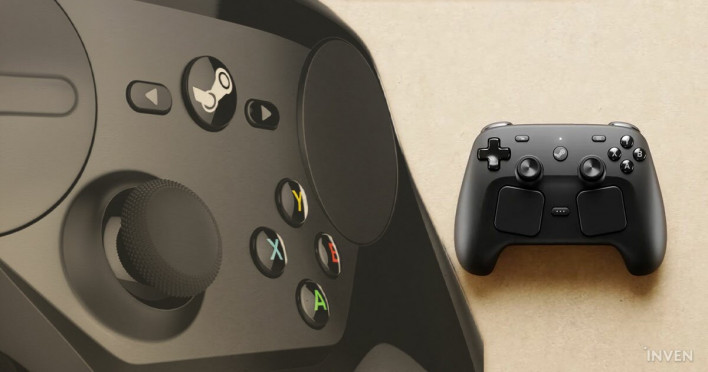
The 2026 version was redesigned under the Steam Deck’s design philosophy
The Steam Deck didn't give up on mouse-like precision, but the approach was different. It maintained a familiar gamepad layout while enabling mouse-like control. The 2026 Steam Controller was developed by essentially taking the Steam Deck, removing the screen, and merging the halves. It has received positive reviews in pre-release demonstrations, and its build quality lives up to the hype.
There has also been a shift in development culture. Amidst the fierce 4K high-end graphics race, the Steam Deck’s success has changed how games are made. Instead of obsessing over high-resolution assets and complex lighting, developers are now considering graphics and resource allocation tailored to the Steam Deck’s 800p (1280x800) resolution. The graphics arms race, which seemed unstoppable despite rising development costs, has been forced to pause and reflect thanks to the Steam Deck.
More important than the changes in market and culture is the proof: the fact that a model where hardware and software are controlled by the same entity actually works, and that a Linux-centric ecosystem can thrive in the gaming space. The Steam Deck achieved this.
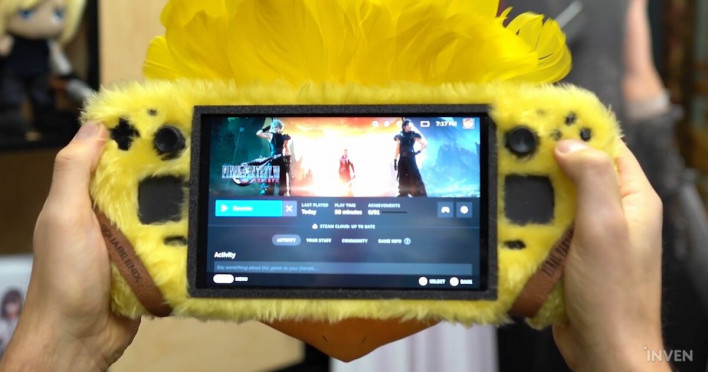
The Steam Deck ushered in an era where optimization and certification for low-spec devices are paramount
2026: Why Are We Looking at the Steam Deck’s Success
Valve Stands Before the Living Room Again After 10 Years
The power of Steam, which dominates the PC game distribution market, is once again turning toward hardware with a sound strategy. The 'Steam Machine' and 'Steam Controller' are being re-released with the exact same names as those from a decade ago. For Valve, this could be a fresh start or an attempt to bury past failures.
What is clear is that today’s attempt is fundamentally different from the one ten years ago. The Windows-closed-app-store strategy has been abandoned, and Steam’s influence has grown so much that even Microsoft’s handheld PCs support it. Valve has used the Linux and Proton technologies—born from that initial threat—to run most Windows games, proving they can provide a console-like experience through unified hardware control. The open environment, which allows for mods and patches without 'jailbreaking' in desktop mode, offers an experience unique to PC gaming.
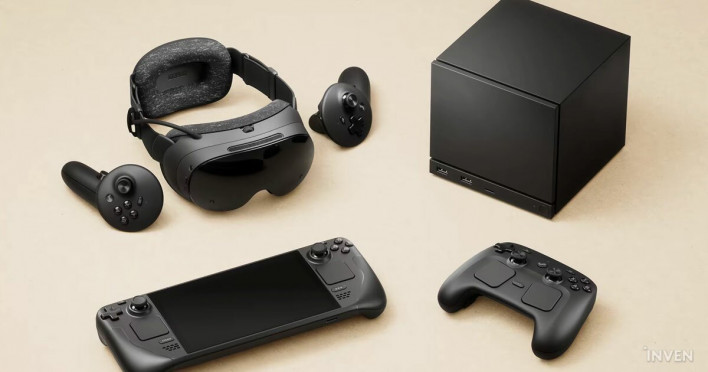
All of these have become the unique advantages of the Steam Machine and Steam OS. The investment in Linux, which was little more than an insurance policy against losses in 2012, has yielded the success of the Steam Deck after one failure, leading to the construction of a new ecosystem.
While the 2026 Steam Controller is launching soon, the release of the Steam Machine remains uncertain, with global semiconductor price volatility acting as a variable. However, there is one decisive difference from 2015: back then, Valve was standing before a blank canvas. Today, they are not. Proton has built the ecosystem, the Steam Deck has proven the potential, and the open experience that only Steam OS can provide is ready. The picture Valve has been painting for over a decade is now being held by a steady hand, standing before the living room.