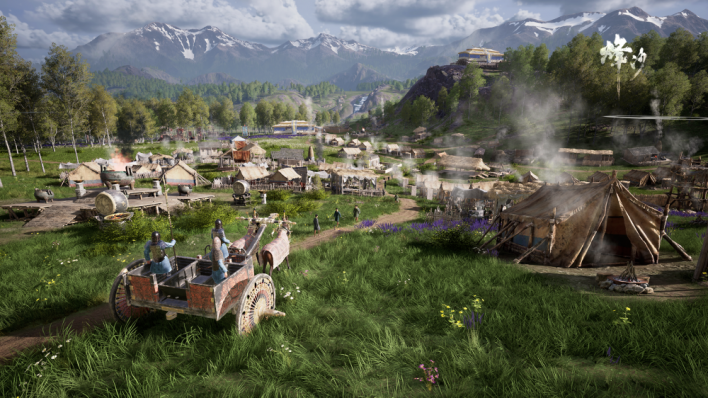
In 2024, the solo-developed 'Manor Lords' set a new milestone for the city-building simulation genre. By combining the familiar setting of medieval Europe with the intricate details of small-scale estate management, it achieved one of the greatest successes in Steam's history, sparking a wave of similar genre attempts. Now, a new team has emerged to challenge the genre, this time set against the backdrop of ancient Eastern history.
'Mandate Order,' currently under development by a small studio based in Chengdu, China, is an 'ancient Chinese fortress simulation' game set during the Spring and Autumn period. The game, which emphasizes fortification, management, and warfare, is slated for an early access release in the third quarter of this year.
On the 21st, attendees at 'Bilibili First Look' in Shanghai, China, were given the opportunity to play an early build of 'Mandate Order.'
It's the 'Spring and Autumn Period,' not the 'Three Kingdoms'
When people think of strategy games based on ancient Chinese history, the Three Kingdoms period usually comes to mind. Beyond Koei's 'Romance of the Three Kingdoms' series, which is incredibly familiar to us, Creative Assembly's 'Total War: Three Kingdoms' reaffirmed that the era is a compelling subject for Western strategy fans as well.
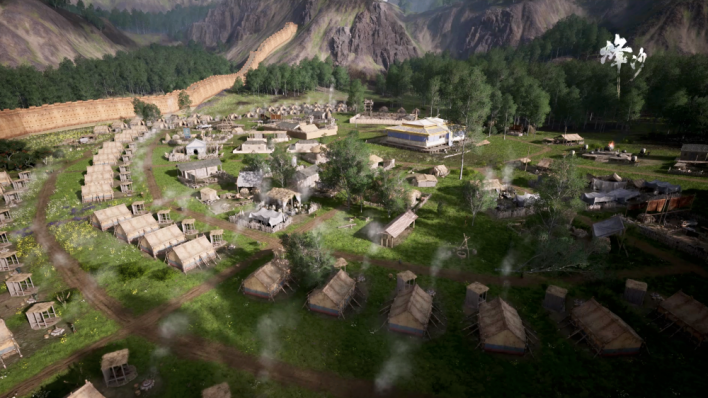
However, this also means the 'Three Kingdoms' has become a somewhat common trope. The developers of 'Mandate Order' chose to look further back in time, selecting the Spring and Autumn period—a span of roughly 800 years from the 8th to the 3rd century BC.
The game doesn't just borrow the setting. The Spring and Autumn period was a time of social restructuring from slavery to feudalism, and an era where countless thinkers like Confucius, Mozi, and Han Fei debated the future of the state. 'Mandate Order' strives to reflect these characteristics of the era in its game system design.
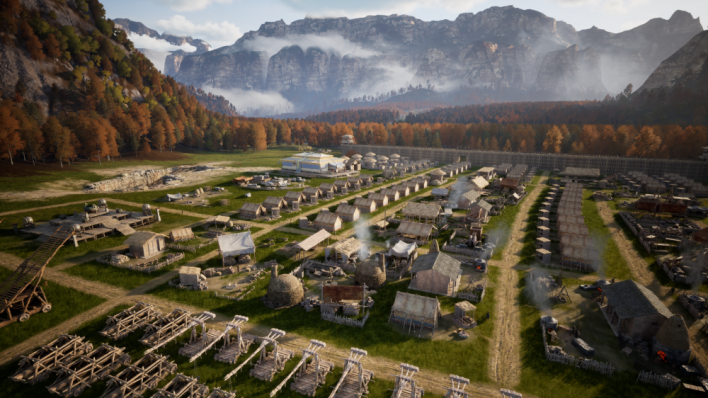
For instance, the developers revealed that the game's defense system was inspired by the "City Defense" (Cheng Shou) chapter of the Mozi. The Mohists were a school of thought famous for their defensive tactics, and "Mandate Order" structures this philosophy into the game, treating city walls as the "sovereign's shield and the people's refuge." Instead of medieval European castles, players will encounter Warring States-era military architecture like rammed-earth walls, beacon fire alarms, and tunnel warfare.
People... no, wood comes first
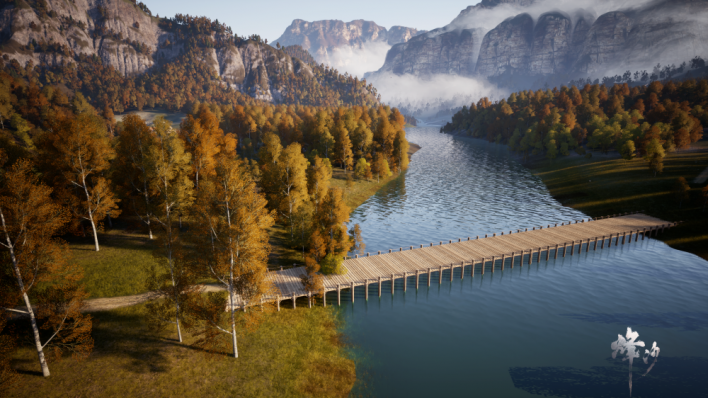
My first impression of the early build of 'Mandate Order' at the Bilibili First Look demo was quite clear: it is a game where you can enjoy both city-building and large-scale combat simultaneously. To put it slightly hyperbolically, it felt like the developers' goal was to let players enjoy SimCity and Total War in a single game.

When the game begins, the player commands a small group of people—calling them a 'faction' feels like a stretch—somewhere on the map. Since there isn't a single decent building at the start, you must quickly increase your resources to build a village.
The game starts by constructing a logging camp and assigning people to it, who then automatically begin gathering nearby wood, which is then used to build tents for the population.
According to the developers, they worked hard to make the resource cycle in 'Mandate Order' highly organic. Just as the old Korean saying goes, 'Agriculture is the foundation of the world,' farming plays a major role in this game. In a game session that progresses through four seasons over time, spring is the only time you can sow seeds in your fields and paddies. If you miss this window, it means you will be unable to obtain food for the rest of the year, other than by foraging for jujubes or hunting deer in the wild.
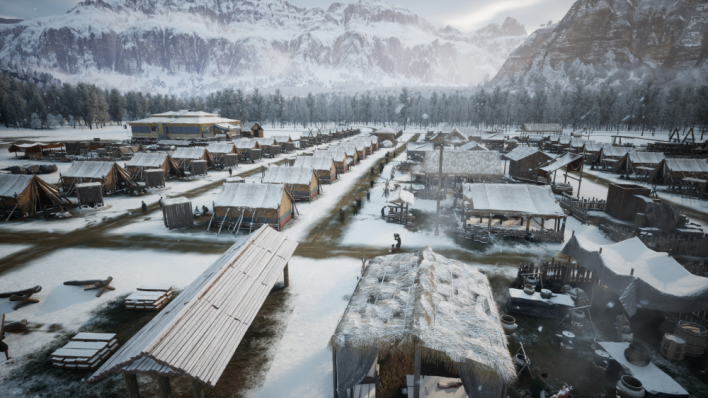
'People' are also a vital resource. The population in Mandate Order is organized into 'Wu' (a unit of five, the smallest unit in ancient Chinese military systems), and each tent built by the player can house one 'Wu.' Replenishing the population is simple: if the population's satisfaction is 50 or higher and there is an empty tent, a new 'Wu' will move in the following month.
The role of these 'Wu' is endless. As mentioned, they are needed to gather basic resources like wood, clay, and iron ore, and to process them. If resources are far from the main base, 'Wu' are also required for transport. Since more people mean more capabilities, it was important to install tents frequently and in large numbers.
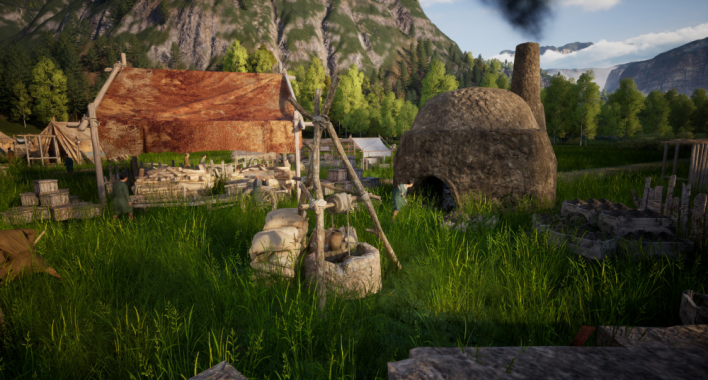
Diverse buildings each have their own roles, so you need to build at least one of each. While the early build didn't reveal everything, following the tutorial allowed me to naturally learn the resource cycle. You collect wood and create processed goods for various uses—these could become charcoal or wooden hinges needed for construction.

Perhaps because it was an era before oil was used as a resource, it is no exaggeration to say that all basic resources in 'Mandate Order' start with wood. You need so much of it. At first, the surrounding forest looked dense, but it was impossible to avoid turning the mountains bare within 10 minutes. To prevent this, the game includes facilities for replanting trees.
From resource gathering, storage, and transport to housing for the people, the construction system this game offers is deeper and more robust than I expected. Furthermore, when you zoom in with the mouse wheel and watch the people running around the village working, you might find yourself thinking, 'This is actually pretty well-made.'
However, construction is only part of the fun. The combat is still to come.
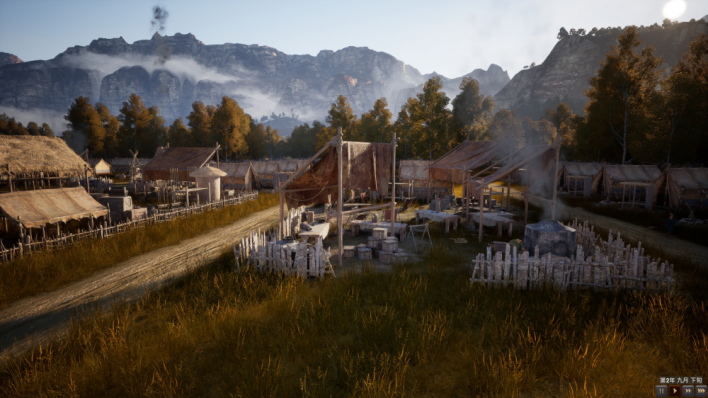
Why logistics are important in war
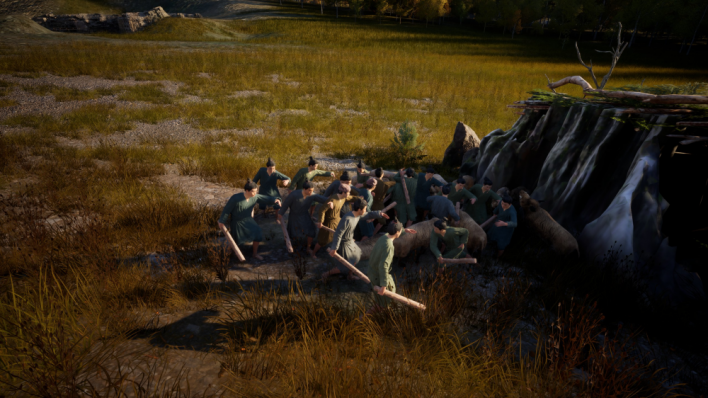
Producing troops in this game is a more arduous task than you might think. It would be a mistake to assume you can simply 'click' to produce the unit type you want, as you might in other strategy simulations. Creating a single soldier requires a great deal of preparation, including people (naturally), weapons, armor, and more.
Troops are also based on the 'Wu' system. If you suddenly conscript many soldiers, the people who were previously gathering resources will quit their jobs to enlist. Therefore, producing a large number of soldiers in the early game was nearly impossible.
The fact that you have to craft weapons yourself is another hurdle. The tutorial easily teaches you how to make wooden clubs, but crafting a copper sword is a completely different story. I had to send a 'Wu' to a copper mine far from the base to mine ore, build wheels at a wheelwright, make a cart with those wheels, build a logistics center, and then bring the ore back.
Once the ore is brought back, it needs to be processed into 'ingots.' To process copper at a refinery, you need charcoal. Charcoal can only be obtained by burning logs at a lumber mill. Oh no—I had already used all my logs to make planks.
These are the kinds of trial-and-error experiences I had while trying to craft a single copper sword. If you want to make a shield-bearer, you also need to equip them with a shield in their left hand, which adds the process of building a shield workshop and obtaining the necessary processed materials. Archers? Chariots? It's all the same.
Hearing this might make the process sound painful, but 'Mandate Order' is not a game where you compete against others. The developers are creating a purely single-player experience, and as you gradually build your fortress, you will eventually gather the resources to produce weapons. It helps to think of it as gathering materials for swords, shields, and chariots while playing SimCity.

In the city-building simulation genre, combat has generally remained a secondary element. Even 'Manor Lords' was criticized for having relatively simple combat. However, 'Mandate Order' presents a quite ambitious plan to layer large-scale warfare on top of robust city-building.

The core of this is a unit control system the developers call 'Quick Line Drawing Formation.' By selecting a unit and 'right-click dragging' to a desired location, you can change the formation of your troops according to the cursor's trajectory. You can create a sharp wedge to break through enemy lines or easily form a 'hammer and anvil' tactic through multi-unit coordinated formations.
Furthermore, classic elements like damage calculations based on elevation for archers and unit-type relationships are all included. It is very impressive that such deep combat, rarely seen in typical city-builders, is possible.
60,000 wishlists, good news for strategy game enthusiasts
Unfortunately, I couldn't experience large-scale unit battles during this demo because I was too busy just trying to make a single copper weapon. However, the screenshots shown by the developers and the various elements to be added to the game later will likely be very appealing to strategy game enthusiasts.
Another feature of 'Mandate Order' is the 'Guest' (Menke) system, inspired by the story of Lord Xinling (Wei Wuji) having over 3,000 retainers. It is an element that brings the characteristics of the Spring and Autumn period, when the Hundred Schools of Thought were active, into the game system. According to the developers, the guests the player receives support the faction with diverse abilities, and some have quite surprising (?) effects.
The natural disaster system shares a similar design philosophy. Disasters like floods, droughts, and plagues occur unexpectedly in the mid-to-late game, disrupting the rhythm of construction and requiring the player to respond appropriately. You might have to quarantine the infected to prevent the plague from spreading, or perhaps execute them.
The meteorite impact event is also impressive. It causes massive damage to the surrounding area but creates a rare resource called 'star iron,' which can be used to craft new weapons if successfully harvested.
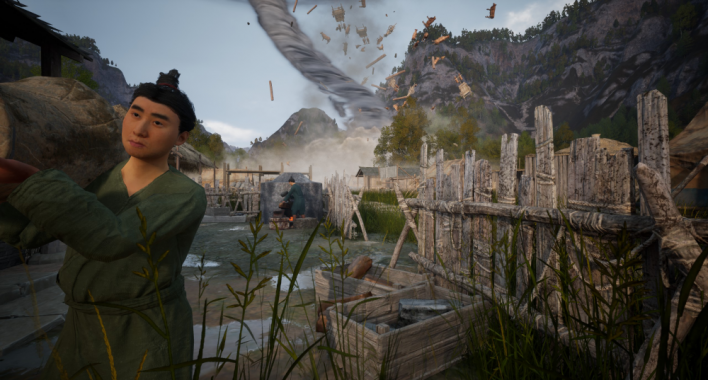
Diverse strategies reflecting the era are also being prepared for war. Although I didn't mention it earlier, all the people live in tents and 'defecate.' This is why you must build facilities to process waste for their comfort. These buildings can use the waste to create a resource called 'gold juice' (jin zhi), which originates from actual ancient tactics where boiled human waste was dropped on enemies during sieges.
The fact that a 28-person small studio developed a game with this level of depth in just one year is both surprising and concerning. The developer officially acknowledged that issues such as NPC model clipping, partial disappearance of character models, and frame drops during long play sessions remain. The tutorial also had translation errors, which caused quite a bit of difficulty while playing the Korean version.
Nevertheless, the reason to pay attention to this game is clear. According to the developer, the Steam wishlist has already surpassed 60,000, with nearly 90% of those being overseas users. It is quite unusual for a game based on ancient Chinese history to garner anticipation outside of China first.
While it didn't show perfection as an early version, it clearly seems to be one of the most interesting answers to the question of where city-building simulations can go after 'Manor Lords.'
'Mandate Order' is slated for an early access release in the third quarter, and a campaign DLC based on the 'Battle of Changping,' one of the most famous battles of the Spring and Autumn period, is also in development. You can currently download and enjoy the demo version on the Steam store page.